High-Protein Ice Cream vs Frozen Yogurt: Which Is the Better Treat?
The real answer depends on your protein math, your lactose tolerance, and how much sugar alcohol your gut can handle before it rebels.
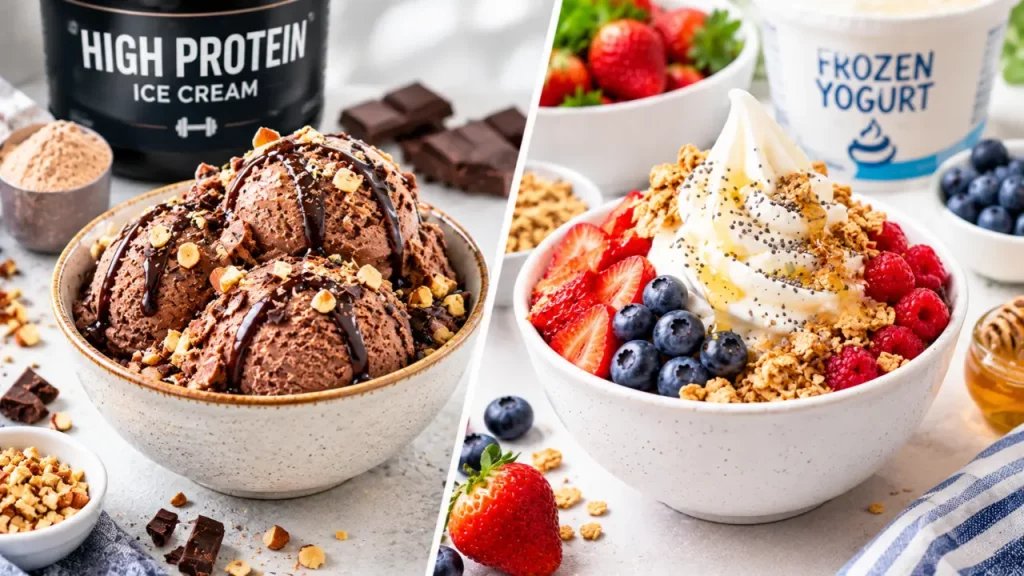
The treat that keeps you full longer is the one with the actual protein in it — not the one with the cleanest-looking label.
That’s the short answer: high-protein ice cream wins on satiety for most people, because it’s built around concentrated protein rather than live-culture dairy. But “most people” isn’t everyone, and the fine print on sugar alcohols, lactose, and blood sugar response matters a lot more than either container’s health claims suggest. Basic definitions, calorie counts, and the “both are treats, not health foods” verdict are covered everywhere else. Here’s what isn’t: the actual gram numbers, the gut thresholds, and exactly who should put one of these two tubs back in the freezer case.
Step 1: Do the Protein Math Before You Trust the Front of the Carton
High-protein ice cream earns its name by adding concentrated whey, usually whey protein isolate, directly into the base. USDA nutrient data for whey protein isolate powder shows that a single 1 oz (28 g) scoop of the isolate itself delivers 16.5 g of protein and 8.25 g of carbohydrate. Scale that to 100 g of the powder and you get 58.1 g of protein against just 29.1 g of carbohydrate — a protein-to-carb ratio that no dairy base can match on its own. That’s why pints marketed as “high protein” that land in the 15–20 g-per-serving range aren’t exaggerating; they’re often just blending in roughly an ounce of isolate like the one USDA measured.
Frozen yogurt doesn’t do this. Its protein comes from the milk and cultured yogurt base itself, not from an added isolate, so a typical serving carries only a fraction of what a fortified ice cream delivers — closer to what you’d get from an unfortified dairy dessert than from a scoop of protein powder.
Tip: Flip the carton and look for “whey protein isolate” or “whey protein concentrate” near the top of the ingredient list. If it’s absent, the protein number on the nutrition panel is coming from milk alone, and it won’t come close to isolate-fortified territory.
Step 2: Know Your Sugar Alcohol Ceiling Before You Finish the Pint
Sugar alcohols — erythritol, sorbitol, maltitol — are how high-protein ice cream keeps sugar counts low while staying sweet. The problem is that they aren’t fully absorbed in the small intestine; the unabsorbed portion travels to the colon, where gut bacteria ferment it, pulling in water and producing gas along the way. That’s the mechanism behind the bloating, cramping, and loose stools some people report after a full pint. There isn’t one universal gram threshold that applies to every person — tolerance varies with gut bacteria, portion speed, and whether the sugar alcohol is eaten alone or with fat and protein that slow digestion — which is exactly why two people can eat the same pint and have completely different afternoons.
Tip: Treat the first few servings of any new sugar-alcohol-sweetened product as a test, not a snack. Eat half a serving, wait, and track how your gut responds before committing to the full container.
Step 3: Match the Lactose Load to Your Gut, Not the Marketing
This is where the two treats diverge in a way most comparisons skip entirely. Whey protein isolate is produced by filtering milk heavily to concentrate protein, which strips out most of the lactose along the way — it’s the reason isolate-based supplements are often marketed as suitable for lactose-sensitive users. If a high-protein ice cream leans on isolate rather than concentrate, its lactose load can be meaningfully lower than a standard dairy dessert’s.
Frozen yogurt is the opposite case. Its live cultures ferment some lactose during production, but culturing alone doesn’t eliminate it — the base is still largely milk, and a serving typically retains substantially more lactose than an isolate-fortified product. For someone who reacts to dairy sugar specifically, frozen yogurt’s “cultured” label doesn’t make it a safe bet.
Tip: Lactose-intolerant readers should check whether a high-protein ice cream lists isolate (lower lactose) versus concentrate (higher lactose) — the words matter more than the “protein” claim itself.
Step 4: Don’t Assume Sugar Alcohols Mean a Flat Blood Sugar Line
A review of food-based ingredients that modulate blood glucose groups sugar alcohols alongside simple sugars and certain proteins as ingredients that influence glycemic and insulin response — and it treats them with the same caution it applies to added sugar, not as an automatic free pass. Not every polyol behaves the same way: some pass through largely unabsorbed with minimal effect on blood glucose, while others are digested more readily and nudge glucose upward more than people expect from a “sugar-free” label. The review’s broader point is that these ingredients need to be considered in moderation rather than assumed neutral, which undercuts the common marketing shorthand that any sugar-alcohol-sweetened dessert is automatically blood-sugar-friendly.
Tip: If you’re monitoring blood sugar closely, don’t rely on the “sugar alcohol” label alone — check which specific one is used, since they aren’t interchangeable in how your body processes them.
Step 5: Decide Who Should Skip Which Tub Entirely
- IBS and FODMAP-sensitive eaters: both treats carry a fermentable-carbohydrate risk, just from different sources — sugar alcohols in high-protein ice cream, lactose in frozen yogurt. Neither is automatically “safer”; the smarter move is identifying which trigger your gut handles worse and avoiding that one specifically, in small tested portions.
- Young children: a review of paraprobiotics in high-protein ice cream notes that nonvital bacterial additives are being explored specifically because they’re safer for people with weaker immune systems, including children, and support gut and immune health without the risks of live microbial overgrowth. That’s promising for paraprobiotic-fortified products, but it doesn’t cover the sugar alcohol load stacked into many of the same pints — a small child’s body weight means the same gram amount hits much harder than it would in an adult.
- Lactose-intolerant readers: isolate-based high-protein ice cream is generally the lower-lactose option; standard frozen yogurt, cultures or not, still carries a meaningful lactose load.
- Anyone sensitive to artificial or sugar-alcohol sweeteners generally: skip high-protein ice cream and choose a mod
