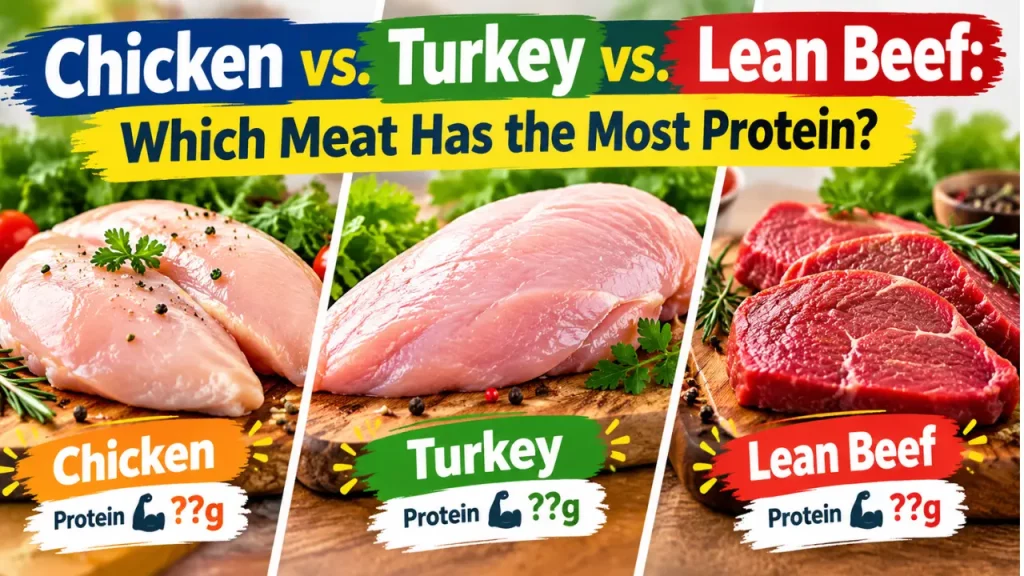
Chicken vs. Turkey vs. Lean Beef: Which Meat Has the Most Protein?
Grams per 100g don't tell you which meat actually builds muscle or restocks iron — leucine, DIAAS, and absorption rates do.
The kitchen scale reads 113 grams. On it sits a chicken breast, cooked and cubed, next to an equal weight of ground turkey and an equal weight of 93% lean ground beef. A spreadsheet is open on the counter, three columns wide, and the question driving it isn’t “which has more protein” — that’s answered in five seconds on any nutrition label. The real question is which pile of meat is actually going to turn into muscle, and which one is going to do more for a ferritin level that came back low at the last blood draw. Those answers don’t live on the label at all.
- Per 100 grams, chicken breast (~31g protein), turkey breast (~29g), and 93% lean beef (~26g) look close — but total grams hide how much of that protein your body can actually use.
- Beef’s iron is heme iron, absorbed roughly two to three times more efficiently than the non-heme iron in chicken and turkey, so the “beef has more iron” gap understates beef’s real advantage.
- Muscle protein synthesis isn’t triggered by total protein alone — it depends on hitting a leucine threshold, and research on this threshold is clearer about who needs more (older adults) than about which meat delivers it best.
- Dark meat (thigh) and a true cost-per-gram-protein calculation — not cost-per-pound — change the practical ranking for anyone shopping on a budget.
The quick answer
By raw weight, chicken breast wins on protein density, turkey breast is close behind, and lean beef trails by about 15-20% per 100 grams. But “wins” depends entirely on what you’re optimizing for. If the goal is maximum grams of protein for minimum calories, chicken breast is the clear choice. If the goal is muscle repair after training, iron status, or stretching a grocery budget, the ranking shifts — sometimes dramatically — once you look past the label.
Why total protein isn’t the same as usable protein
Muscle protein synthesis (MPS) — the process that actually rebuilds tissue after exercise or everyday wear — doesn’t respond in a straight line to how much protein you eat. It responds to leucine, a single amino acid that acts like a trigger switch in the muscle. Researchers describe this as the “leucine threshold hypothesis”: below a certain dose, MPS barely rises; above it, the response levels off. A review of amino acid ingestion and resistance exercise found protein’s effect on muscle-building signaling (via a pathway called mTORC1) is dose-dependent up to a point, after which more protein in a single sitting stops adding benefit.
This matters for a meat comparison because two servings with similar total protein can differ in how quickly and how high they push leucine levels, depending on the protein’s amino acid profile and digestion speed — which is part of what protein-quality scores like DIAAS are designed to capture, beyond the simple gram count on a label. A modeling study of plant-based diets for rugby athletes set a practical reference point: about 2.9 grams of leucine per meal is enough to exceed the threshold needed for maximal muscle gains. Because whole animal proteins are leucine-dense relative to their total protein content, a typical 100-120 gram serving of chicken, turkey, or beef comfortably clears that bar — the three meats are far closer to each other on this measure than the gap in total grams per 100g suggests.
Who actually needs to care about hitting that threshold precisely? Mostly older adults. A systematic review on aging and muscle protein synthesis found that in roughly half of the studies examined, older adults showed a blunted MPS response to exercise or amino acid intake compared with younger people — a pattern researchers call anabolic resistance. A related systematic review of leucine and post-exercise MPS found that leucine dose predicted the size of the MPS response in older adults, but not in younger adults, whose MPS response didn’t track neatly with any single leucine measurement. In practice, that means a 45-year-old lifting weights may benefit more from a larger, leucine-rich serving — beef, chicken, or turkey, chosen for taste and budget — than from chasing a specific “best” meat. A review on dietary protein and muscle mass during aging and immobilization adds a caution: while a single high-leucine meal reliably boosts short-term MPS, chronic leucine supplementation hasn’t consistently translated into long-term muscle mass gains in the studies reviewed — so leaning entirely on one “high-leucine” meat as a strategy is unlikely to outperform simply eating enough total protein across the day.
The iron math nobody finishes
Lean beef typically supplies more iron per 100 grams than chicken or turkey — a gap often reported as something like 2.5mg versus 1mg. But that comparison stops at the content label. Iron in beef is mostly heme iron, bound inside hemoglobin and myoglobin, which the gut absorbs roughly two to three times more efficiently than the non-heme iron found in poultry and plants. Run that absorption difference through the numbers and beef’s real-world iron advantage over chicken or turkey is noticeably larger than the content figures alone suggest — closer to a four- or five-fold gap in iron actually taken up by the body, not the two-and-a-half-fold gap the raw milligrams imply.
The cut and the calculation everyone skips
Every comparison of chicken, turkey, and beef uses breast meat and lean ground beef — the priciest, leanest cuts of the first two animals. Thigh meat, which most of these comparisons ignore, is both cheaper per pound and noticeably richer in iron and zinc than breast meat, at the cost of a bit more fat. For anyone prioritizing iron intake on a budget, chicken or turkey thigh deserves a seat at this comparison that it rarely gets.
The same oversight applies to cost. Most “cheapest meat” claims compare price per pound, which is misleading because the three meats aren’t equally protein-dense. The number that actually matters is cost per gram of protein: take the price per pound, divide by protein grams per 100g, and adjust for the roughly 454 grams in a pound. A meat

Tom Fletcher
The latest from the Australian and global BBQ scene — comps, cooks and culture.