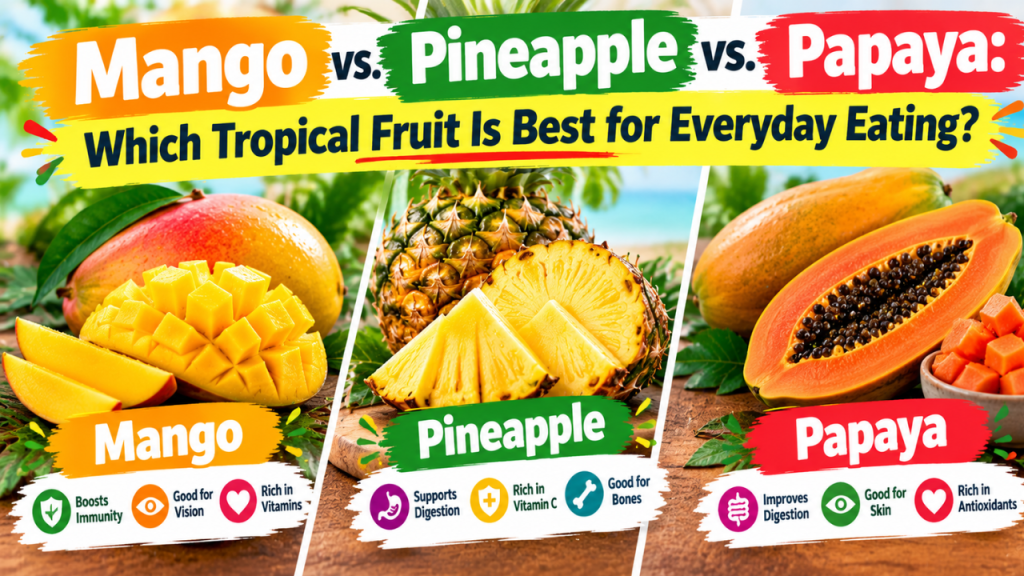
Mango vs. Pineapple vs. Papaya: Which Tropical Fruit Is Best for Everyday Eating?
The right tropical fruit depends on your blood sugar, your workout, your meds, and your kid's age — here's which one to grab when.
Your blood glucose meter beeps twenty minutes after breakfast, and you’re staring at a cutting board with mango, pineapple, and papaya on it, trying to figure out which one is responsible for that number. Or maybe you’re packing a toddler’s lunchbox and wondering if papaya chunks are a choking risk. Or you’re on blood thinners and someone told you pineapple is “fine, just don’t overdo it” — which tells you nothing.
There isn’t one best tropical fruit. There’s a best fruit for your specific situation, and the research actually gives some clear answers.
Which one actually spikes your blood sugar
This is the question with the most solid data behind it. A study that fed type 2 diabetic patients standardized portions of local fruits containing 25 g of available carbohydrate each and measured their actual blood glucose response found real, meaningful gaps between these three fruits.
Mango came out with a glycemic index of 59. Pineapple came in at 73. Papaya was the highest of the three at 86 — a GI gap of 27 points between mango and papaya, which is not a rounding error. For context, the researchers compared all of these to wheat bread, and mango’s blood glucose area under the curve was significantly lower than bread’s. Papaya’s was not.
The study’s authors point to fiber content, sugar type, and how the fruit breaks down when chewed as the likely reasons. Mango’s fructose content specifically seems to slow the rise in blood sugar compared to papaya’s more rapidly absorbed sugars.
This was a small trial — ten diabetic subjects — so treat it as solid early evidence, not the final word. But if you’re managing blood sugar day to day and choosing between these three, mango is the one with actual human glucose-response data behind it, not just a lower sugar number on a label.
Before or after a workout
Timing matters here, and the same GI numbers that help a diabetic patient slow down a spike are exactly what an athlete might want to speed one up.
If you want fast glucose into your bloodstream right before a workout, papaya’s high GI of 86 and pineapple’s 73 push sugar into your system quickly — useful for a short burst of pre-exercise energy if you’re not watching blood sugar for medical reasons. Mango’s lower GI of 59 makes it a steadier option, better suited to eating an hour or more before activity so you’re not riding a sharp spike-and-crash during your session.
After a workout, when your muscles are primed to soak up glucose for glycogen refill, a quicker-absorbing fruit like pineapple or papaya may get sugar into your system faster during that recovery window. None of this comes from exercise-specific trials — it’s a reasonable extension of the glycemic response data — so treat it as informed reasoning, not a proven recovery protocol.
What bromelain and papain actually do once you swallow them
Pineapple’s bromelain and papaya’s papain aren’t just trivia — they’re active cysteine proteases, enzymes built to break down protein. Lab research on these exact enzymes, including a 2025 study on immobilizing ficin, papain, and bromelain for industrial use, confirms they stay chemically reactive enough that scientists can bond them to carriers and crosslink them with glutaraldehyde without destroying their protein-digesting activity.
That’s a lab and industrial-biotechnology study, not a clinical trial in people — it doesn’t tell you what happens when you eat pineapple while on a specific prescription. But it does confirm something worth taking seriously: these are genuinely active enzymes, not inert plant chemicals, and they don’t go dormant the moment they hit your stomach.
Because of that, anyone taking oral enzyme supplements, protein-based medications, or anything where the drug itself is a protein structure should ask a pharmacist before pairing it with large amounts of fresh pineapple or papaya — not because there’s direct clinical proof of harm in every case, but because the mechanism for interference is biologically plausible and under-studied. If your only caution so far has been a vague “ask your doctor about blood thinners,” that’s not the same as understanding that the enzyme itself is the active ingredient doing the interacting.
Weight loss: satiety and water content
Papaya is lowest in calories and sugar of the three, which is already well known. Less discussed is the texture difference: papaya and pineapple are both high in water content, which adds volume to a serving without adding much energy, a combination that tends to support fullness per bite. Mango is denser and sweeter, which can make it easier to overeat without noticing, simply because it delivers more concentrated sugar per mouthful. None of the three is a fiber powerhouse compared to something like whole grains, but pineapple’s fibrous core and papaya’s seed-flecked flesh both require more chewing, which can slow down how fast you eat a serving.
Ripeness changes more than sweetness
Unripe fruit behaves differently in your body than ripe fruit, across all three. As mango and papaya ripen, starches convert to sugars and the flesh softens, which is also when papain and the fruit’s natural sugars become more concentrated. Unripe, green fruit carries more starch and less free sugar, and enzyme activity in unripe papaya is notably higher and more irritating, which is part of why unripe papaya carries specific caution for pregnant women. Pineapple doesn’t continue ripening much after harvest, so its sugar content at purchase is closer to what you’ll get at the table.
Kids, choking, and allergies
Pineapple’s fibrous texture and papaya’s slippery, seed-studded flesh both need to be cut into small, manageable pieces for young children — whole chunks of either can be a choking risk for toddlers. Mango’s smooth flesh is easier to manage but its skin can trigger a rash in children sensitive to urushiol, the same compound found in poison ivy.
Quick recap:
- Blood sugar control: mango (GI 59) over pineapple (GI 73) and papaya (GI 86), based on real glucose-response testing in diabetic patients
- Pre-workout quick energy: pineapple or papaya; steadier pre-workout fuel: mango
- On enzyme-sensitive medications: ask a pharmacist before regular pineapple or papaya, since bromelain and papain are genuinely active proteases
- Weight loss: papaya and pineapple’s water content edges out mango’s denser sugar load
- Ripeness: riper fruit means more sugar and more active enzymes, especially in papaya
- Kids: cut pineapple and papaya small for choking safety; watch mango skin for rash
The real takeaway: stop asking which tropical fruit is “healthiest” overall, and start asking what you need it to do today — because mango, pineapple, and papaya each win a different job.
Sources

James Carter
The EverBBQ editorial desk — covering BBQ news, features and everything off the grill.