Whole Wheat Roti vs. Corn Tortillas vs. Flour Tortillas: Which Has More Fiber and Fewer Calories?
Equalize for weight and calories, add glycemic data, and the roti-vs-tortilla "winner" changes depending on your blood sugar, gut, and gluten needs.
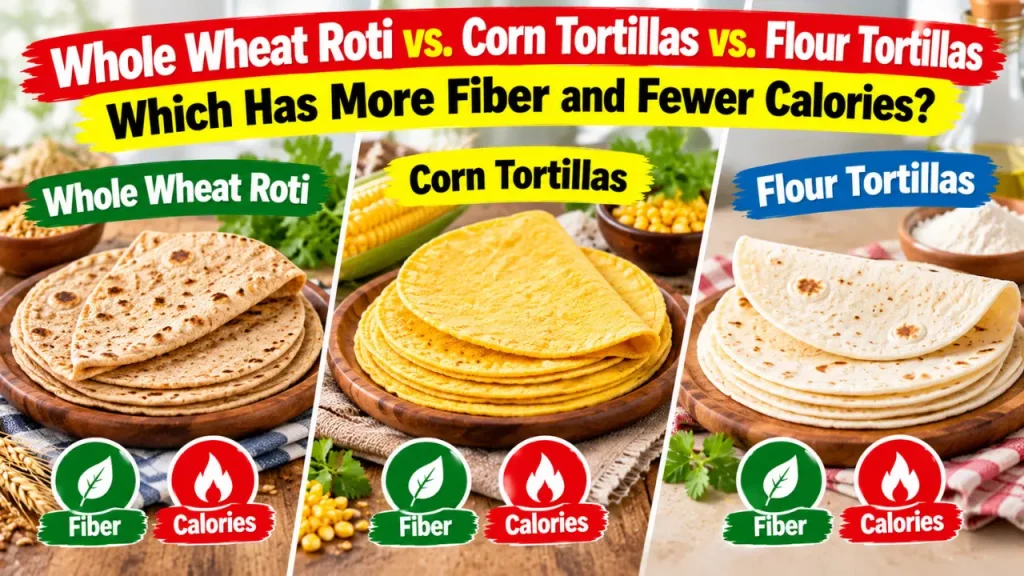
You’re standing at the counter with three stacks in front of you: a package of whole wheat roti from the freezer, a bag of corn tortillas, and a bag of flour tortillas, trying to decide which one goes into this week’s lunch rotation. The nutrition labels all use different serving sizes, different piece weights, and none of them tell you what any of this does to your blood sugar an hour after you eat it. So you guess. Most people guess wrong, because the comparison nobody runs is the one that actually matters: same weight, same calories, same question — what happens to your glucose?
Here’s the direct answer first. Gram for gram, whole wheat roti generally carries more fiber than either tortilla because it’s made from 100% whole wheat flour with no refining step. Corn tortillas tend to be the lowest-calorie, lowest-sodium option per piece, mostly because they’re smaller and simpler — corn, water, lime. Flour tortillas sit at the bottom on both counts: more refined flour, more added fat, more sodium. That much is settled. What’s missing is what happens once you stop comparing random-sized pieces and start comparing them the way your body actually experiences them — by calorie load and by how fast that food turns into blood sugar.
Step 1: Compare them at equal weight first
Pull the same 100-gram amount of each. At this stage, the fiber gap is the headline: roti’s bran and germ survive milling, so its fiber density stays high, while flour tortillas lose most of that fiber in refining. Corn tortillas land in between, and the type of corn processing changes that number more than people expect. A study on nixtamalized corn tortillas found that tortillas made with calcium carbonate processing had the highest dietary fiber content of the tortillas tested, with the highest insoluble fiber fraction specifically — higher than commercial tortillas made with faster industrial methods.
Tip: If you buy corn tortillas, check whether the label mentions nixtamalization or lime-processing. Not all corn tortillas are processed the same way, and that single step shifts both fiber and starch digestibility.
Step 2: Now re-run the comparison at equal calories
This is the step nobody else runs, and it flips part of the story. Because corn tortillas are less calorie-dense, a 150-calorie portion of corn tortilla is a noticeably larger pile of food, by weight, than a 150-calorie portion of flour tortilla. That means more fiber per calorie, more water volume, and more chewing per bite — all things that affect fullness independent of the raw fiber number. Roti still tends to win on fiber per calorie because whole wheat’s fiber survives intact, but the calorie-equalized corn tortilla portion closes some of the gap people assume exists when they only look at per-piece labels.
Tip: When comparing packaged flatbreads, divide fiber grams by calories, not by piece count. A “low-fiber-looking” tortilla can still deliver more fiber per 100 calories than a bigger, denser one.
Step 3: Check glycemic response, not just fiber grams
Fiber content and blood sugar impact are related but not identical, and this is the gap every other comparison skips. In vitro digestion work on corn tortillas and black beans found that available starch in tortillas dropped between 3% and 6% after 48–72 hours of cold storage, while resistant starch — the starch fraction your body digests slowly, like fiber — rose by 1.5% to 1.6% over the same period. In other words, a cold, day-old corn tortilla behaves differently in your gut than a fresh, hot one off the comal. On the wheat side, cooking method matters just as much: a study on Indian wheat flatbreads compared roasted chapati, boiled dalia, shallow-fried paratha, and deep-fried poori, tracking how resistant starch formation and blood glucose response changed with cooking and storage temperature — confirming that “roti” isn’t one glycemic category, it’s several, depending on how it’s cooked.
Tip: If you’re managing blood sugar, let roti or tortillas cool slightly, or refrigerate and reheat leftovers rather than always eating them fresh off the heat — the resistant starch formed during cooling appears to stick around even after reheating.
Step 4: Don’t ignore protein quality
Corn protein is widely recognized in nutrition science as limited in the amino acid lysine, and wheat gluten is also a lower-quality protein by amino acid balance — so neither tortilla nor roti should be counted on as a primary protein source on its own. This isn’t just theoretical: a chapati study using pigeon pea flour found that blending whole wheat flour with legume flour raised chapati’s protein content by 1.18 times at a 20% substitution and 1.34 times at a 40% substitution compared to standard whole wheat chapati, while also slowing glucose release during simulated digestion. The takeaway: pairing your flatbread with beans, lentils, or eggs does more for both protein quality and blood sugar than switching flatbread brands ever will.
Tip: Treat roti and tortillas as the carbohydrate base of a meal, not the protein source — pair with beans, dal, or egg for a real amino acid profile.
Step 5: Account for oil before you declare a winner
Plain roasted chapati and a ghee-brushed one are not the same food. Frying wheat dough, as in paratha or poori, changes both the fat load and the starch structure compared to dry-roasted chapati, per the same Indian flatbread cooking study. A daily habit of adding a teaspoon of oil or ghee to each roti, multiplied across a week, adds up to real calories that no per-piece label accounts for — since most labels assume the plain, dry version.
Tip: If you’re counting calories, weigh your roti dough before and after adding fat, or simply dry-roast most days and reserve ghee for occasional meals.
Step 6: Match the bread to your actual condition, not a general ranking
A “best overall” answer doesn’t work for everyone. People with celiac disease or gluten sensitivity need to avoid wheat roti and flour tortillas entirely — corn is the only one of the three that’s naturally gluten-free. People with corn allergies or FODMAP sensitivities should flip that and lean on wheat-based options instead. For people managing diabetes, the relevant evidence isn’t fiber grams at all — it’s glucose response. A randomized crossover trial comparing a 250-calorie tortilla chip snack to an equicaloric pecan snack in adults with overweight or obesity found that glucose and insulin rose significantly more after the tortilla chip snack, even though total calories and self-reported appetite didn’t differ between the two. That’s a reminder that what you eat alongside the tortilla or roti — fat, protein, or refined starch — can matter as much as which flatbread you picked.
Tip: If you have diabetes, prioritize pairing any of these three with protein or fat rather than hunting for the single “lowest-GI” option — the combination changes the glucose curve more than the bread alone.
Common mistakes people make in this comparison
- Comparing a small corn tortilla to a large flour tortilla “per piece” and calling it a fair fight — weight and calories first, always.
- Assuming all roti is equal, when dry-roasted chapati and ghee-fried paratha are nutritionally different foods.
- Ignoring storage and reheating effects on starch digestibility, which the cold-storage tortilla research shows can shift resistant starch content within 48–72 hours.
- Treating any of these three as a complete protein source instead of pairing with beans, lentils, or eggs.
- Picking “gluten-free” corn tortillas by default without checking for corn sensitivity or FODMAP issues first.
So which one actually belongs in your kitchen — the roti you grew up eating, the corn tortilla your gut tolerates better, or the flour tortilla that’s just easier to find? What’s actually on your plate next to it?
Sources
- Randomized, Crossover Trial Assessing Appetite and Blood Biomarkers: Pecan Snack vs. Equicaloric Tortilla Chip Snack (2024, Nutrients)
- Effect of Nixtamalization with Calcium Carbonate on Indigestible Carbohydrate Content and Starch Digestibility of Corn Tortilla (2014, Journal of Cereal Science)
- In Vitro Starch Digestibility and Predicted Glycemic Index of Corn Tortilla, Black Beans, and Tortilla-Bean Mixture (2005, Journal of Agricultural and

Mick Hudson
Low-and-slow recipes, rubs, sauces and fire management from our pitmaster team.