American Root Beer vs. British Ginger Beer: Taste, Sugar and Key Differences
Caffeine, real ginger dose, and sassafras safety rules decide which drink actually suits pregnant women, blood-thinner users and caffeine-avoiders.
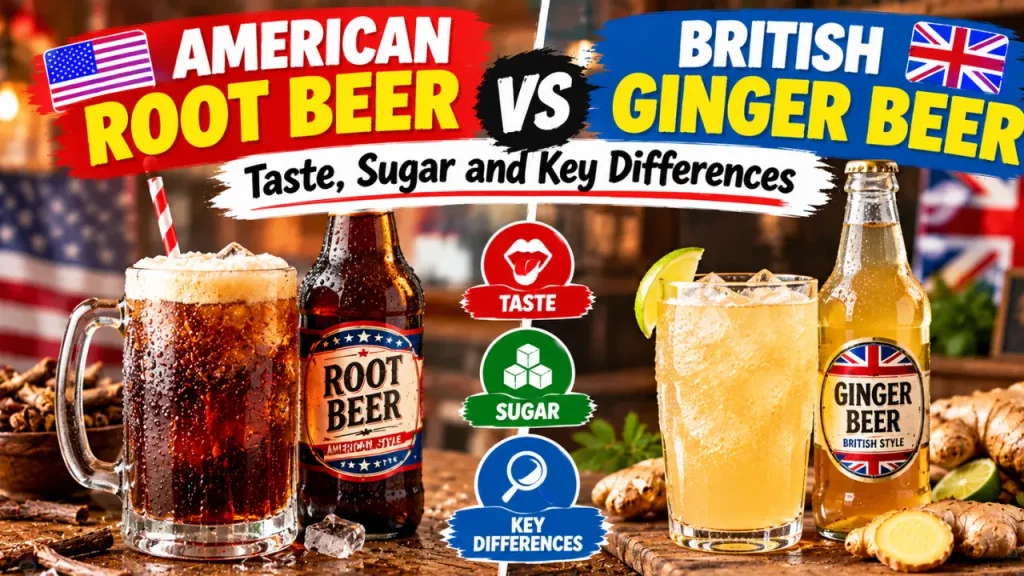
Most root beer contains zero caffeine — it’s one of the only sodas on American shelves that doesn’t. So it’s genuinely surprising that Barq’s, one of the biggest-selling root beer brands in the US, deliberately puts caffeine back in. That one formulation choice is the entire reason purists insist “Barq’s isn’t real root beer,” and it’s also the reason a caffeine-sensitive shopper cannot assume anything just because a bottle says “root beer” on the label. The honest answer to which drink is “better” isn’t about flavour at all — it depends on what’s actually in the specific can you pick up, and who’s drinking it.
Why Barq’s Has Caffeine and Most Root Beers Don’t
Traditional root beer is flavoured with sassafras bark, sarsaparilla and assorted roots and herbs, none of which naturally contain caffeine. That’s why A&W, Mug, IBC and Dad’s are all caffeine-free by default. Barq’s broke from that tradition by adding caffeine to its formula, positioning itself closer to a cola than a classic root beer. This isn’t a trivial branding quirk — it’s the exact mechanism behind the “Barq’s isn’t root beer” argument, and it means caffeine-avoiders genuinely cannot treat the category as uniformly decaf. If you’re cutting caffeine for sleep, pregnancy, or anxiety reasons, the rule is simple: check the specific brand, not the drink category.
It helps to think about why a manufacturer would bother. Caffeine is a mild stimulant and, in soft drinks, it also acts as a flavour enhancer that sharpens bitterness and makes a cola-style drink taste “sharper” on the finish. Barq’s leaning into that profile is a deliberate business decision to compete with colas rather than with other root beers, not an accident of brewing. For an everyday example: someone who avoids caffeine after 2 p.m. because it disrupts their sleep could grab a Barq’s at a restaurant fountain machine, assume it’s “just root beer,” and unknowingly add roughly the same caffeine as a small cola to their evening. The label usually does disclose it in small print, but fountain dispensers, vending machines and restaurant menus rarely spell this out, which is exactly where the mistake happens in real life.
This matters even more for parents making choices for children, since kids are smaller and more sensitive to even modest caffeine doses than adults. A child who drinks A&W at one meal and Barq’s at the next is getting two meaningfully different drinks despite near-identical branding and appearance. The practical fix is simple and costs nothing: glance at the ingredients list once per brand, remember which ones carry caffeine, and treat that as fixed information rather than re-checking every time.
Does Ginger Beer Actually Contain Enough Ginger to Help Your Stomach?
The claim that ginger beer “settles your stomach” has real biology behind it, but the dose matters enormously. A 2025 randomized clinical trial on ginger’s prokinetic effects in tuberculosis patients gave participants a standardized 1 gram daily dose of ginger and tracked gastrointestinal disturbances caused by anti-TB medication. Out of 200 enrolled participants split across four groups, 47 completed the ginger arm, and researchers compared outcomes against a placebo group, a caraway group and a peppermint group. The ginger group showed measurable prokinetic effects — meaning ginger genuinely moved digestion along and reduced nausea-type symptoms in that population.
The catch: that’s a controlled 1 gram dose of actual dried, crushed ginger, taken daily as a nutraceutical. Commercial ginger beer isn’t required to disclose how much real ginger root versus ginger flavouring or extract goes into each bottle, and mass-market brands typically rely on extracts and carbonation for bite rather than whole root. A supporting 2025 review of dietary bioactive compounds, including ginger bioactives, confirms the underlying mechanism is plausible — ginger compounds do interact with inflammatory and digestive pathways — but the review stresses this evidence is still developing and doesn’t translate directly into a soft drink dosage claim. In short: the “ginger beer settles your stomach” folklore has a real scientific seed, but there’s no published evidence that a can of commercial ginger beer delivers anywhere near the dose shown to work in trials.
There’s also a practical distinction worth knowing: “ginger ale” and “ginger beer” are not interchangeable despite often sitting on the same supermarket shelf. Ginger ale is traditionally a lighter, more heavily sweetened drink with less ginger character, while ginger beer is brewed to be spicier and historically closer to a fermented product, which in theory should mean more real ginger content. In practice, though, both categories now include brands that lean almost entirely on flavouring rather than root, so the name on the label is not a reliable guide to actual ginger dose — the only way to know is to read the ingredients list and see whether ginger root or ginger extract appears near the top rather than the bottom.
Pregnancy, Blood Thinners and Caffeine Sensitivity: Who Should Choose What
A 2019 prospective cohort study of 225 Danish pregnant women, surveyed at 10–16 weeks of pregnancy, looked specifically at use of alternative remedies including ginger and licorice for nausea. The study’s background is the useful part for shoppers: it flags that herbal products like ginger are not automatically “safe because natural,” since they can alter hormone metabolism and cytochrome P450 enzyme function — the same liver pathway that processes many prescription drugs, including some blood thinners. That doesn’t mean a can of ginger beer is dangerous, but it does mean pregnant women and anyone on anticoagulant medication shouldn’t treat ginger beer as a therapeutic substitute for a doctor’s advice, especially given that its real ginger content is unlabelled and inconsistent between brands.
For breastfeeding mothers wondering if ginger might boost milk supply, a Cochrane systematic review on oral galactagogues for increasing breast milk production was specifically designed to put natural botanical agents through the same evidence standard as pharmaceutical ones — a reminder that popular food-based claims need controlled trial data, not tradition, before they’re acted on.
A separate, more recent line of evidence worth flagging for anyone already managing a chronic condition comes from a 2025 clinical report on herbal-drug interaction risk in patients on long-term medication, which underscores that interaction risk isn’t limited to pregnancy — it applies to anyone combining everyday herbal-flavoured consumables with prescribed drugs over an extended period. The practical takeaway isn’t to panic over an occasional can of ginger beer; it’s that “occasional” is the operative word, and daily, high-volume consumption is where any theoretical interaction risk would actually have room to matter.
What This Means When You’re Standing in the Soda Aisle
Putting it together: caffeine-sensitive people should default to any root beer except Barq’s, or to ginger beer, which is caffeine-free across the board. Pregnant women or blood-thinner users should treat ginger beer as a flavoured drink, not medicine, and check with a clinician before relying on it for nausea. Neither drink is a health product; both are sodas with incidental, under-dosed traces of their “medicinal” ingredient. The most useful habit a shopper can build isn’t memorizing brand names — it’s reading the ingredients panel once, noting where caffeine or real ginger actually sits in the list, and applying that knowledge consistently rather than assuming a whole category behaves the same way every time.
Sources
