White Rice vs. Brown Rice vs. Basmati: How Do They Compare Nutritionally?
Real numbers on fibre, arsenic, GI and diabetes risk — matched to diabetes, weight loss, kidney disease, babies, and your grocery budget.
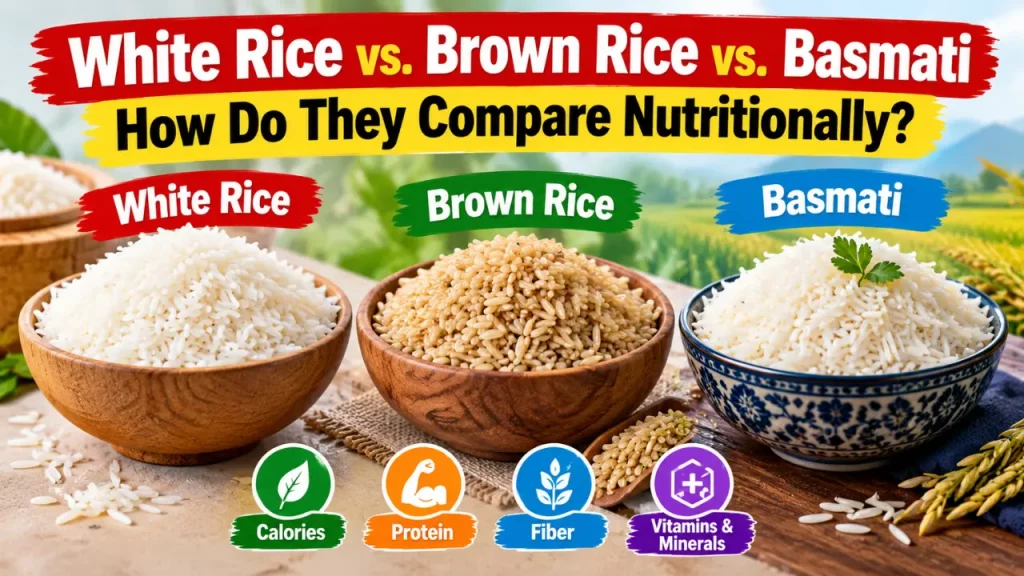
In Tehran, people eat roughly 250 grams of white rice a day. In rural Golestan, a few hundred kilometres away, people eat about 120 grams — less than half. If “white rice causes diabetes” were a simple rule, Tehran should have the worse numbers. It doesn’t: Golestan’s cumulative type-2 diabetes incidence was 9.9%, Tehran’s was 8.0%, according to a prospective cohort study from Iran following more than 11,000 people. More rice, less diabetes, in the same staple-eating country. That single result should make anyone suspicious of simple rice-colour rules — and it’s the right place to start before deciding which rice actually belongs in your kitchen.
Nutritionally, per the USDA, white rice (cooked, unenriched) has 97 kcal, 21.1 g carbohydrate, 2.02 g protein, 1 g fibre and 5 mg sodium per 100 g, with only 5 mg magnesium and 10 mg potassium — see USDA data on cooked white rice. A parboiled brown rice, per 100 g, has 147 kcal, 31.3 g carbohydrate, 3.09 g protein, 1.7 g fibre, 39 mg magnesium and 61 mg potassium — see USDA data on cooked brown rice. That’s nearly eight times the magnesium, over six times the potassium, and about 1.7 times the fibre. These two entries aren’t a perfect apples-to-apples match (one is glutinous white, one is parboiled brown), but the direction and scale of the gap holds across rice types generally. Basmati sits nutritionally close to other white or brown rice of the same milling — its real distinguishing feature is a lower glycemic index, not a different mineral profile.
The colour of your rice barely moves the needle compared with how much of it lands on your plate — the exceptions are a handful of medical situations where the extra fibre, potassium or bran genuinely change the outcome.
Step 1: Work out whether you actually need brown rice’s extra fibre
The fibre difference between white and brown rice is 1 g versus 1.7 g per 100 g — under one extra gram per typical serving. Against a daily fibre target of 25–30 g, that’s close to irrelevant for someone already eating vegetables, legumes or whole fruit. It matters more for someone whose diet is otherwise low in fibre and who eats rice in large, frequent portions — there, brown rice’s extra fibre, plus its magnesium and zinc, add up over weeks.
Tip: if you’re already hitting fibre targets elsewhere, don’t feel obligated to switch — the fibre argument for brown rice is weakest for people who already eat well.
Step 2: Treat basmati’s low GI as a single-meal number, not a guarantee
A lower glycemic index means basmati raises blood sugar more slowly after one bowl, measured in a lab. But none of the large cohort studies linking rice intake to diabetes — including a systematic review and meta-analysis of white and brown rice covering 19 studies, or a dose-response meta-analysis across 1,527,198 participants — separate basmati from other white rice varieties. That second review found each additional 150 g of white rice a day was linked to a 6% greater risk of type-2 diabetes, with a roughly linear trend. Nobody has run the equivalent basmati-only study over years. So the honest answer is: basmati’s GI advantage is real in the short term, unproven as a long-term HbA1c benefit.
Tip: if you have diabetes, basmati is a reasonable swap for jasmine or short-grain white rice, but don’t treat it as a reason to double your portion.
Step 3: Settle the weight-loss question
Here’s the decisive part most comparisons avoid: calories per 100 g are 97 for white versus 147 for the brown rice entry above, carbohydrate is 21.1 g versus 31.3 g, and the fibre gap is under a gram per serving. That’s not a calorie-density advantage for brown rice at all — if anything the brown entry is denser in energy. Combined with a fibre difference too small to meaningfully change satiety, the available evidence doesn’t support brown rice producing measurable weight loss over white rice on its own. Weight outcomes track total calories, protein, and portion size — rice colour is noise once those are controlled.
Tip: if weight loss is the goal, spend your attention on portion size and protein at the same meal, not on which bag of rice is in the pantry.
Step 4: Know who should actually avoid brown rice
- IBS/IBD during flares — the intact bran in brown rice is harder to digest and can worsen symptoms during active flares; white rice is the gentler choice short-term.
- Kidney disease on a potassium-restricted diet — brown rice carries roughly six times the potassium of white rice (61 mg vs 10 mg per 100 g), which matters for anyone managing hyperkalaemia.
- Infants and young children — arsenic from soil and irrigation water concentrates in the bran layer, so brown rice (bran retained) carries more than white rice (bran removed) from the same crop, which is why pediatric guidance steers young children toward smaller, varied rice portions rather than brown rice as a daily staple.
Tip: these are exceptions, not general warnings — most healthy adults have no reason to avoid brown
