Whole Milk vs. Skim Milk vs. Almond Milk: Which Is Healthier?
The right milk depends on your kidneys, blood pressure, and blood sugar — here are the actual numbers behind that answer.
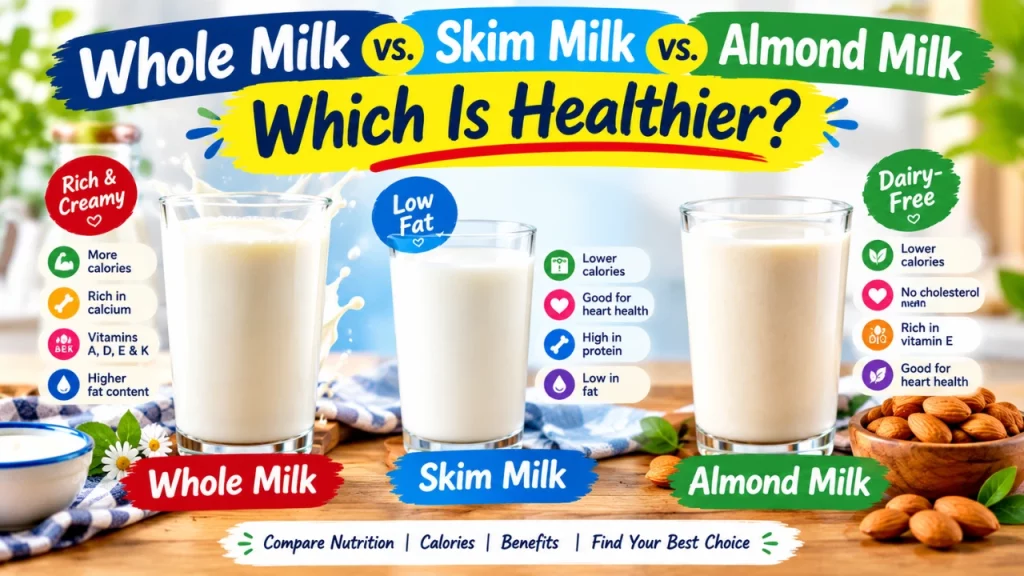
There is no single healthiest milk — but there is a correct milk for your kidneys, your blood pressure, your blood sugar, and your actual grocery cart.
Most comparisons stop at calories and protein. That leaves out the questions people actually type into a search bar at 9 p.m.: Will this hurt my kidneys? Will this move my blood pressure number? Will this spike my glucose? Here’s what the numbers say.
So which milk actually wins?
It depends on the problem you’re solving, not on a single “healthiest” label. A quick side-by-side, per standard cup (244 g) or the almond/soy equivalent, makes the trade-offs obvious:
| Milk (unsweetened, per cup) | Calories | Potassium | Calcium | Added sugar |
|---|---|---|---|---|
| Whole milk | ~149 | ~380 mg | ~280 mg | 0 g |
| 2% milk | ~122 | ~380 mg | ~290 mg | 0 g |
| Skim milk | ~83 | ~380 mg | ~300 mg | 0 g |
| Almond milk, unsweetened | ~30–40 | ~160 mg | ~450 mg (fortified) | 0 g |
| Almond milk, sweetened | ~80 | ~160 mg | ~450 mg (fortified) | ~7 g |
| Soy milk, unsweetened | ~80–100 | ~290–300 mg | ~300 mg (fortified) | 0 g |
Is almond milk actually a problem for people prone to kidney stones?
Yes, and this is the gap almost nobody flags. Almonds are classified among the higher-oxalate foods, and that oxalate carries straight into almond milk. Most kidney stones in adults are calcium oxalate stones, formed when oxalate binds calcium in the urine. Someone who has already had a stone, or who has been told by a urologist to watch oxalate intake, is often advised to limit almonds, almond butter, and almond milk specifically — a detail that rarely comes up in general dairy-vs-plant-milk comparisons. Dairy milk, by contrast, contains essentially no oxalate, and its calcium may even bind oxalate in the gut before it reaches the kidneys. If stones are a known issue for you, that’s one of the clearest, least ambiguous reasons to default to dairy or soy over almond.
Which milk actually helps blood pressure?
Dairy milk has a real, if modest, edge — and potassium is the main reason. A cup of whole, 2%, or skim milk delivers roughly 380 mg of potassium, compared with roughly 160 mg in unsweetened almond milk — less than half. Potassium matters because a dietary analysis from the INTERMAP study found that in a population already eating more sodium than potassium, milk and dairy contributed about 200 mg per day toward a total potassium intake of 2,791 mg per day, making it a meaningful, overlooked source alongside vegetables and fruit. A review of milk products and blood pressure management found that calcium, potassium, and magnesium from dairy, tested in randomized trials, lowered systolic blood pressure by roughly 1.27 to 4.6 mmHg and diastolic by 0.24 to 3.8 mmHg — modest numbers, but real and reproducible. A separate evidence review of dairy and hypertension similarly concluded there is moderate evidence for an inverse relationship between dairy intake and blood pressure. Notably, a small Japanese workplace study found most people simply don’t know milk’s potassium even helps blood pressure, which may explain why almond milk gets recommended by default even to people who’d benefit more from dairy’s potassium load.
What does dairy milk actually do to blood sugar?
Dairy milk contains lactose, a sugar, so it will raise blood glucose somewhat after drinking it; unsweetened almond milk carries almost no carbohydrate, so its glucose impact is close to zero. For someone managing diabetes closely, that’s a real distinction glossed over elsewhere — sweetened almond or soy milk, however, can undo that advantage instantly, since added sugar behaves no differently than any other sugar in the bloodstream. The safest rule for a diabetic reader: unsweetened almond or soy milk if glucose control is the priority, and always check the label for “added sugar,” not just “sugar.”
Does almond milk’s fortified calcium actually work as well as dairy’s?
Only if you shake it every time. Calcium carbonate added to almond milk is a mineral suspended in liquid, not dissolved — it settles to the bottom of the carton between pours. Skip the carton, and your glass may carry a fraction of the 450 mg listed on the label, while the rest stays behind. Dairy’s calcium is naturally dissolved and evenly distributed, so every glass delivers roughly the same amount whether it’s the first pour or the last. This single habit — shake, every time — is the difference between almond milk’s calcium claim being accurate or misleading in practice.
What about 2% milk, the one most people actually buy?
It’s the real middle ground nobody profiles. At roughly 122 calories per cup, it sits between whole milk’s 149 and skim’s 83, while keeping the same ~380 mg potassium and similar calcium as both. For someone who isn’t trying to cut fat aggressively but also isn’t chasing whole milk’s extra calories, 2% delivers nearly all of dairy’s blood-pressure-relevant potassium and calcium without whole milk’s fuller fat load.
Why isn’t soy milk ever part of this comparison?
Because almond milk gets the headlines, but soy milk is the only plant milk that doesn’t force a trade-off. Unsweetened soy milk carries roughly 290–300 mg of potassium per cup — far closer to dairy’s ~380 mg than almond milk’s ~160 mg — while also providing protein much closer to dairy’s amount than almond milk’s 1 gram. For someone who wants a plant milk without giving up potassium or protein, soy is the more honest substitute, not almond.
Should I worry about additives like carrageenan or gums in almond milk?
For most people, no — but for some, maybe. Carrageenan and stabilizing gums are added to keep almond milk’s texture smooth, and a limited amount of research, mostly in animal models, has raised questions about gut irritation from carrageenan specifically. Human evidence is thin and far from conclusive, so this isn’t a reason for most people to avoid almond milk — but anyone with an unexplained flare in digestive symptoms after switching to a carton brand with added gums has a reasonable, low-cost experiment available: switch to a brand without them and see what changes.
Which milk actually produces weight-loss results?</

Mick Hudson
Low-and-slow recipes, rubs, sauces and fire management from our pitmaster team.