Which Mushroom Has More Protein? Button vs Oyster vs Shiitake
Raw protein grams don't tell the real story — cooking, chitin and amino acid gaps decide how much mushroom protein your body actually uses.
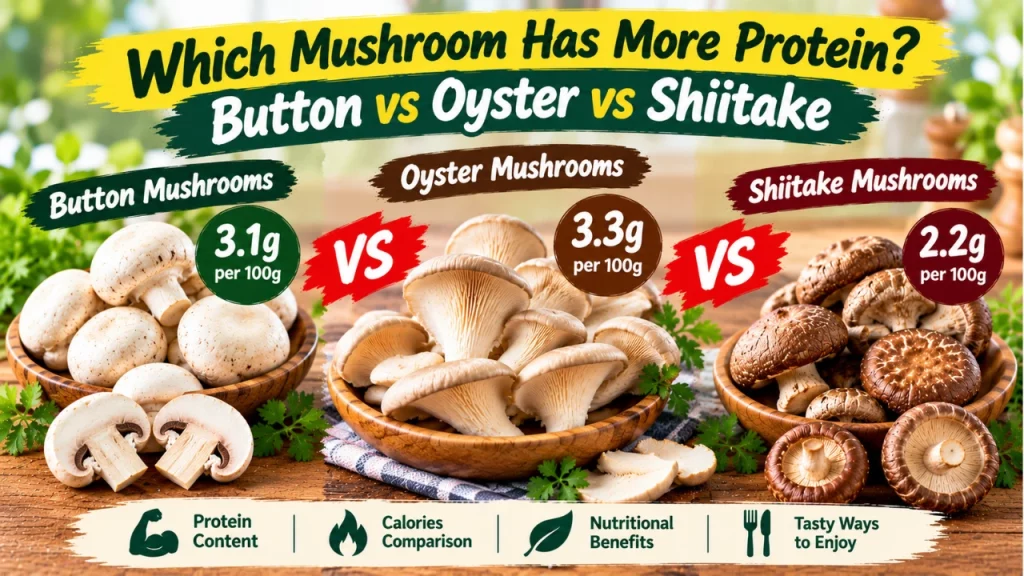
How many mushrooms would you actually need to eat before you matched the protein in a single egg? Most comparisons stop at the raw numbers — button around 3 grams per 100 grams, oyster closer to 3 to 3.5 grams, shiitake around 2 to 2.5 grams fresh but 9 to 10 grams once dried — and declare oyster the narrow winner. That’s a fine trivia answer. It’s a bad meal-planning tool, because none of us eat raw mushrooms by the fistful, and the body doesn’t absorb mushroom protein the way it absorbs egg or tofu protein.
The real number that matters isn’t grams per 100g on a label — it’s how much usable protein survives cooking and digestion, and by that measure, mushrooms are a minor player no matter which one you pick.
Myth: Cooking Mushrooms Destroys Their Protein
Mushrooms are roughly 90 percent water, and sautéing, grilling or roasting them drives off a large share of that water — commonly 50 to 70 percent of their raw volume. Protein doesn’t evaporate with the steam, so the same grams of protein end up packed into far fewer grams of food. Do the arithmetic on a raw button mushroom with about 3 grams of protein per 100 grams: if cooking shrinks that 100 grams down to roughly 40 grams of cooked mushroom, the protein concentration more than doubles, landing somewhere around 7 to 8 grams per 100 grams of cooked weight. That’s not a trick — it’s the same reason cooked spinach looks like a different food than the raw bag it came from. The practical upshot is that nutrition labels listing raw mushroom protein badly understate what’s sitting on your plate after cooking, but they don’t change how much of it your gut can actually pull out.
A Mushroom’s Protein Label Tells You What You’ll Absorb
This is the part most comparisons skip entirely. Fungal cells are built around chitin, the same tough structural polymer found in insect shells and fungal cell walls, and the human digestive tract doesn’t produce much of the enzyme needed to break it down efficiently. That means some of the protein packed inside those cell walls can stay locked away rather than being released during digestion, so the grams on a label likely overstate what you actually absorb. There isn’t a large human trial measuring exactly what percentage of whole mushroom protein gets through, which is an honest gap in the science, but the mechanism is well established. Interestingly, fungi aren’t purely a digestibility obstacle — they can also be digestibility tools. A study on shiitake mycelium fermentation found that fermenting a pea and rice protein blend with shiitake mycelium raised its Digestible Indispensable Amino Acid Score enough, in ileal digestibility testing done in pigs, to turn it into what researchers classified as an “excellent source” of protein for humans. That’s an animal study, and it tested shiitake enzymes working on plant protein, not on the mushroom’s own tissue — but it shows fungal processing can meaningfully change how much protein a food actually delivers, for better or worse.
Mushroom Protein Is as Complete as Egg or Soy Protein
Complete proteins supply all nine essential amino acids in reasonable proportions; eggs and soy are the usual gold standards. Mushroom protein typically falls short somewhere in the amino acid lineup, which is exactly why fermenting plant protein with shiitake mycelium was worth testing in the first place — the fermented blend’s DIAAS score only climbed to “excellent” status after the fungal fermentation reshaped its amino acid availability, implying the starting proteins, and by extension fungal protein generally, aren’t automatically balanced on their own. Separately, research comparing oyster mushroom fruiting bodies with lab-grown mycelia found protein content ranging from 35.8 to 39.5 grams per 100 grams depending on the growth medium — but that’s dried mycelial biomass grown in liquid culture as an alternative protein ingredient, not the fresh mushroom you’d buy at a grocery store, and even that study was built around comparing amino acid and flavor profiles across different growing substrates rather than proving completeness. The takeaway isn’t that mushroom protein is useless — it’s that treating any single mushroom as a stand-alone complete protein, the way you might treat an egg, isn’t supported by the evidence.
You Can Swap Mushrooms for Eggs or Tofu Gram for Gram
Here’s where the cooking-concentration math becomes genuinely useful. Using roughly 6 grams of protein per large egg and roughly 8 grams of protein per 100 grams of firm tofu as common reference points, here’s what it takes in cooked mushroom weight to match each:
| Mushroom | Raw protein per 100g | Estimated cooked protein per 100g | Cooked grams to match 1 egg (~6g) | Cooked grams to match 100g tofu (~8g) |
|---|---|---|---|---|
| Button | ~3g | ~7.5g | ~80g | ~107g |
| Oyster | ~3.5g | ~8.5g | ~70g | ~94g |
| Shiitake, fresh | ~2.5g | ~6g | ~100g | ~133g |
| Shiitake, dried | ~9.5g (already concentrated) | n/a — rehydrate, don’t cook off water | ~63g dried | ~84g dried |
These are estimates built from known water-loss behavior during cooking, not lab-measured cooked values, so treat them as planning math rather than a lab certificate. But the pattern is consistent: even after cooking concentrates the protein, you need somewhere between two-thirds of a cup and a full cup of cooked mushrooms just to equal one egg, and that’s before accounting for the chitin-related absorption gap, which likely shrinks the usable amount further.
Mushrooms Are a Waste of Time for Serious Protein Goals
Not entirely — it depends who’s asking. Athletes, people recovering from illness, and older ad

Mick Hudson
Low-and-slow recipes, rubs, sauces and fire management from our pitmaster team.