USA vs. Australia: American Chocolate Chip Cookies vs. Australian Anzac Biscuits
The real gap isn't taste — it's law, shelf-life chemistry, glycemic data, and a coconut allergy risk nobody flags.
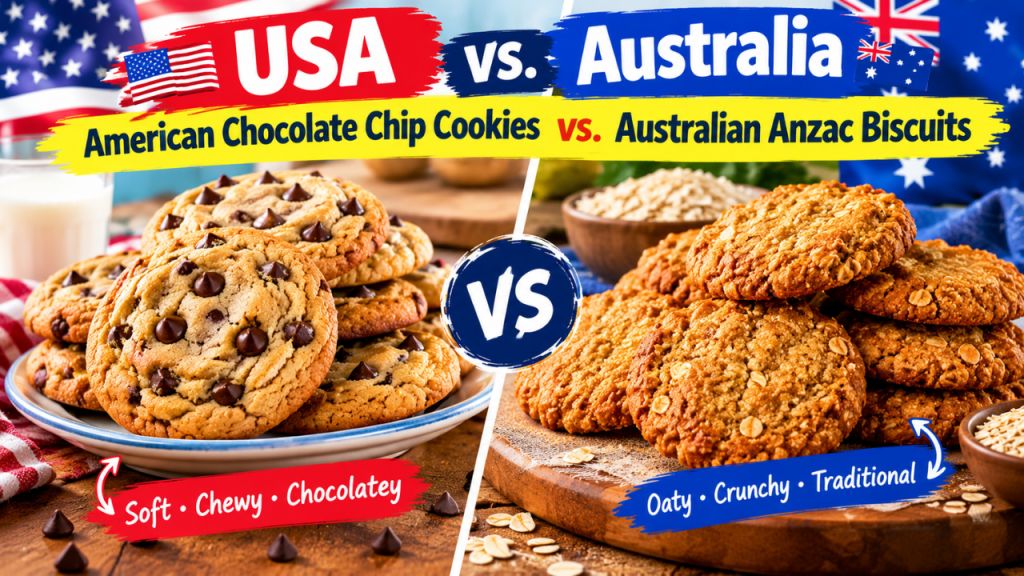
Most people assume the real difference between an Anzac biscuit and a chocolate chip cookie comes down to dried oats versus melted chocolate, or a crisp snap versus a gooey middle. That’s the version you’ll find everywhere. What almost nobody explains is why Australians legally avoid the word “cookie” for these biscuits at all, what the actual fiber and sugar numbers look like when you put oat-based baking under a microscope, or why a coconut-heavy biscuit carries a labeling risk that a chocolate chip cookie simply doesn’t.
The short version: Anzac biscuits last longer for chemical reasons, carry a genuine coconut allergy risk, and their oat base has better glycemic evidence behind it than their “lighter” reputation suggests — while the word “Anzac” itself is protected in a way “chocolate chip” never will be.
Why “Anzac Cookie” Doesn’t Exist Commercially
This isn’t a matter of regional spelling preference. In Australia, the word “Anzac” is treated as protected national heritage, administered through regulations tied to the Department of Veterans’ Affairs, and businesses generally need approval before using it commercially on a product. Bakeries and food manufacturers that want to sell a biscuit under the Anzac name are expected to call it a “biscuit,” not a “cookie,” because the word is meant to evoke the original wartime recipe and tradition rather than a modern, Americanized snack category. A company rebranding the product as an “Anzac cookie” risks being seen as trading on the name for commercial gain in a way regulators and veterans’ groups have historically pushed back against. That’s why, unlike “cookie” and “biscuit” elsewhere in English, this particular naming line isn’t about dialect — it’s about who gets to use a word tied to military memory, and under what conditions.
Why Anzac Biscuits Keep for Weeks
Anzac biscuits contain no eggs and no added preservatives, yet they routinely sit in tins for weeks without spoiling, while a batch of chocolate chip cookies softens or stales within days. The explanation is basic food science: golden syrup and sugar act as humectants, binding available water so tightly that there’s little left for mold or bacteria to use, while the butter and syrup combination lowers the biscuit’s overall water activity. Chocolate chip cookies, with their egg content and comparatively higher moisture, simply don’t achieve the same low-water, high-sugar, high-fat matrix.
That said, “shelf-stable” doesn’t mean “risk-free.” A recent review of foodborne pathogen survival in high-salt, high-sugar, and high-fat foods found that products once assumed inhospitable to bacteria — including chocolate and other sugar-dense foods — have still been linked to outbreaks involving Salmonella, Listeria monocytogenes, and Staphylococcus aureus, because these pathogens can persist, adapt, and sometimes resist standard inactivation methods within sugar- and fat-heavy matrices. The lesson isn’t that Anzac biscuits are unsafe; it’s that long shelf life from sugar and fat is a real chemical effect, not an automatic sterility guarantee, and the same caution applies to any sugar-dense baked good stored for weeks.
Oats, Coconut, and the Glycemic Question
Because Anzac biscuits lean on rolled oats and desiccated coconut rather than refined white flour, there’s a reasonable case they behave differently in the bloodstream than a chocolate chip cookie built almost entirely on white flour and sugar. A small pilot study of short-chain oat fiber in 63 healthy adults found the fiber was well tolerated at daily doses up to 20 grams and measurably altered glucose dynamics during a rice challenge in a subgroup tested with continuous glucose monitors — early evidence, but evidence nonetheless, that oat-derived fiber can blunt a carbohydrate spike.
Separately, a 2026 trial testing low-calorie, oat- and psyllium-fiber-enriched snacks in 20 healthy adults and 20 people with type 2 diabetes found that boosting fiber content from a 7.86% baseline to a 12.61–17.55% range cut available carbohydrates from 55.16% down to a 48.24–52.06% range, alongside a lower overall energy value, compared with a standard fiber-free control snack. These aren’t Anzac biscuit numbers specifically — the study used date-based snacks, not oat biscuits — but they show the same principle at work: higher oat/psyllium fiber content measurably lowers the available carbohydrate load a snack delivers, which matters for anyone managing blood sugar. A chocolate chip cookie, built on refined flour with no comparable fiber fraction, doesn’t get that benefit. It’s a meaningful signal in the right direction for Anzac biscuits, not proof they’re diabetic-friendly.
The Coconut Allergy Risk Nobody Flags
Desiccated coconut is a non-negotiable ingredient in a traditional Anzac biscuit, yet coconut allergy barely gets mentioned next to the gluten and tree-nut warnings that dominate most baking comparisons. A nationally representative U.S. survey of 78,851 people assessing coconut allergy prevalence found 0.39% of the general population had a convincing coconut allergy, including 0.22% of children and 0.43% of adults — and under the Food Allergen Labeling and Consumer Protection Act, coconut must be disclosed on packaged products in the U.S. precisely because reactions, while uncommon, are real and sometimes severe. A chocolate chip cookie carries no such built-in requirement unless coconut is deliberately added. For anyone baking Anzac biscuits for a shared morning tea or school fundraiser, that’s a small but genuine consideration the dried-fruit-versus-chocolate framing never raises.
| Factor | Anzac Biscuit | Chocolate Chip Cookie |
|---|---|---|
| Name protection | “Anzac” restricted; commercial use needs approval, “biscuit” expected | No naming restriction of any kind |
| Shelf stability mechanism | Low water activity from sugar/syrup/fat acting as humectants | Higher moisture from eggs; stales faster |
| Pathogen risk in storage | Still possible per high-sugar/fat food matrix review (Salmonella, Listeria, S. aureus outbreaks documented) | Same matrix risks apply; lower sugar/fat buffering |
| Fiber-driven carb reduction (analogous data) | Oat base aligns with studies showing 7.86% to 12.61–17.55% fiber cutting available carbs to 48.24–52.06% | Refined flour offers no comparable fiber fraction |
| Coconut allergy exposure | Core ingredient; 0.39% of U.S. population affected | Not typically present |
Verdict
Neither treat wins outright. The chocolate chip cookie carries no naming baggage and no built-in coconut risk, but it stales faster and offers no fiber advantage for blood sugar. The Anzac biscuit keeps longer thanks to real humectant chemistry, has early but genuine evidence favoring its oat base for glycemic response, and comes wrapped in a legally protected name — but that same coconut base is a labeling and allergy consideration a cookie doesn’t carry, and “shelf-stable” is not the same as “risk-free” once you look at how sugar-dense foods actually behave with bacteria over time. If you’re managing blood sugar or baking for a crowd with unknown allergies, the Anzac biscuit’s oat content is the stronger nutritional case — but only if you’re reading the coconut label as closely as the sugar content.
Which tradeoff would change what’s in your biscuit tin — the shelf life, the fiber, or the allergy label?
Sources
- Foodborne Pathogens in High-Salt, High-Sugar, and High-Fat Foods (2026)
- Nutritional characterization and postprandial glycemic response of low-calorie date snacks (2026)
- Prevalence and burden of coconut allergy in the United States (2023)
- Short-chain oat fiber improves gastrointestinal tolerance and regulates glucose metabolism (2026)
