Starbucks Sugar-Free Protein Drinks Lawsuit: What to Know
The FDA's actual "sugar free" rule, the science on lactose versus added sugar, and how similar lawsuits have ended.
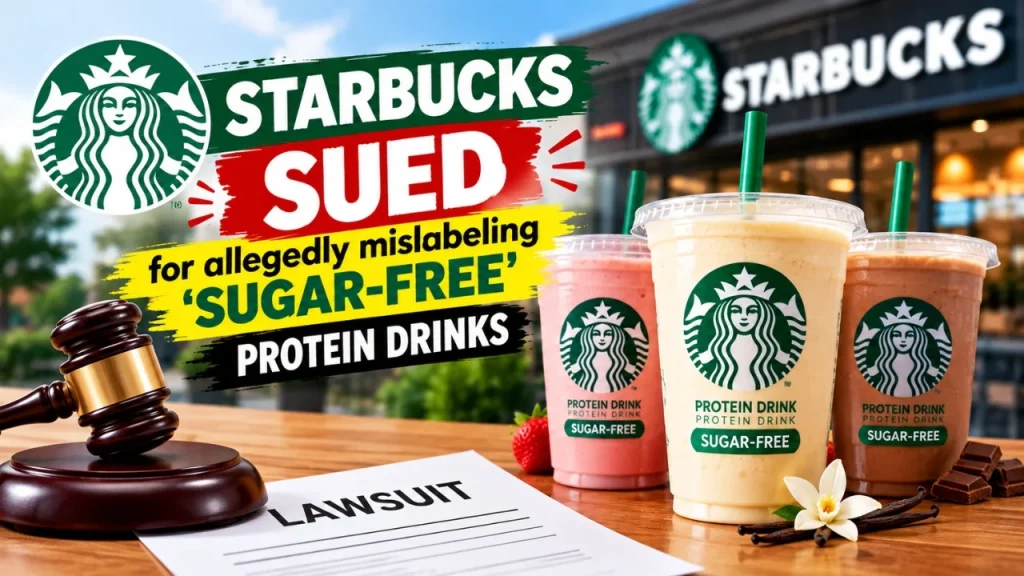
A woman waiting at the pickup counter glances at her phone while the barista calls out “venti, sugar-free vanilla, oat milk.” She ordered it because the menu board said sugar-free, and she is tracking carbs for a reason that has nothing to do with a lawsuit. She has no idea that the cup in front of her, if made with regular dairy milk instead of oat, would carry a name three consumers in Washington state now say shouldn’t say “sugar-free” at all. The question worth answering isn’t whether the lawsuit exists — it’s whether the label was ever actually wrong.
The Rule Starbucks Is Accused of Breaking
The FDA’s nutrient-content-claim regulation, 21 CFR 101.60, sets the bar for when a food or drink can legally use the words “sugar free.” In substance, the rule allows that phrase — along with “sugarless,” “no sugar,” or “zero sugar” — only when the product contains less than 0.5 gram of sugars per the FDA’s standard reference serving size and per labeled serving. The regulation also addresses calories: if a product uses a sugar-related claim but doesn’t separately qualify as “low calorie” or “calorie free,” the label is expected to direct the shopper to the calorie information rather than imply the drink is low in energy. A venti sugar-free latte at 270 to 340 calories with 13 to 21 grams of sugar — all already reported as coming from milk’s natural lactose, not syrup — is the gap the plaintiffs are pointing to: a number far above 0.5 grams, attached to a word that, on paper, means “almost none.”
Does Lactose Count the Same as Added Sugar?
Starbucks’ defense hinges partly on an intuitive idea: lactose is “natural,” so it shouldn’t count against a sugar-free claim the way corn syrup would. Regulators don’t make that distinction — the rule counts total sugars, not their source. But biologically, is there a difference? Lactose breaks down into glucose and galactose, while table sugar (sucrose) breaks down into glucose and fructose. A 2026 review on sugar reduction and metabolic mechanisms in food systems explains that glucose and fructose are absorbed and processed differently in the body: fructose is metabolized largely in the liver and is more strongly linked to de novo fat production and insulin signaling changes, while glucose is used more broadly throughout the body. Lactose doesn’t carry that fructose load, which matters for the liver-specific effects — though galactose still enters glucose metabolism and isn’t a free pass.
The same review also makes a second point that matters here: sugar’s effect on the body isn’t just about the molecule, it’s about the “matrix” it arrives in. Sugar embedded in a protein- and fat-rich liquid like milk is absorbed more slowly than sugar in a thin syrup, which blunts the blood sugar spike. A 12-week randomized trial on full-fat and low-fat fermented dairy and cardiometabolic markers in adults with overweight or obesity and high triglycerides was designed specifically to test whether the fat and sugar package in dairy behaves differently than sugar eaten alone — a reminder that researchers themselves don’t treat “sugar in milk” and “added sugar” as interchangeable, even if the FDA’s label math does.
Lessons From Past Label Lawsuits
This isn’t the first time a food label’s technical wording has ended up in court. Dannon faced regulatory action over health claims tied to its Activia yogurt line, ultimately changing its marketing rather than proving the claims in court. Vitaminwater’s maker was sued over marketing a sugary drink as a health product, and the case ended in a settlement with label and claim changes rather than a finding that the company had broken the law. Quaker Oats has faced repeated suits over “natural” and ingredient-related claims on its labels, with several dismissed and others settled quietly. The pattern across these cases: full trials are rare, companies almost never admit wrongdoing, and the more common outcomes are either dismissal (if the claim is judged accurate or not misleading to a “reasonable consumer”) or a settlement that changes future labels without big cash payouts to individual shoppers. A lawsuit built around a specific numeric regulation like 21 CFR 101.60 — rather than a vague “healthy” claim — tends to be harder to dismiss early, because the question becomes a math check instead of a judgment call. That gives this case a slightly better shot at surviving a motion to dismiss than the vaguer “natural” suits, though it still doesn’t guarantee a win at trial.
Who This Lawsuit Doesn’t Touch
The claims in the suit are specific to eight drinks made with regular dairy milk. Anyone who orders the same sugar-free vanilla or caramel latte with unsweetened almond, soy, or oat milk is removing most of the lactose — and with it, most of the sugar the lawsuit is about. Anyone who orders a tall instead of a venti is also working with a smaller absolute number. And anyone managing blood glucose rather than a label’s wording has a different, more useful question to ask: not “does this technically qualify as sugar-free,” but “how much sugar is actually in the cup I’m about to drink.”
Do the Math Yourself
Because Starbucks’ own range (13 to 21 grams of sugar in a 20-ounce venti) scales roughly with volume, you can estimate smaller sizes without waiting for a verdict.
| Size (oz) | Estimated sugar, low end (g) | Estimated sugar, high end (g) |
|---|---|---|
| Tall (12 oz) | ~7.8 | ~12.6 |
| Grande (16 oz) | ~10.4 | ~16.8 |
