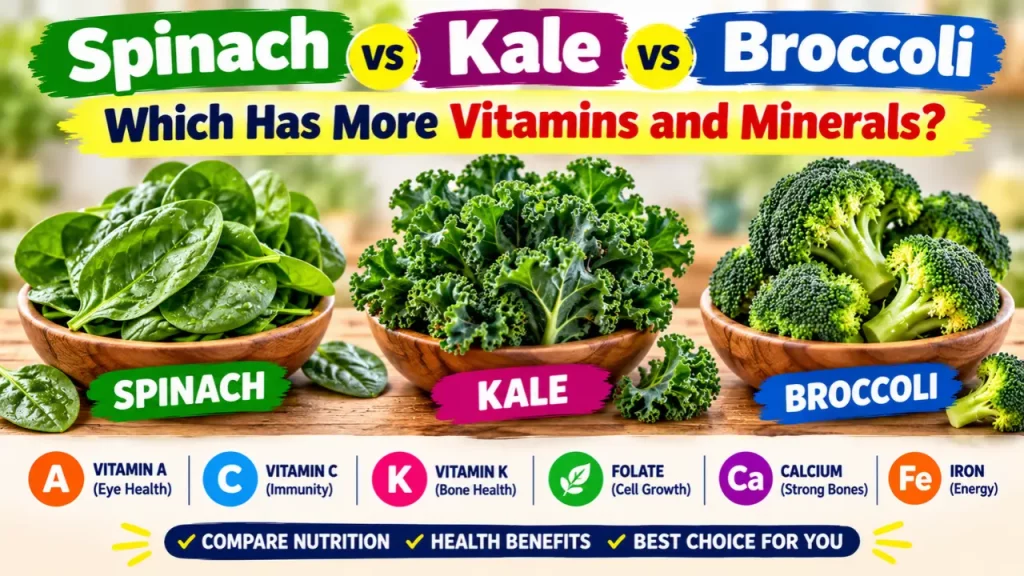
Spinach vs Kale vs Broccoli: Which Has More Vitamins and Minerals?
The raw-leaf nutrient tables lie: cooking method, oxalates, and your own health history decide which green actually wins.
The water is just starting to roll at a full boil, and three cutting boards sit on the counter — a pile of spinach going limp under its own weight, a stack of kale ribs stripped and waiting, and a head of broccoli broken into florets. The pot can only take one batch before dinner gets cold. A hand hovers over the spinach, then the kale, then back again, because somewhere in the back of the mind is a half-remembered headline ranking these three vegetables by vitamin content — as if the answer were that simple, and as if it didn’t depend on what happens in the next ten minutes of cooking, or on what’s actually going on inside the person eating it.
It isn’t that simple. Kale edges out spinach on raw vitamin C, A, and K, and spinach edges out kale on folate and iron, while broccoli holds its own on vitamin C and fiber — that much is settled and not really in dispute. What’s missing from those raw comparisons is everything that happens between the cutting board and the fork: how much of that iron or calcium the body can actually use, whether cooking helps or guts the numbers, and whether the “healthiest” vegetable on paper is actually the wrong choice for a given body.
The oxalate myth about spinach’s iron
Spinach’s iron and calcium numbers look impressive, and spinach is also famously loaded with oxalic acid, which is often blamed for locking those minerals away. A small randomized crossover study using stable iron isotopes in a comparison of kale and spinach meals tested this directly in sixteen healthy women. The result ran against the popular assumption: potassium oxalate did not measurably reduce nonhaem iron absorption from a kale meal, and the researchers concluded that oxalic acid in fruits and vegetables is “of minor relevance” to iron nutrition. That’s one small study, and it doesn’t settle the calcium question — the same researchers were testing iron, not calcium, so claims about spinach’s calcium being poorly absorbed because of oxalate rest on a different, separate line of reasoning and shouldn’t be assumed to behave the same way. For someone eating spinach specifically to fix iron-deficiency anemia, this is good news: the oxalate scare may be overstated, though it’s still one trial and not a final word.
Kale’s goitrogens: who actually needs to worry
Kale, broccoli, and other cruciferous vegetables contain goitrogenic compounds, substances that can interfere with the thyroid’s ability to use iodine. A review on the role of micronutrients in thyroid dysfunction names cruciferous vegetables alongside pearl millet, soy, and cassava as dietary goitrogen sources, and recommends avoiding excessive intake, especially in regions where iodine deficiency is already common. The key word is excessive — this isn’t a reason for most people to avoid kale salads. But it matters more for people who are already borderline on iodine, including pregnant women: a cohort study of iodine status in pregnant women and their newborns found that even mild-to-moderate iodine deficiency was linked to measurable shifts in thyroid markers, with higher dietary iodine intake associated with lower thyroglobulin levels. Put the two together and the practical takeaway is narrow but real: someone with diagnosed hypothyroidism, a goiter, or known low iodine intake should go easy on large raw servings of kale and broccoli, favor cooked over raw (cooking deactivates some goitrogenic enzymes), and make sure iodine — from iodized salt, dairy, or seafood — isn’t also running low.
What the pot actually does to these vegetables
This is where most comparisons quietly mislead, because they quote raw nutrient values as if that’s what ends up on the plate. A broader review on vitamin retention during heat treatment lays out just how uneven cooking losses are: boiled vegetables retain only about 33% of their retinol (vitamin A precursor), folate retention drops to around 40% because it leaches into the cooking water, thiamin losses swing wildly from 20% to 80% depending on method, while vitamin C is damaged by both heat and oxygen exposure. Vitamin K and vitamin D data, by contrast, are described as still too incomplete to pin down — a gap that matters later.
A separate experiment on leafy greens — using Ethiopian collards and cabbage rather than spinach or kale directly, so the exact figures don’t transfer one-to-one, but the mechanism does — tracked ascorbic acid destruction under open-pan versus pressure cooking. Starting vitamin C levels were 38.14 mg per 100 g for the collard and 33.76 mg per 100 g for the cabbage. After just 10 minutes of pressure cooking, the collard retained only 31.8% of its original vitamin C; the cabbage needed a much longer cooking time to even reach edible tenderness, losing proportionally more along the way. The pattern holds across leafy brassicas generally: the longer and harder the cooking, the steeper the vitamin C cliff. Translated to the kitchen, that means a quick steam (a few minutes, lid on, minimal water) preserves far more vitamin C and folate in spinach, kale, or broccoli than a rolling boil does, and raw is obviously best for vitamin C alone — but raw also means more oxalate and more goitrogenic compounds hitting the gut and thyroid unmodified. There’s no single best method; there’s a trade-off depending on which nutrient, and which health concern, matters most that day.
Vitamin K and the warfarin problem no ranking mentions
Kale’s standout nutrient is vitamin K, and in most “healthiest vegetable” rankings that’s treated as an unqualified win. For someone on warfarin or another vitamin K antagonist, it isn’t. These drugs work by blocking vitamin K’s role in clotting, so a sudden spike or drop in dietary vitamin K can throw off blood test results (INR) and the drug dose built around them. The complication, per the same vitamin-retention review above, is that reliable data on how cooking changes vitamin K content is still thin compared to other vitamins — so even careful cooks can’t precisely predict how much vitamin K survives a given method. The safer approach for someone on blood thinners isn’t avoiding kale; it’s eating a consistent amount, prepared a consistent way, week to week, so the baseline the doctor is managing around doesn’t keep moving underneath them.
A decision guide, not a leaderboard
| If your priority is… | Lean toward | Why, with the caveat |
|---|---|---|
| Iron-deficiency anemia | Spinach or kale | Oxalate appears not to block iron absorption (small study, E5), so the raw iron numbers may hold up better than assumed |
| Bone health / calcium | Kale over spinach | Kale’s lower oxalate load is generally considered friendlier to calcium, though this wasn’t the mineral tested in the absorption study above |
| Hypothyroid or low iodine status | Broccoli/kale, cooked, in moderate portions | Cooking reduces goitrogen activity; pair with adequate iodine intake (E2, E4) |
| On warfarin/blood thinners | Any, but keep it steady | Consistency of vitamin K intake matters more than total amount, since cooking’s effect on vitamin K is poorly quantified |
| Oxalate kidney stones | Broccoli or kale over spinach | Spinach is one of the highest-oxalate common vegetables; lower-oxalate choices reduce dietary oxalate load |
| Weight loss / fiber | Broccoli | Already established as fiber-rich; bulk and chewing time help satiety |
Back at the stove, the pot is still boiling, and the choice is less about which vegetable wins a chart and more about what’s being solved for tonight. Low on iron, the spinach goes in for a quick steam, not a boil, to keep both the iron and what vitamin C survives. Thyroid levels under watch, the kale gets cooked instead of eaten raw. No particular condition at play, any of the three, cooked briefly, beats whichever one stays in the crisper drawer. The headline question never had one winner — it had three vegetables, several bodies, and a handful of minutes on the stove that change the math every time.
Sources
- Oxalic acid does not influence nonhaem iron absorption in humans: a comparison of kale and spinach meals (2008)
- The role of micronutrients in thyroid dysfunction (2020)
- Can Mild-to-Moderate Iodine Deficiency during Pregnancy Alter Thyroid Function? (2022)
- Vitamin losses: Retention during heat treatment and continual changes expressed by mathematical models (2006)
- Effect of Cooking Methods on Ascorbic Acid Destruction of Green Leafy Vegetables (2020)

James Carter
The EverBBQ editorial desk — covering BBQ news, features and everything off the grill.