Seafood vs. Beef: Which Has More Protein? Nutrition, Benefits, and Key Differences
Per-100g protein counts are nearly tied—so the real winner depends on your iron levels, pregnancy, budget, and training goals.
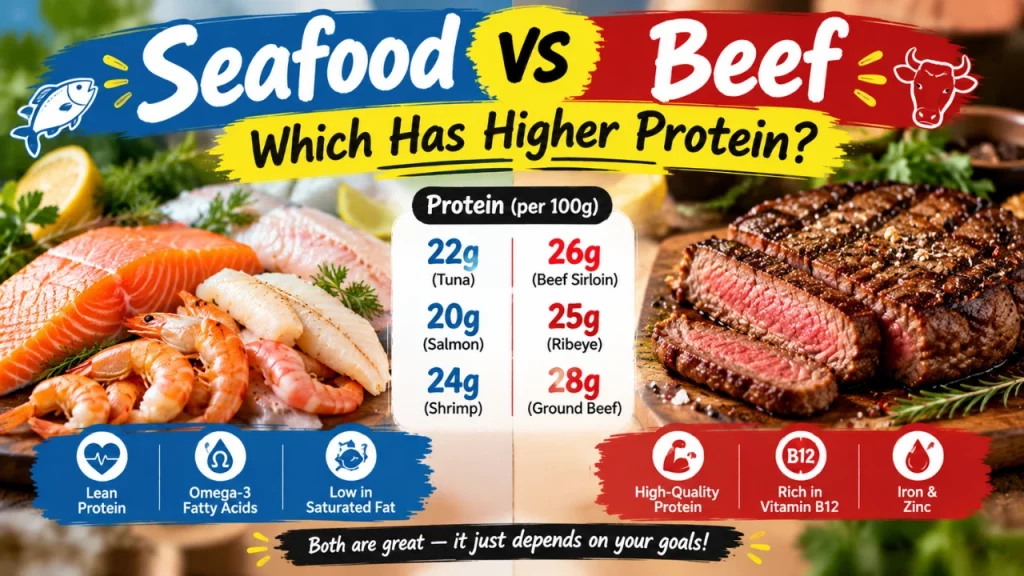
You’re standing in the grocery store with a salmon fillet in one hand and a pack of ground beef in the other. Your trainer says eat more protein. Your doctor mentioned your ferritin is low. Your partner is pregnant and googling mercury limits at 11pm. The nutrition label on both packages says roughly the same thing: about 20-26 grams of protein per 100 grams. So which one do you actually put in the cart?
The grams-per-100g answer is almost a tie, and seafood edges out beef on calories and saturated fat while beef wins on heme iron and zinc — that part’s been said elsewhere a hundred times. What actually decides this for you isn’t the label. It’s whether your body absorbs that protein and those minerals the same way, whether the fish you grabbed carries a mercury warning, and whether you’re paying double for the same gram of muscle-building power. That’s the comparison nobody runs for you.
Iron: the number on the label lies about what your body keeps
Beef’s iron is heme iron. Seafood’s iron is mostly non-heme iron. Those two forms are absorbed at wildly different rates, and that gap is bigger than almost any other nutrition difference between the two foods.
In a controlled feeding study using radiolabeled meals, researchers found that heme iron absorption came in at 15%, while non-heme iron absorption was only 7% over two weeks, with initial mucosal uptake of non-heme iron at 11% study measuring heme and non-heme iron absorption in adults. In plain terms: out of the iron sitting in your steak, your body keeps roughly double the share it keeps from the iron sitting in your shrimp or cod.
Does pairing fish with vitamin C close that gap? The same study found that adding calcium (as cheese) to a high-bioavailability meal did not change heme or non-heme iron absorption — the retention numbers held steady regardless. That doesn’t prove vitamin C is useless for non-heme iron (other mechanisms are at play there), but it’s a reminder that the absorption disadvantage of seafood’s iron is structural, not something you squeeze away by adding a side salad.
If a blood test says you’re iron-deficient or borderline anemic, this is the single biggest reason to lean toward beef over seafood, not the other benefits.
Mercury: which fish actually carry risk, and for whom
This is where seafood’s downside lives, and it’s almost entirely concentrated in a handful of large predatory species — tuna steaks, swordfish, shark, king mackerel — not the tilapia, salmon, shrimp, or canned light tuna most people actually eat most weeks.
A birth cohort study in Spain measured cord blood mercury in 554 newborns and found that babies in the highest mercury quartile weighed 143.7 grams less at birth than those in the lowest quartile, and had higher odds of being born small for gestational age in length cord blood mercury and birth size study. Interestingly, the same study found mothers eating two or more servings a week of canned tuna specifically had newborns who weighed more, not less — suggesting the fish type matters more than fish intake overall.
A separate cohort following children to age 8 found that maternal hair mercury at or above 1 microgram per gram was linked to higher risk of inattentive and impulsive/hyperactive behavior, with adjusted risk ratios of 1.4 and 1.7 compared to lower exposure ADHD-related behavior and prenatal mercury study. The median mercury level in that study population was 0.45 micrograms per gram, and over half the mothers ate more than two fish servings weekly — so most women were well under the apparent risk threshold, but the women eating the highest-mercury fish species were not.
A systematic review of 48 studies tried to pin down the lowest hair mercury concentration linked to measurable neurodevelopmental harm in children exposed prenatally systematic review on mercury exposure thresholds, concluding the evidence base is inconsistent enough that no single safe cutoff fits everyone — which is exactly why “just eat fish twice a week” advice undersells the real variable: species choice.
A broader European cohort looking at children’s metabolic and inflammatory markers also examined this fish-versus-mercury trade-off during pregnancy, reinforcing that the relationship isn’t simple nutrition math — both benefit and risk move together depending on what’s actually being eaten fish consumption, mercury exposure, and child metabolic health study.
Practical translation: pregnant women, young children, and anyone eating fish several times a week should favor salmon, sardines, shrimp, tilapia, and canned light tuna, and treat swordfish, shark, king mackerel, and tuna steaks as occasional, not routine.
Cost per gram of protein: the value question nobody runs
Ground beef is usually one of the cheapest animal proteins per pound in any grocery store, and that often makes it cheaper per gram of protein than fresh salmon, shrimp, or swordfish, which carry a premium for freshness and handling. But that flips the moment you compare beef to canned tuna, frozen tilapia, or canned sardines — all of which are typically priced closer to or below ground beef per pound, while delivering a similar protein density. So “beef is cheaper” and “seafood is cheaper” are both true statements depending on which seafood you’re picturing. If your grocery budget is tight, canned and frozen seafood options are usually the better per-gram-of-protein value than fresh cuts of either beef or fish.
Building muscle: does one beat the other?
Both lean beef and seafood are complete proteins with a full amino acid profile, and both are digested efficiently — that much is well established and not in dispute. What’s less settled is whether one triggers more muscle protein synthesis per serving than the other for athletes or older adults trying to prevent age-related muscle loss. The honest answer is that direct head-to-head research comparing beef and seafood on this specific point is thin, so be skeptical of anyone giving you a confident ranking here. What the evidence does support is that both qualify as high-quality, complete protein sources suitable for muscle maintenance goals — the bigger lever is how much you eat and how consistently, not which animal it came from.
Who should actually lean one way
If you have diagnosed iron-deficiency anemia, beef’s heme iron absorption advantage is real and meaningful. If you’re pregnant, stick to low-mercury seafood and treat swordfish and tuna steaks as rare treats, not weekly staples. If you have high cardiovascular risk, seafood’s lower saturated fat content already covered elsewhere becomes more relevant to you specifically. If you have kidney concerns, both are protein-dense and portion size matters more than which one you choose, so that’s a conversation for your care team, not a grocery aisle decision.
Quick tip: keep both in rotation rather than picking a permanent winner — beef a few times a week for the iron, low-mercury fish like salmon or canned light tuna on other days for the omega-3s, and save the swordfish and tuna steaks for special occasions rather than meal prep.
Which one do you actually reach for most, and has a health concern ever changed your answer?
Sources
- Initial uptake and absorption of nonheme iron and absorption of heme iron in humans (2002)
- Fish consumption during pregnancy, prenatal mercury exposure, and anthropometric measures at birth (2009)
- Prenatal exposure to mercury and fish consumption and ADHD-related behavior in children (2012)
- Defining a lowest observable adverse effect hair concentration of mercury: a systematic review (2009)
- Association of Fish Consumption and Mercury Exposure During Pregnancy With Metabolic Health and Inflammatory Biomarkers in Children (2020)
