Raspberries vs. Blueberries vs. Cranberries: Which Berry Is Best for Your Health?
The real question isn't which berry wins — it's how much you'd need to eat, for how long, and who shouldn't count on it at all.
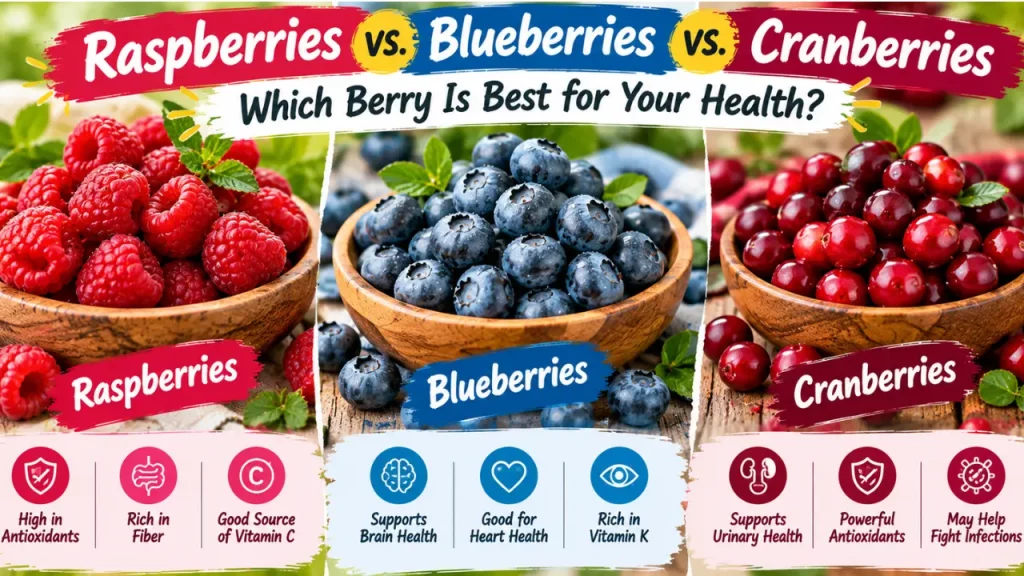
None of these three berries work at the dose most people actually eat. The studies behind the heart, brain, and urinary tract claims used specific amounts, for specific lengths of time, in specific groups of people — and a lot of those details quietly disqualify the average handful you toss on your cereal.
Raspberries, blueberries, and cranberries each get credited with a different headline benefit: raspberries for fiber with minimal sugar, blueberries for heart and brain support through anthocyanins, cranberries for urinary tract health. Those basics are true but incomplete. The real answer to “which is best” depends on what dose actually moved the needle in a trial, and whether you’re the kind of person that trial was even testing.
Step 1: Match the berry to the specific benefit you want — at the dose that was tested
For cardiometabolic and cognitive effects, the evidence points to blueberries. A randomized crossover trial on wild blueberries and postprandial outcomes gave 24 healthy adults (mean age 28) a high-carbohydrate breakfast alongside a drink containing 0, 150, 300, or 450 mg of anthocyanins. Blood glucose and insulin declined in a dose-dependent way after the meal, alongside changes in satiety and blood pressure measured over three hours, with cognitive testing done at 90 minutes. That’s a single-meal effect, not a long-term outcome — and 450 mg of anthocyanins is roughly what’s packed into a concentrated freeze-dried blueberry drink, not a casual spoonful on yogurt.
For urinary tract infections, cranberries have the longest trial history, but the picture is split by population, which Step 3 covers in detail.
Tip: if your goal is a specific outcome — fewer UTIs, better post-meal glucose — pick the berry with a matching trial, not the one with the better general reputation.
Step 2: Use the actual doses and durations from the trials, not a guess
| Study | Population | Dose | Duration | Result |
|---|---|---|---|---|
| Cranberry beverage trial | Women with recent UTI history, mean age 40.9 | 240 mL cranberry beverage/day | 24 weeks | Lower clinical UTI incidence density vs. placebo |
| Naturopathic cranberry trial | Sexually active women, 21–72 | 250 mL juice 3x/day or tablets 2x/day | 1 year | Both forms cut symptomatic UTIs by more than half |
| Nursing home capsule trial | Women 65+ in nursing homes | 72 mg proanthocyanidin/day (≈20 oz juice equivalent) | Not specified beyond trial period | No significant reduction in bacteriuria plus pyuria |
| Pediatric cranberry juice trial | Children treated for UTI | Cranberry juice daily | 6 months, 1-year follow-up | No significant difference (16% vs. 22% recurrence, P=.21) |
| Wild blueberry crossover trial | Healthy adults, mean age 28 | 150–450 mg anthocyanins in one drink | Single meal, 3-hour measurement | Dose-dependent drop in post-meal glucose and insulin |
Tip: notice that the two positive cranberry trials used daily, sustained intake over months, not a glass “when you feel a UTI coming on.”
Step 3: Know who should not rely on cranberries for UTI prevention
This is the detail most berry roundups skip. Cranberry’s UTI benefit is not universal — it clusters in one group: adult women with a history of recurrent UTIs, drinking or taking cranberry daily for months. That’s exactly the population in both the naturopathic cranberry trial and the cranberry beverage trial, both of which found real reductions in symptomatic infections.
Outside that group, the evidence weakens or disappears. In children treated for UTI, a Finnish randomized trial found cranberry juice for six months did not significantly lower recurrence. In older women living in nursing homes, a JAMA-published trial of concentrated cranberry capsules — delivering the proanthocyanidin equivalent of 20 ounces of juice daily — found no significant drop in bacteriuria plus pyuria. Neither trial tested catheter users or pregnant women directly, but the pattern is consistent enough that cranberry shouldn’t be assumed to protect every at-risk group equally.
Tip: if you’re over 65, in long-term care, pregnant, or using a catheter, don’t substitute cranberry juice or pills for medical UTI prevention — ask a clinician what’s actually been shown to work for your situation.
Step 4: Check for interactions before increasing your intake
Vitamin K content in blueberries and raspberries (covered in general nutrition breakdowns elsewhere) matters specifically if you’re on warfarin or another vitamin K antagonist — sudden, large increases in intake can blunt the drug’s effect, so consistency matters more than restriction; talk to whoever manages your anticoagulation before changing your berry habits.
People prone to calcium oxalate kidney stones should also be cautious. Berries, including cranberries and raspberries, contribute oxalates, and concentrated cranberry supplements or juice taken daily for months — the same dosing shown to help UTIs in the trials above — are a different exposure than an occasional handful of fresh fruit. If you’ve had a stone, ask a clinician before starting a daily cranberry regimen rather than assuming “natural” means risk-free.
Finally, anyone with IBS or known FODMAP sensitivity may react to the sorbitol and fructose in berries, especially in juice form or in the larger volumes used in trials (one study used 750 mL of cranberry juice a day). Bloating, gas, or diarrhea after berry-heavy days is a sorbitol/fructose response, not a sign the fruit is “bad” — it just means your dose needs to be lower than the study dose.
Tip: if you’re adding berries specifically to replicate a trial’s benefit, increase the amount gradually over a week or two rather than jumping straight to the full study dose.
Common Mistakes
- Assuming a small daily handful of any berry matches the dose used in the positive trials — several effective doses were in the 240–750 mL/day or 150–450 mg anthocyanin range, sustained for weeks to months.
- Treating cranberry as a universal UTI fix, when the strongest evidence is specific to adult women with recurrent infections, not children, older nursing home residents, or catheter users.
- Ignoring warfarin, oxalate, or FODMAP considerations because berries are marketed as uniformly “healthy.”
- Switching between juice, capsules, and whole fruit without noticing the dose equivalence — 72 mg of proanthocyanidin was described in one trial as equal to 20 ounces of juice, a volume most people never actually drink.
- Expecting a single serving to produce the cognitive or glucose effects seen in trials that measured responses meal-by-meal, not from occasional snacking.
Sources
- Cranberry juice for prevention of recurrent UTIs in children, randomized controlled trial (2012)
- Cranberry capsules and bacteriuria plus pyuria in nursing home women, randomized trial (2016)
- Naturopathic cranberry products for UTI prophylaxis, randomized trial (2002)
- Dose-dependent effects of wild blueberries on metabolic and cognitive outcomes (2026)
- Cranberry juice beverage and clinical UTI episodes in women (2016)

James Carter
The EverBBQ editorial desk — covering BBQ news, features and everything off the grill.