Pumpkin Seeds vs. Almonds vs. Walnuts: Which Offers the Most Health Benefits?
The real answer depends on your kidney history, medications, and gut — not just whose nutrient chart looks best.
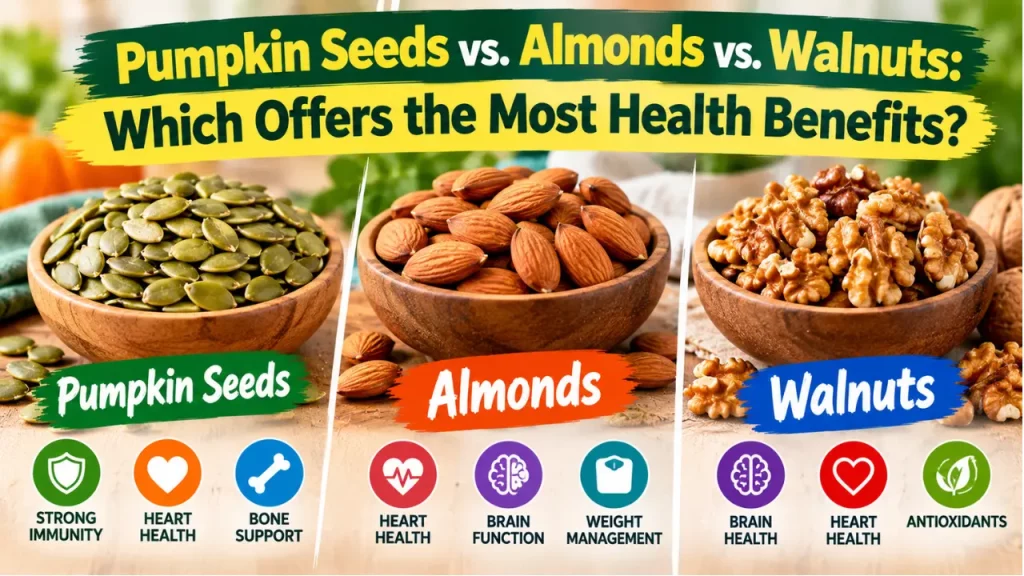
The common assumption goes like this: compare the nutrition labels, pick whichever one wins on the most lines, eat an ounce of it every day, and call it a health upgrade. The problem is that pumpkin seeds, almonds, and walnuts overlap so heavily on magnesium and “eat daily” advice that the label comparison barely matters. What actually decides which one belongs in your routine is whether it fights with a medication you take, a condition you manage, or a gut that doesn’t tolerate fiber well. That’s a different question, and almost nobody answers it.
1. There is no single winner — the question is who’s asking
Walnuts bring more omega-3 fat, almonds bring more vitamin E and fiber, and pumpkin seeds bring more protein, magnesium, and zinc per ounce — that part is settled and not really in dispute. But “most health benefits” assumes every eater has the same body. Someone with a history of kidney stones, someone on warfarin, someone with IBS, and someone simply trying to stay under a calorie target are not choosing between the same three foods at all. For them, the “best” nut or seed is the one that doesn’t quietly cancel out its own benefit.
2. Walnuts and almonds carry an oxalate load that matters for stone-prone people
Both walnuts and almonds are classed among the higher-oxalate tree nuts, which is relevant because dietary oxalate is one of the building blocks of the most common type of kidney stone. A large cross-sectional study of nearly 9,840 Iranian adults examined how closely people followed plant-based eating patterns and whether they had a history of kidney stones, and found that 16.4 percent of participants reported a history of kidney stones — a reminder of how common the condition is in a population eating a largely plant-forward diet. That study doesn’t single out almonds or walnuts specifically, and it’s observational, meaning it shows a pattern rather than proof that any one food caused a stone. But for anyone who has already passed a calcium-oxalate stone, it’s a reasonable prompt to ask a doctor or dietitian whether almonds and walnuts should be capped rather than eaten daily, while pumpkin seeds — lower in oxalate — are less likely to need that conversation.
3. Phytic acid quietly blocks mineral absorption in all three
This is the overlap nobody mentions: pumpkin seeds, almonds, and walnuts all contain phytic acid, a compound that binds to minerals like zinc, iron, and magnesium in the gut and reduces how much of them you actually absorb. That matters because the headline selling point of these foods — their magnesium and zinc content — is partly undercut by the same food carrying the compound that blocks it. Soaking, roasting, or sprouting measurably reduce phytic acid in seeds and nuts, which is why “raw and daily” isn’t automatically the optimal way to eat any of the three. If mineral status is the reason you’re eating them — say, for magnesium or zinc specifically — roasted or soaked versions get you closer to the numbers on the label than raw ones do.
4. The omega-3 math on walnuts doesn’t add up the way people assume
Walnuts are marketed hardest on omega-3s because they’re rich in alpha-linolenic acid, or ALA. The part left out is how little of that ALA the body actually turns into the long-chain omega-3s — EPA and especially DHA — that are behind most of the research on heart and brain benefits. A review of plant-based omega-3 sources notes that conversion of ALA to long-chain omega-3s in humans is limited by a rate-limiting enzyme step, meaning the ALA in walnuts doesn’t convert efficiently no matter how much you eat. A separate review of ALA supplementation studies found that ALA intake generally raises EPA levels but has no measurable effect on DHA or on overall omega-3 index. That’s a meaningful gap, because DHA is the fraction most tied to brain health; one review on omega-3s and aging notes that DHA synthesis from ALA in humans is very low, which is why researchers are cautious about claiming walnuts alone can substitute for DHA from fish. None of this erases walnuts’ ALA benefit, but it means someone eating walnuts specifically to raise brain-targeted DHA is likely not getting there through that pathway, and should know that before skipping fish or algae-based DHA entirely.
5. Blood thinners and omega-3s deserve a real conversation, not a footnote
Omega-3 fatty acids don’t just sit in cell membranes — a review on omega-3 physiology explains that EPA and DHA influence lipid-mediator generation and cell signaling once incorporated into the body’s tissue and blood pools, mechanisms that are also part of why fish oil and omega-3-rich diets are sometimes flagged for people on anticoagulant medication. Walnuts’ ALA converts only partially into that active pool, as the research above shows, so the interaction risk from walnuts alone is smaller than from fish oil capsules. Still, anyone on warfarin or another blood thinner who is adding daily walnuts on top of fish, fish oil, or flaxseed should mention it to whoever manages their prescription, rather than assuming “it’s just a nut” settles the question.
6. IBS and FODMAP sensitivity change the ranking entirely
For anyone managing irritable bowel syndrome, the nutrient scoreboard stops being the deciding factor and gut tolerance takes over. Almonds in larger portions are more likely to trigger symptoms in FODMAP-sensitive people than a small handful, because the fermentable carbohydrates that cause bloating and gas concentrate as the serving grows. Pumpkin seeds, being lower in fermentable fiber types and higher in protein and fat relative to carbohydrate, tend to be the gentler option for sensitive guts at the same ounce-for-ounce serving. Walnuts sit in between. None of this shows up on a standard nutrient comparison chart, but it’s often the deciding factor for people who’ve already learned the hard way which foods flare their symptoms.
7. What happens when you stack all three every day
The “eat them daily” advice usually treats each food in isolation, but plenty of health-conscious eaters add pumpkin seeds to breakfast, almonds as a snack, and walnuts to a salad — all on the same day. Three separate one-ounce servings is three ounces of dense fat and fiber stacked into one day’s eating, on top of whatever else is on the plate. For someone already tracking calories closely, that combination can eat up a sizable share of a daily fat allowance before dinner even starts. For someone with a sensitive gut, it’s also three overlapping fiber loads arriving at once, which raises the odds of bloating regardless of which individual food would have been fine alone.
Quick tip: if you want the benefits of all three without the overlap problems, rotate them across the week instead of eating all three daily — walnuts a few days for the ALA, pumpkin seeds on days you want more zinc and protein with a gentler gut load, almonds when fiber and vitamin E are the goal — and lean toward roasted or soaked versions when mineral absorption is the point.
- History of kidney stones: be cautious with walnuts and almonds; pumpkin seeds are the lower-oxalate choice
- Want better mineral absorption: choose roasted or soaked over raw for all three
- On blood thinners: mention daily walnut or omega-3 intake to your prescriber, especially alongside fish oil
- IBS or FODMAP-sensitive: pumpkin seeds tend to be gentlest; keep almond portions small
- Eating all three daily: treat it as three stacked servings, not three small snacks, for both calories and fiber load
The honest answer to which one offers the most health benefits is that it depends on what you’re managing, not just what’s on the nutrient label. Match the food to your medical history and your gut, and the overlap in magnesium stops being the point.
Sources
- Plant-based diet indices and kidney stones among Iranian adults (2025)
- Plant-based stearidonic acid as an omega-3 source (2021)
- ALA conversion to EPA and DHA in obesity and related diseases (2022)
- Understanding omega-3 polyunsaturated fatty acids (2009)
- Omega-3 fatty acids and brain function during aging (2006)
