Pomegranate vs Apple vs Guava: Which Fruit Has More Fiber?
Guava, pomegranate and apple don't just differ in fiber grams — they deliver different fiber types, which matters more for your gut than the number.
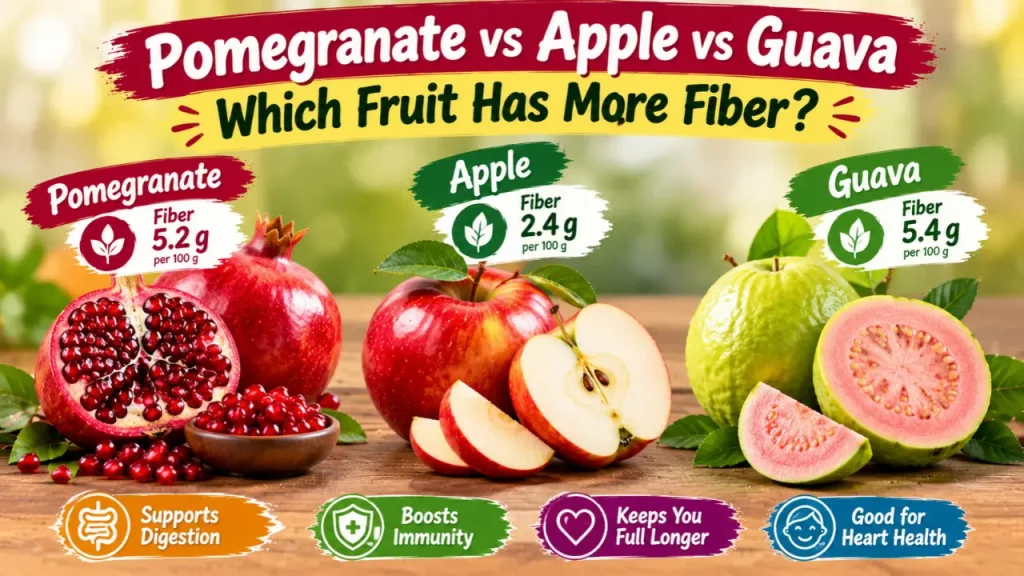
Does your gut actually care how many grams of fiber are printed on a nutrition label? Not really. A number on a chart can’t tell you whether a fruit will soften your stool, speed up a diarrhea-prone gut, spike your blood sugar, or leave you doubled over with bloating two hours later. Guava wins the raw fiber count, pomegranate hides most of its fiber in seeds you may or may not eat, and apple trails both — but none of that settles which fruit actually helps the digestive problem you’re trying to fix.
1. The headline answer, and why it’s not the useful one
If you only want the ranking: guava has the most fiber of the three, pomegranate’s fiber is concentrated almost entirely in its seeds and disappears if you drink the juice instead, and apple has the least of the three but still a respectable amount when eaten whole with the skin on. That much is settled and not really in dispute.
What’s missing from that ranking is the part that actually changes how you feel after eating. Fiber isn’t one substance. It’s a mix of soluble and insoluble types, and the ratio in each fruit — not the total gram count — determines whether it relieves constipation, irritates an already-sensitive bowel, or does almost nothing for the problem you have.
2. Soluble calms, insoluble scrubs — and your gut decides which helps
Soluble fiber dissolves into a gel in water, slows digestion, feeds gut bacteria, and tends to be gentle on an irritable system. Insoluble fiber doesn’t dissolve; it adds bulk and mechanically speeds up transit, which is exactly what a sluggish, constipated gut needs but can be exactly what an already-fast, cramping gut does not need.
Guava carries a large share of insoluble fiber, largely because of its skin and the seeds scattered through the flesh. Pomegranate’s fiber is also mostly insoluble, again concentrated in the seed coat of each aril. Apple is the outlier: its flesh contains a meaningful portion of soluble fiber (pectin), while the skin adds the insoluble portion. That structural difference is why a randomized trial comparing mixed soluble/insoluble fiber to psyllium found both approaches raised weekly bowel movements in chronically constipated adults almost identically — about 75% of people in each group responded — but a review on fiber’s role in irritable bowel syndrome notes that soluble and insoluble fiber can produce different results in IBS specifically, with insoluble fiber more likely to aggravate symptoms in some patients.
3. What one guava, one apple, and half a pomegranate actually give you
Per-100-gram comparisons look impressive on a chart, but almost nobody eats fruit by the gram. A single guava, a medium apple, and half a pomegranate are different weights entirely, so the fiber you actually swallow in one sitting doesn’t track the per-100g ranking as cleanly as it seems to. A smaller guava eaten whole, seeds included, still delivers a solid hit of mostly insoluble fiber in one go. A medium apple, skin on, spreads its fiber more evenly between soluble and insoluble. Half a pomegranate gives you fiber only in proportion to how many arils you actually chew through — spit out the seeds, and you’ve eaten mostly sugar water with flecks of pulp.
Quick tip: if constipation is your main problem, eat the fruit whole and don’t strain the seeds or skin out — insoluble fiber’s bulking effect depends on that structure staying intact, and juicing or peeling erases most of the benefit regardless of which fruit you choose.
4. When guava seeds and pomegranate arils are the wrong move
High insoluble fiber and hard seeds are a liability, not a bonus, for some guts. People with diverticulitis flare-ups, anyone recovering from bowel surgery, and a subset of people with IBS — particularly the diarrhea-predominant or pain-dominant type — are commonly advised to limit coarse, seedy, skin-heavy produce because the same bulking action that helps a constipated gut can worsen cramping, urgency, or irritation in a gut that’s already reactive. A review of dietary approaches to IBS and functional constipation points out that the foods that ease functional constipation are not interchangeable with the foods that ease IBS symptoms, and that reactions are individual enough that a blanket “eat more fiber” rule fails a meaningful share of patients.
That’s the practical takeaway for guava and pomegranate specifically: their fiber advantage is real, but it’s delivered in the form most likely to aggravate an irritated or recently-operated-on gut. Apple’s softer, more pectin-rich structure is generally the gentler starting point if you’re unsure which category you fall into.
The fiber grams on a label are the least useful number on it — what matters is whether that fiber dissolves into a soothing gel or stays rigid and scrapes through a gut that’s already inflamed.
5. Same fiber number, different blood sugar line
Two fruits can carry similar total fiber and still produce very different blood sugar responses, because fiber type and sugar structure interact. Soluble fiber’s gel slows sugar absorption into the bloodstream; insoluble fiber does much less of that job, since it passes through largely intact rather than slowing digestion. Apple’s higher soluble-fiber share gives it an edge here over guava and pomegranate, which rely more on insoluble bulk and therefore blunt sugar spikes less, gram for gram.
This is also where seeds and arils matter again: chewing through pomegranate seeds, rather than swallowing juice, keeps that fiber attached to the sugar as it digests, moderating the rise rather than letting sugar hit the bloodstream unaccompanied.
6. The apple’s hidden ingredient: sorbitol and fructans
Apple has the best fiber reputation of the three, but it also carries sorbitol and fructans — carbohydrates that ferment in the gut and are a well-documented trigger of bloating, gas, and cramping in sensitive people, independent of fiber content entirely. A validation study using a food and symptom diary in people with IBS was built specifically around tracking fiber and fermentable carbohydrate intake against gut symptoms, underscoring that these two factors are tracked separately for a reason: a food can be fiber-rich and still provoke symptoms through an entirely different mechanism. If apples reliably leave you bloated despite their “healthy” label, the sorbitol and fructans, not the fiber, are the more likely culprit.
7. So which fruit actually fits your problem
For plain, uncomplicated constipation, especially in older adults, the research supports simply getting enough total fiber and fluid in the diet — a cross-sectional study of dietary intake and constipation in elderly adults found that people with functional constipation consistently ate less soluble fiber, less insoluble fiber, and less fluid than those without it, regardless of which fruit supplied it. In that case, guava’s density of mostly insoluble fiber, eaten whole, is a reasonable first choice.
For IBS, diverticulitis recovery, or any gut that reacts badly to roughage, apple — peeled if sorbitol is a known trigger, unpeeled if it isn’t — is the safer starting point, with pomegranate seeds used sparingly and guava seeds avoided or strained out. For blood sugar control, apple’s pectin again edges ahead of the other two’s insoluble bulk. There is no single winner here; there’s only the fruit whose fiber type matches the gut problem you’re actually trying to solve.
Sources
- Randomised clinical trial: mixed soluble/insoluble fibre vs. psyllium for chronic constipation (2016)
- Specific foods can reduce symptoms of irritable bowel syndrome and functional constipation: a review (2019)
- The role of fiber in the treatment of irritable bowel syndrome (2006)
- Functional Constipation in Elderly and Related Determinant Risk Factors (2023)
- Measuring Diet Intake and Gastrointestinal Symptoms in Irritable Bowel Syndrome (2019)

James Carter
The EverBBQ editorial desk — covering BBQ news, features and everything off the grill.