Peanuts vs Brazil Nuts vs Macadamia Nuts vs Cashews: Which Is Healthiest?
The "healthiest nut" question has no single answer — it depends on your cholesterol, blood sugar, allergy history, or kidney risk.
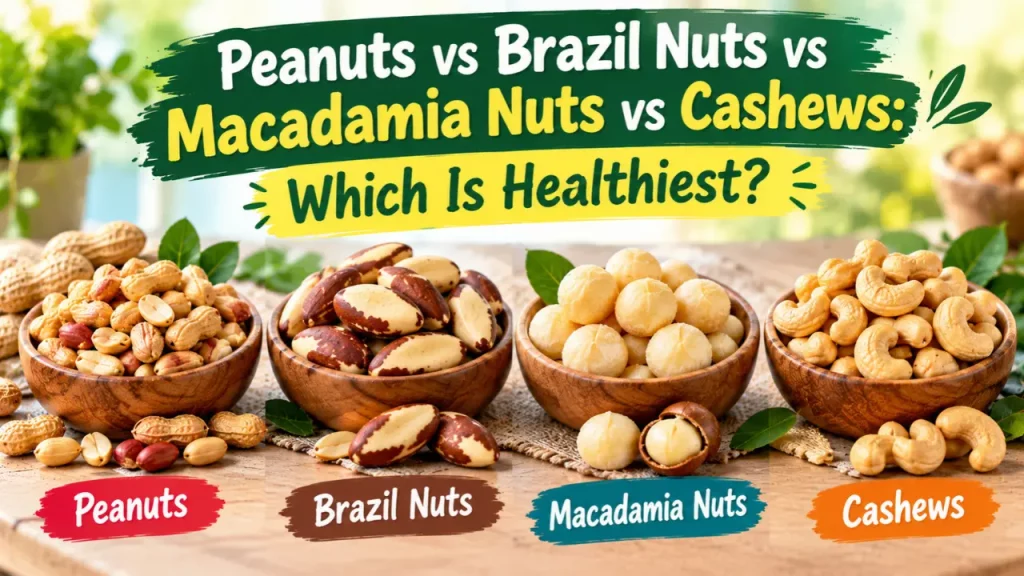
Most people assume that if they have a peanut allergy, switching to “real” tree nuts like cashews or Brazil nuts is a safe workaround, since peanuts are technically a legume. That assumption is exactly where this gets complicated, because the immune system does not always respect botanical categories. Whether peanuts, Brazil nuts, macadamias, or cashews are the “healthiest” choice for you depends far less on a generic ranking and much more on what you’re actually trying to manage: cholesterol, blood sugar, weight, a nut allergy, or a kidney stone history.
1. The quick answer: match the nut to the goal, not a leaderboard
There is no single winner because each of these four nuts solves a different problem. Peanuts and cashews are the practical, budget-friendly options for most healthy eaters. Macadamias make sense almost exclusively for people deliberately chasing a high-fat, low-carb eating pattern. Brazil nuts are powerful in tiny doses and risky in large ones. And for anyone with an existing nut allergy, the entire conversation changes, because the allergy risk can outweigh every nutritional advantage. The sections below walk through each specific situation rather than crowning one nut as universally best.
2. If you have a peanut allergy: the other three are not automatically safe
Peanut allergy and tree nut allergy are clinically separate conditions, but a large share of peanut-allergic people also react to tree nuts, and researchers have spent two decades trying to explain why. One line of research found that the major peanut allergen Ara h 2 shares enough structural similarity with proteins in almond and Brazil nut that serum from peanut-allergic patients bound to Brazil nut and almond proteins in laboratory testing, and that pre-treating the serum with Brazil nut extract reduced binding to the peanut allergen itself — direct lab evidence of shared, not just coincidental, reactivity.
A separate study went looking for the exact peptide sequences responsible and found that a protein in walnut, structurally similar to peanut’s Ara h 2, bound IgE antibodies from patients who reacted to walnut, peanut, or both. A broader investigation using western blotting and ELISA testing on peanut- and tree-nut-allergic patients found IgE reactivity to peanut, almond, Brazil nut, hazelnut, and cashew extracts, with cross-inhibition confirming the allergens overlap rather than simply co-existing. For cashews specifically, more recent peptide-mapping work identified shared epitope patterns between peanut and cashew proteins that bound IgE in patients allergic to both. None of this proves every peanut-allergic person will react to cashews or Brazil nuts — but it explains, at the protein level, why so many do, and why self-testing tree nuts at home without medical supervision is a real gamble rather than a reasonable shortcut.
3. If you have a tree nut allergy: cashew and macadamia deserve special caution
Macadamia is botanically and clinically classified as a tree nut, which matters because tree nut allergies rarely resolve on their own. A clinical review on allergen homology found that tree nut allergies are outgrown in fewer than 10% of cases, unlike many childhood food allergies, and noted that cashew and pistachio show particularly strong cross-reactivity with each other. Because the clinical overlap between individual tree nuts — including macadamia, which is less studied than walnut or cashew — remains incompletely mapped, the same review states that the standard medical guideline is to avoid all tree nuts once any single tree nut allergy is confirmed, rather than testing which ones are “safe” through trial and error.
4. If you’re tracking selenium or thyroid health: do the Brazil nut math
Brazil nuts are in a nutritional category of their own because their selenium content is not just higher than the other three nuts, it is dramatically higher, often by a factor of ten or more per ounce, and selenium content varies substantially depending on the soil the tree grew in. That variability matters because selenium has a narrow safety window: the commonly cited tolerable upper intake level for adults sits around 400 micrograms a day, and a small daily habit of several Brazil nuts can push some people toward or past that ceiling, particularly if they also take a multivitamin or selenium supplement. Reported symptoms of excess intake include hair and nail brittleness, nausea, fatigue, and a metallic taste. For pregnant women and people with thyroid conditions, where selenium plays a direct role in thyroid hormone metabolism, this is precisely the nut that warrants portion discipline rather than daily handfuls — peanuts, macadamias, and cashews carry no comparable selenium ceiling.
5. If you’re managing cholesterol or blood sugar: there’s no shortcut comparison to lean on
This is the gap nobody likes to admit: there is no large clinical trial directly pitting peanuts, Brazil nuts, macadamias, and cashews against each other on LDL cholesterol or post-meal glucose response. What does exist is basic fat chemistry. Macadamias lean heavily monounsaturated, the fat type most consistently linked to healthier LDL profiles in broader nutrition research; cashews carry more starch-like carbohydrate per serving than the other three, which matters more for blood sugar control than fat content does; peanuts fall in between. Until head-to-head human trials on these specific four nuts exist, the honest answer for someone managing cholesterol or diabetes is to treat portion size and what the nut replaces in the diet as more decisive than which of these four you pick.
6. If you’re prone to kidney stones or histamine sensitivity: watch cashews and peanuts
Nuts in general sit on the higher end of plant oxalate content, which matters for anyone with a history of calcium-oxalate kidney stones. Among this group, cashews and peanuts are typically flagged by renal dietitians as the higher-oxalate choices, with macadamias generally considered the gentler option for stone-formers. For histamine-sensitive readers, nuts are not a major histamine source the way aged cheese or cured meat is, so this concern is usually smaller than the oxalate one — but anyone with both kidney stone history and a reaction to high-oxalate foods should treat cashews and peanuts as the nuts to limit, not eliminate entirely.
7. Does roasting change the health math?
Beyond the sodium concern already well known, direct comparative research on how roasting affects antioxidant retention or acrylamide formation across these four specific nuts is limited. What’s established more broadly is that high-heat roasting can reduce certain heat-sensitive antioxidant compounds and can generate small amounts of acrylamide, a compound of concern at high exposure levels, in starchier roasted foods generally. Dry-roasting at lower temperatures and shorter times is the safer middle ground if you want the flavor without maximizing that trade-off.
The real decision isn’t which nut ranks highest overall — it’s which single risk factor in your own health profile that nut either soothes or aggravates.
- Peanut allergy does not guarantee safety with Brazil nuts, almonds, or cashews — shared protein structures cause real cross-reactivity in lab testing.
- One tree nut allergy diagnosis means medical guidelines favor avoiding all tree nuts, including macadamia and cashew, not just the one tested.
- Brazil nuts’ selenium load is the one genuine overdose risk among these four, relevant especially in pregnancy and thyroid conditions.
- No existing trial directly compares these four nuts on cholesterol or blood sugar, so portion control matters more than the brand of nut.
- Cashews and peanuts carry more oxalate concern for kidney stone formers; macadamias are the gentler pick there.
The nut aisle doesn’t need a single champion. It needs a reader who knows which of these five questions applies to them.
Sources
