Peanut Butter vs Almond Butter vs Whole Almonds: Which Is Healthier?
A decision framework for weight loss, kidney stones, cholesterol, and blood sugar — based on actual human trials, not another nutrient chart.
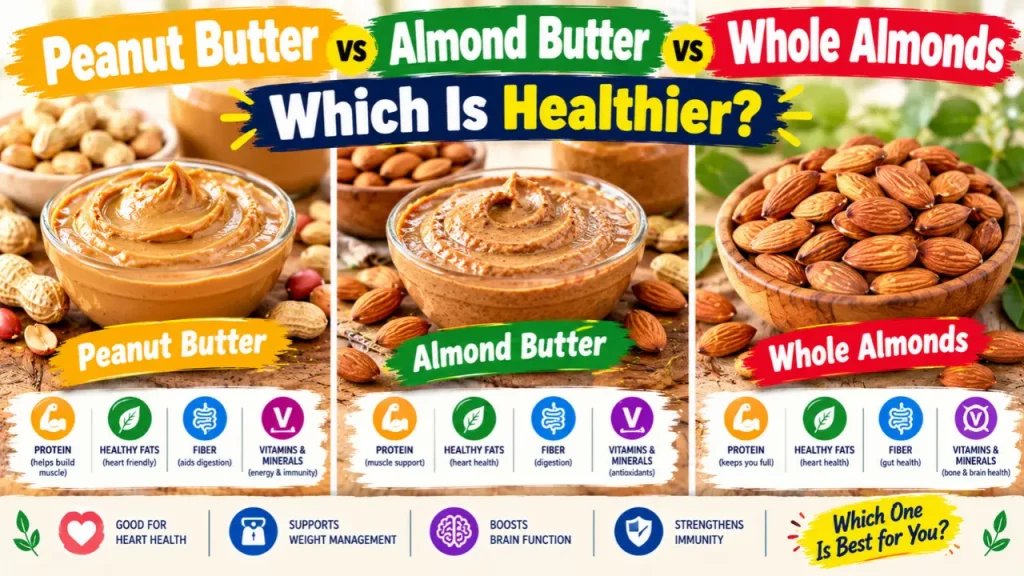
Two jars sit open on the counter, knives sticking out of each like tiny flags. One is a smooth beige, the other flecked and slightly darker. Your spoon hovers between them while your brain runs through everything you’ve half-read: aflatoxin in peanuts, oxalates in almonds, “healthy fats” that somehow still show up on your hips. None of that tells you which jar to actually close and put back in the cupboard. The answer depends less on the nut and more on you — your kidneys, your cholesterol, your waistline, your blood sugar.
1. The short answer, before the details
For most healthy adults, peanut butter and almond butter are close enough nutritionally that the deciding factor should be your specific health profile, not a vague sense that almonds are “fancier.” If you have a history of calcium-oxalate kidney stones, almond butter is the one to limit. If you’re managing LDL cholesterol or inflammation, the human evidence supports both peanuts and tree nuts almost equally. If weight loss and appetite control are your goal, whole almonds (or any whole nut eaten in a measured portion) outperform a spoonable butter simply because they’re harder to overeat. Aflatoxin, the thing peanut-butter skeptics bring up most, turns out to be the weakest argument in the whole debate — more on that below.
2. Aflatoxin: a real contaminant, but not the deciding factor
Aflatoxin is a mold toxin that can contaminate peanuts, and it’s a legitimate food-safety issue that regulators actively monitor and limit in commercial peanut butter. But “a contaminant exists” and “this changes your health outcome if you eat peanut butter a few times a week” are two different claims, and the second one needs a study, not a scare headline. None of the controlled human trials on peanut and nut consumption point to aflatoxin exposure from regulated, store-bought peanut butter as a driver of disease risk in the way it’s sometimes implied in marketing for alternatives like almond butter. The strongest human evidence we actually have on peanuts versus tree nuts is about cardiovascular outcomes, not toxin exposure — and on that front, peanuts hold their own (see section 5). Treat aflatoxin as a reason to buy from reputable brands and avoid old, discolored, or bulk-bin peanut products, not as a reason to abandon peanut butter altogether.
3. Kidney stones: the oxalate concern is specific, not generic
This is the gap almond-butter fans don’t want to hear about. Almonds are a genuinely high-oxalate food, and oxalate is the main building block of the most common type of kidney stone. A study measuring oxalate content across plant-based milk alternatives found that almond milk had the highest oxalate concentration of all the milks tested, higher than cashew, hazelnut, soy, rice, or dairy milk. Almond milk is a diluted product — a spoonful of almond butter or a handful of whole almonds delivers a far more concentrated dose of the same oxalate load.
For someone with no history of kidney stones, this likely isn’t a concern worth losing sleep over. But if you’ve ever passed a calcium-oxalate stone, or your doctor has specifically put you on a low-oxalate diet, almond butter is not the “safe, clean” choice it’s often marketed as — it may work against you. Peanut butter and peanuts are comparatively low in oxalate and are a more sensible nut-based protein source for that specific population.
4. Weight loss and satiety: the whole nut wins, not the brand of butter
Calorie-for-calorie charts make peanut butter and almond butter look like a tie, but satiety studies are where a real difference shows up — and it’s not about peanuts versus almonds, it’s about whole versus processed. In a 12-week randomized trial, overweight adults on a calorie-restricted diet who ate 1.5 oz of mixed tree nuts daily had a dropout rate of just 16.4%, compared with 35.9% in the group eating an equal-calorie pretzel snack, and the nut group lost a meaningful amount of weight while reporting greater satiety in a 2021 weight-loss and maintenance trial. A separate 8-week randomized trial in women at cardiometabolic risk tested a nut-enriched breakfast against a nut-free one and found the nut-containing meal was associated with reduced hunger ratings over several hours after eating, in a small study of 28 women published as the Brazilian Nuts Study.
Neither trial isolated peanut butter against almond butter specifically, so don’t expect a precise head-to-head number here — this is an honest gap in the evidence. But the pattern is consistent: whole, chewable nuts that require effort to eat produce better appetite control than a smooth spread you can eat by the spoonful without noticing. If weight management is your main goal, whole almonds or whole peanuts beat either butter, mostly because portioning yourself out of a jar is far easier to lose track of.
5. Cholesterol and inflammation: peanuts are not the lesser nut here
This is where the “almonds are healthier” narrative falls apart under its own weight. A review of epidemiologic and clinical trial evidence on tree nuts and peanuts together found that people in the highest nut-intake group had about a 35% lower risk of coronary heart disease incidence compared to the lowest intake group, based on a pooled analysis of four U.S. epidemiologic studies reviewed in a 2008 Journal of Nutrition paper. That same review notes the LDL-cholesterol-lowering effect seen in clinical nut and peanut studies was larger than what would be predicted just from the change in dietary fatty acid profile — suggesting peanuts and tree nuts both bring something extra to the table beyond “good fats,” and the review treats peanuts as an equal partner to tree nuts throughout, not an inferior substitute.
On inflammation and cardiovascular signaling, a smaller mechanistic study following the same tree-nut trial population found that mixed nut consumption altered tryptophan metabolism — a pathway linked to cardiovascular disease — alongside decreased heart rate and increased satiety in a 2022 gut microbiota study. This evidence again doesn’t separate peanuts from almonds specifically, but it undercuts the idea that almond butter has some unique inflammation-fighting edge peanut butter lacks.
6. Blood sugar and insulin resistance: an honest gap
If you were hoping for a clean answer here, there isn’t one in the available human evidence comparing peanut butter directly against almond butter on post-meal blood sugar response. What we can say with confidence is structural: both are low in carbohydrate and high in fat and fiber relative to a slice of bread or a cracker, which generally blunts a glucose spike regardless of which nut it came from. If you have insulin resistance or diabetes, the bigger risk factor in either jar is added sugar or inflated serving sizes, not the base nut — which is also why label-reading (already common advice) matters more here than the peanut-versus-almond question itself.
7. Match the nut to your profile
| Your situation | Better pick | Why |
|---|---|---|
| History of kidney stones | Peanut butter | Lower oxalate load than almond-based products |
| Weight loss / appetite control | Whole almonds or whole peanuts | Whole nuts showed higher satiety and lower dropout in diet trials than processed snack forms |
| LDL cholesterol / heart health | Either | Pooled studies show comparable CHD risk reduction for peanuts and tree nuts |
| General inflammation concern | Either | Evidence covers nuts broadly, not almond-specific superiority |
| Diabetes / insulin resistance | Either, watch added sugar | No dedicated comparative trial exists; label matters more than nut type |
None of this requires abandoning either jar. The peanut-allergy-versus-tree-nut-allergy distinction, the near-identical calorie counts, and almond butter’s edge in vitamin E, calcium, and magnesium are all real and already well covered elsewhere — they just aren’t the deciding factors for most people. What actually moves the needle is whether you’ve ever had a kidney stone, what your cholesterol panel looks like, and whether you can trust yourself with a spoon versus a handful. Pick for your body, not for the jar’s marketing copy.
Sources
- Including Mixed Tree Nut Snacks in a Weight Loss and Weight Maintenance Intervention Resulted in Weight Loss and Increased Satiety (2021)
- The role of tree nuts and peanuts in the prevention of coronary heart disease: multiple potential mechanisms (2008)
- Nut-enriched energy restricted diet has potential to decrease hunger in women at cardiometabolic risk (2023)
- Plant-Based Milk Alternatives and Risk Factors for Kidney Stones and Chronic Kidney Disease (2022)
- Mixed Nuts as Healthy Snack: Effect on Gut Microbiota and Tryptophan Metabolism (2022)

Tom Fletcher
The latest from the Australian and global BBQ scene — comps, cooks and culture.