Mung Bean Sprouts vs. Lentil Sprouts vs. Chickpea Sprouts: Which Has the Most Protein?
Per-100g rankings flip once you do the math per serving, per calorie, and per gram your body can actually absorb.
There’s a woman standing at her kitchen counter with three mason jars of sprouts, a food scale, and her phone’s calculator app open. She’s trying to figure out which jar is actually worth eating if her goal is hitting 100 grams of protein a day. Every article she’s found gives her a different “winner,” all based on the same flawed question: which sprout has the most protein per 100 grams. She wants to know which one actually moves her daily number. That’s a different question, and almost nobody answers it.
Myth: The sprout with the highest protein per 100g is obviously the best protein source
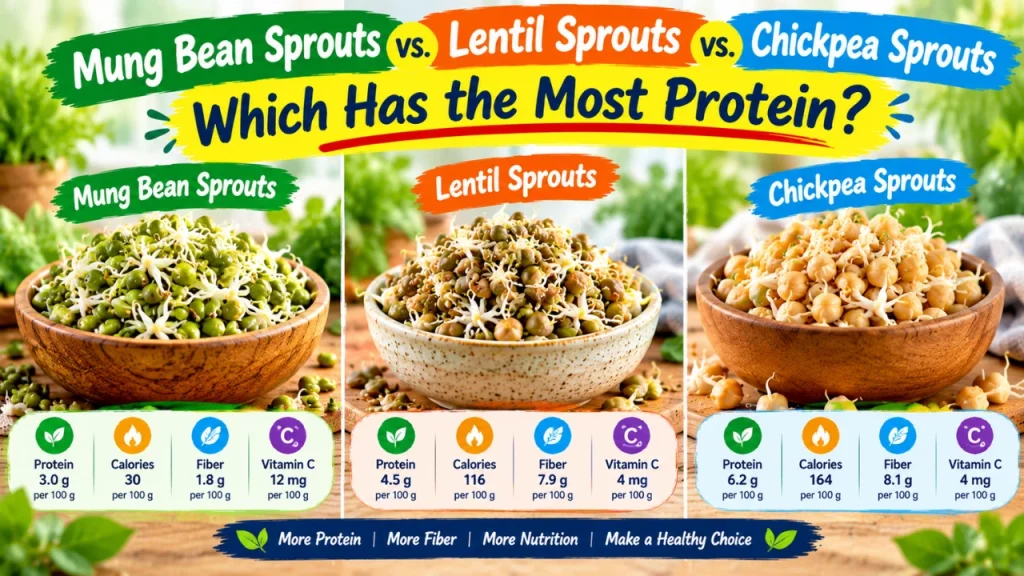
Per-100g numbers are the default in every database and every article, but 100 grams isn’t a meaningful portion unless you’re weighing out servings with a kitchen scale every time. More importantly, 100 grams of a low-calorie sprout and 100 grams of a calorie-dense one aren’t nutritionally equivalent — one fills more of your calorie budget to deliver that protein. Typical U.S. nutrition database figures for raw sprouts look something like this:
| Sprout (raw) | Protein per 100g | Calories per 100g | Protein per 100 kcal |
|---|---|---|---|
| Mung bean | ~3.0 g | ~30 kcal | ~10.0 g |
| Lentil | ~9.0 g | ~106 kcal | ~8.5 g |
| Chickpea | ~6–9 g (wide variance) | ~160–180 kcal | ~4–5 g |
Lentil sprouts win on raw protein grams, roughly triple mung bean’s number. But once you divide by calories, mung bean sprouts quietly pull ahead, because they’re also the least calorie-dense of the three. Chickpea sprouts, despite sometimes reporting protein numbers close to lentils, fall furthest behind per calorie — their higher fat and carbohydrate content dilutes the protein payoff. If your real constraint is a daily calorie budget rather than a daily volume of food, mung bean sprouts deliver more protein for every calorie spent, even though they look like the “weakest” option per 100 grams.
The sprout that wins depends entirely on whether you’re counting grams of food, grams of calories, or grams your digestive system can actually use — and those three contests have three different winners.
Myth: Lab-tested “crude protein” and the grams on a nutrition label are the same number
If you’ve seen lab reports listing sprout “crude protein” at something like 1.6% to 4.1%, while nutrition databases list 3 to 9 grams per 100 grams for the same legumes, it looks like someone made an error. They didn’t — they’re measuring different things, on different bases. Crude protein assays typically measure total nitrogen in a fresh (wet) sample and multiply by a conversion factor, and the result is extremely sensitive to how much water is still in the sample, which cultivar was tested, and which conversion factor the lab chose. Nutrition-label values are compiled from standardized food composition databases built from many samples at a defined moisture point, which smooths out a lot of that batch-to-batch noise. Neither number is “wrong”; they’re answering different questions — a snapshot of one lab sample’s nitrogen content versus a standardized average meant for meal planning. This is also why chickpea sprouts, specifically, show the widest spread of reported protein values: their sprouting time, bean size, and moisture at testing vary more between sources than mung bean or lentil sprouts do.
Myth: If a sprout has more protein grams, your body absorbs more protein
Grams on a label describe protein quantity, not usability. A small, early study that heat-treated germinated soybean, lupin, and black bean — not the exact three sprouts in this article, but the same family of germinated legumes — found that a study on heat treatment of germinated legume seeds raised net protein utilization by 20% after cooking, specifically in germinated soybean and lupin. Raw germinated legumes still carry trypsin inhibitors, compounds that block the enzymes your gut uses to break protein down, and heat treatment completely inactivated them. Notably, the actual proximate protein content and amino acid profile didn’t change with heat — the grams stayed the same, but how much of those grams your body could extract and use went up. A separate review of sprouting across cereals and legumes found that a review on sprouting, phytate, and nutrient bioaccessibility links protein digestibility to phytate reduction, since phytate also interferes with protein breakdown — though the review notes this effect is smaller and less consistent than phytate’s well-established effect on mineral absorption. Put together: sprouting itself improves digestibility somewhat versus the dry, un-sprouted bean, but cooking the sprout afterward is what does most of the heavy lifting on making that protein usable.
Myth: Cooking sprouts destroys their protein
This is backward in most cases. In the same heat-treatment study, total protein, amino acids, and minerals did not change with cooking — what changed was digestibility and, in soybean specifically, true protein digestibility itself increased after heat treatment. Utilizable protein after heat treatment was measured at 289 grams per kilogram of dry weight for germinated soybean, 236 g/kg for lupin, and 132 g/kg for black bean — meaningful differences between legume species, even when raw protein content looked similar on paper. No study in this area has precisely measured how much protein specifically leaches out of mung bean, lentil, or chickpea sprouts when boiled in a large volume of water and drained. Given that some water-soluble compounds are known to leach out during boiling of legumes generally, the safer practical move is to steam or stir-fry sprouts in minimal liquid rather than boil-and-drain, so you’re not pouring part of your protein serving down the sink along with the cooking water.
Myth: Any of these sprouts can replace real protein sources in your diet
For someone tracking a specific daily protein target, none of these three sprouts should be doing the heavy lifting on their own. Even lentil sprouts, the strongest of the three, deliver single-digit grams of protein per 100 grams of food — you’d need a large volume to match what a few ounces of legumes, eggs, or meat provide in a

Mick Hudson
Low-and-slow recipes, rubs, sauces and fire management from our pitmaster team.