Multigrain vs Whole Grain vs Whole Wheat Bread: Which Loaf Is Really Healthier?
Real fiber, sodium, and risk-ratio numbers show which bread actually helps blood sugar, weight, and heart health — and who should skip it.
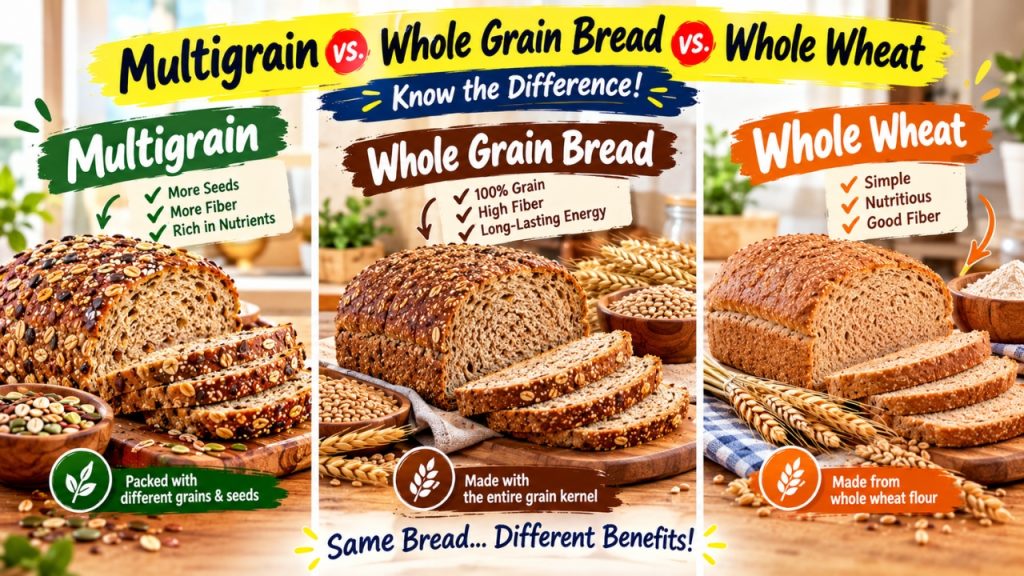
You’re standing at the kitchen counter with three bags lined up — a seeded multigrain loaf, a plain whole wheat sandwich bread, and a dense whole grain boule you bought because it looked virtuous. Your doctor mentioned your fasting glucose was creeping up. Your partner is trying to drop a few pounds. Somebody in the house gets stomach cramps after sandwiches and nobody’s figured out why. All three loaves claim to be the “healthy” one. Only one of them is actually right for what’s happening at your table this week.
The honest answer is that no single loaf wins outright — whole grain bread has the strongest evidence for heart and metabolic health, but the right choice depends on whether your goal is blood sugar, weight, heart disease, or just tolerating bread at all.
What’s Actually on the Nutrition Panel
Per a typical 28 gram (1 oz) slice, white bread runs about 75 calories, 0.8 grams of fiber, and 150 milligrams of sodium. A standard whole wheat slice of the same weight comes in lower on calories, around 69, but roughly double the fiber at close to 2 grams, with sodium similar or slightly lower, around 130 milligrams. Multigrain bread’s numbers vary more by brand because “multigrain” only promises several types of grain, not that they’re intact or whole — some multigrain loaves match whole wheat almost gram for gram, others are closer to white bread with seeds scattered on top for appearance. That inconsistency is the one label issue worth a passing mention here; the rest of this comes down to what the grain actually does inside your body.
The Blood Sugar Question
Multigrain bread has a reputation for being gentler on blood sugar than whole wheat, but the research doesn’t back a clean, large difference between the two. A Spanish cohort of more than 9,000 university graduates, tracked for an average of five years, found no significant association between dietary glycemic index or glycemic load and weight change, and — more importantly for the blood sugar question — no statistically significant link between whole grain bread and the metabolic outcomes measured, while white bread consumption of two or more portions a day was tied to a 40% higher risk of becoming overweight or obese compared with eating it once a week or less (SUN project cohort study). What does move the needle on blood sugar long-term isn’t a brand label but intact grain structure: bread made with coarser, less processed grain digests more slowly because the fiber matrix is still largely intact, regardless of whether the bag says multigrain or whole wheat. In a separate analysis following over 194,000 people across three long-running US cohorts for up to three decades, those eating the most total whole grain foods had a 29% lower rate of developing type 2 diabetes than those eating the least, a gap with a tight confidence interval of 26% to 33% (Nurses’ Health and Health Professionals Follow-Up Study analysis). The takeaway: the whole grain claim matters far more for blood sugar than the multigrain claim does.
What Cardiologists Actually Look For
Cardiology-focused nutrition guidance generally settles on three numbers per slice: sodium under roughly 140 milligrams, fiber at 3 grams or more, and no partially hydrogenated oils listed regardless of grain type. The reason fiber gets weighted so heavily shows up in the data. A dose-response meta-analysis pooling 45 prospective studies found that each additional 90 grams of whole grain eaten daily — about two slices of whole grain bread plus a bowl of cereal — was linked to a 19% lower risk of coronary heart disease and a 22% lower risk of cardiovascular disease overall (BMJ dose-response meta-analysis). A separate review ranking dietary components by strength of evidence found whole grain bread specifically associated with a 15% lower risk of all-cause mortality, a very similar protective size to oatmeal (review of dietary components and mortality). And in a cross-sectional study of nearly 20,000 Dutch adults, a “refined foods” eating pattern built around white bread, fries, and sugary drinks tracked with a worse cardiovascular risk profile than patterns built around whole grain bread and vegetables (Dutch population food pattern study). None of this distinguishes multigrain from whole wheat specifically — it distinguishes whole grain, in any form, from refined white flour.
Can You Actually Eat It Every Day?
For most people, yes, and the cohort data above is built on people doing exactly that for years. But daily bread does add up in ways worth tracking rather than ignoring. Two slices of a typical whole grain loaf can contribute 250 to 300 milligrams of sodium before you’ve added anything else to the sandwich, which matters if you’re managing hypertension and watching a daily sodium ceiling. Whole grains also carry phytic acid, a compound that can mildly reduce absorption of iron and zinc from the same meal — a real effect in nutrition science, though one mostly relevant to people with marginal mineral intake rather than the average bread eater. And wheat-based breads, whole grain or not, contain fructans, a type of fermentable carbohydrate that triggers bloating and cramping in people sensitive to FODMAPs, independent of how virtuous the grain is.
The Weight Loss Verdict
If weight is the goal, the clearest signal in the evidence isn’t about fiber grams on a label, it’s about what you’re replacing. In the Spanish cohort, people eating two or more servings of white bread daily had that 40% higher odds of becoming overweight or obese, while whole grain bread eaters showed no such increased risk across the same follow-up period (SUN project cohort study). That’s a population-level association, not proof that switching your lunch bread alone will shift the scale, but it’s a meaningfully different outcome between the two breads, not a rounding error. Whole wheat and genuinely whole-grain multigrain perform similarly here; the real split in the data is refined versus whole, not whole wheat versus multigrain.
Who Should Skip Even the “Best” Loaf
None of this makes whole grain bread universal. People with diagnosed IBS or confirmed fructan sensitivity often do better on sourdough or low-FODMAP bread, where fermentation partially breaks down the troublesome carbohydrates, even though a label scan would rank it below a seeded whole grain loaf. People with advanced kidney disease or tightly managed hypertension may need to count bread’s sodium contribution the same way they count a can of soup. And some individuals simply show a bigger post-meal glucose rise on certain whole grain breads than on others for reasons tied to their own gut and metabolism rather than the ingredient list — which is why clinicians increasingly suggest checking your own response rather than assuming the healthiest-looking loaf is automatically the healthiest one for you.
Back to the Counter
Standing in front of those three bags again, the decision isn’t really multigrain versus whole wheat versus whole grain as categories — it’s matching what the research actually shows to what’s happening in your body. Watching blood sugar or trying to cut heart disease risk, the whole grain loaf with real fiber numbers on the label wins, consistently, across multiple large studies. Trying to lose weight, the fight that matters is whole grain against white, not whole wheat against multigrain. And if bread never agrees with you no matter how virtuous it looks, the healthiest loaf might be the one with less grain structure left in it, not more. Read the panel, but read it for your goal, not for the word in bold on the front of the bag.
Sources
- Whole grain consumption and risk of cardiovascular disease, cancer, and mortality (BMJ, 2016)
- Intake of whole grain foods and risk of type 2 diabetes (BMJ, 2020)
- Patterns of food consumption and cardiovascular risk factors in the Dutch population (American Journal of Clinical Nutrition, 2003)
- Dietary components and risk of cardiovascular disease and all-cause mortality (European Journal of Preventive Cardiology, 2019)
- Glycemic load, glycemic index, bread and overweight/obesity — the SUN project (BMC Public Health, 2014)

Mick Hudson
Low-and-slow recipes, rubs, sauces and fire management from our pitmaster team.