Mountain Dew Pitch Black Returns With a Bold Citrus-Grape Flavour!
Pitch Black isn't new, the October/November dates aren't really in conflict, and here's what still isn't known about caffeine and sugar.
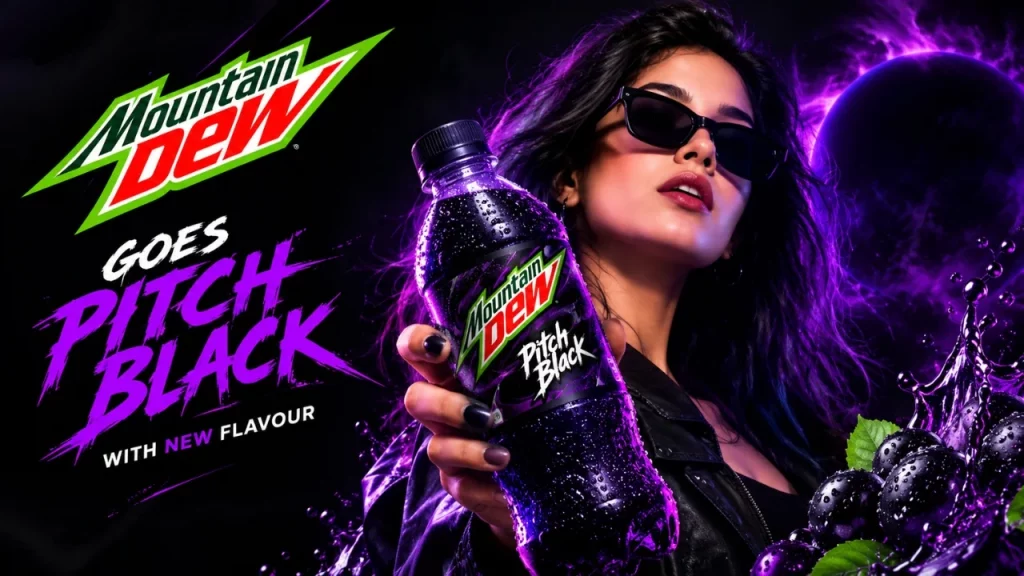
A delivery driver wheels a trolley stacked with black-and-purple cases into the chiller aisle of a small independent shop, the kind that still has a hand-written “new in” sign taped to the fridge door. A shopkeeper peels back the cardboard, lines up a few bottles under the strip lighting, and within the hour a regular customer is holding one up to the light, squinting at the inky purple liquid and asking the obvious question: didn’t this already exist?
It did. That’s the part almost nobody buying Mountain Dew Pitch Black this autumn actually knows, and it changes how you should read every headline about its “return.”
What does “Mountain Dew Pitch Black Returns” actually mean?
It means the flavour is coming to UK shelves after a period of not being stocked here, not that it is making its worldwide debut. The citrus-grape taste, the near-black colour, the space-themed packaging designed to stand out under convenience-store lighting — all of that is being introduced as new to British shoppers, even though the name and concept have a longer history elsewhere. For a UK audience that has never seen it before, “new” is a fair description. For anyone who has spent time in the United States, or who has followed Mountain Dew’s limited-edition flavours online, “returns” is the more accurate word, and it’s doing real work in that headline.
Is Pitch Black actually a new flavour, or has it existed before?
Pitch Black is not a new idea — it is a flavour PepsiCo has run in the US market on and off for years, typically as a Halloween-season special edition built around a dark grape-and-citrus profile and black colouring designed to look suitably eerie on shelf. It has appeared, sold through a season, and then vanished from shelves, only to reappear again in a later year, sometimes with small tweaks to the exact flavour balance or the can and bottle art. That pattern — launch, sell through autumn, pull, relaunch later — is exactly why “returns” is the correct framing rather than “launches.”
Was Pitch Black discontinued, and could it disappear again?
Yes, in the sense that matters to shoppers: it is not a permanent, always-on-shelf flavour, it is a seasonal one that gets pulled after its run and brought back later rather than staying in continuous production. That’s standard practice for limited-edition soft drink flavours tied to a season like Halloween, where scarcity is part of the marketing. So if you see Pitch Black vanish from your local shop again in a few months, that is the flavour behaving exactly as it always has, not a sign something has gone wrong with the product or the brand. Whether it returns again in a future year — 2026 or beyond — isn’t something any retailer or distributor can promise in advance, because that decision sits with PepsiCo and its UK bottling and distribution partner, and past behaviour suggests it depends on how strongly this UK run performs.
When can shoppers actually buy it — October or November?
Both dates are correct, they just describe two different stages of the same rollout. The earlier date marks the start of an exclusive period through Booker, the cash-and-carry wholesaler that supplies many independent convenience stores and symbol groups, meaning only shops that buy through Booker can stock it first. The later date marks the point when the drink becomes available more broadly, through other wholesalers and bigger retail channels, which is the “national rollout” that most shoppers outside the independent-convenience world will actually notice. Coverage that only gives one date isn’t wrong, it’s just describing one half of a staggered launch rather than the whole timeline.
| Stage | Who can buy it | What’s actually happening |
|---|---|---|
| Early window (October) | Shops supplied through Booker | Exclusive period for Booker-stocked independents and symbol stores |
| Later window (November) | Wider retail and wholesale | National rollout as other wholesalers and bigger retailers bring it in |
What is a price-marked bottle, and why does Booker exclusivity matter to shoppers?
A price-marked bottle simply has the retail price printed directly on the packaging by the manufacturer, rather than left for each shop to set independently. For an independent retailer, stocking a price-marked line is a low-risk way to bring in a product customers already trust the value of, since the price is pre-agreed and visibly fair, which tends to help it move off the shelf faster. For a shopper, it means you can expect roughly the same price wherever you see that exact bottle, rather than hunting for the cheapest shop. The Booker-only window matters practically because it means, for a few weeks, Pitch Black will only turn up in stores that buy stock through that wholesaler — typically smaller independent and symbol-group convenience shops rather than the big supermarkets — so if your nearest large supermarket doesn’t have it in October, that’s expected, not a stock error.
How much caffeine and sugar does it contain?
PepsiCo has not published specific caffeine or sugar figures for this UK edition of Pitch Black, so any number you see quoted elsewhere for this exact bottle should be treated with caution unless it comes directly from the pack’s nutrition label. What can be said honestly is that regular Mountain Dew has historically been formulated as a caffeinated, sugar-sweetened carbonated drink, and limited-edition flavour variants in the same range have generally followed the same broad template rather than being reformulated as caffeine-free or sugar-free. If caffeine content matters to you — because you’re caring for children, pregnant, or simply watching your intake — the only reliable answer is to check the small print on the actual bottle in front of you, since that is the one place a real, current figure for this specific drink will appear.
Why are retailers and PepsiCo paying attention to this launch?
Because Mountain Dew has been described by its UK distributor as a growing part of the energy-and-cola-adjacent soft drinks category, and a flavour with a track record of strong seasonal sell-through gives independent retailers a reason to free up fridge space for it. Brand teams typically frame launches like this with upbeat language about momentum and demand, and retailers are generally told to expect a flavour that has already proven itself capable of selling fast during limited windows in other markets. Those are the kinds of claims companies make in press materials around a relaunch — the precise wording and any specific growth figures for this UK push haven’t been independently verified here, so they’re worth treating as marketing context rather than settled fact until a retailer sees it reflected in their own till receipts.
Quick recap
- Pitch Black is a returning seasonal flavour with US history, not a brand-new invention
- It has been discontinued and relaunched before, so a future pause wouldn’t be unusual
- Booker stores get it first in October, wider national stock follows in November
- Price-marked packaging keeps the shelf price consistent and helps independents stock it with confidence
- No official caffeine or sugar numbers exist for this specific UK bottle — check the label on pack
Treat the “returns” in the headline literally. The drink has a past, a pattern of disappearing and reappearing, and a rollout happening in two visible stages rather than one. Knowing that turns a confusing scattering of October-or-November stories into a single, sensible timeline — and saves you wondering why the big supermarket doesn’t have it yet while the corner shop already does.

Tom Fletcher
The latest from the Australian and global BBQ scene — comps, cooks and culture.