McDonald’s Monopoly 2026: $1M Prize, App Rules & Key Dates
The real math behind the $1M prize, the fraud history that shaped today's odds, and which pieces are actually worth chasing.
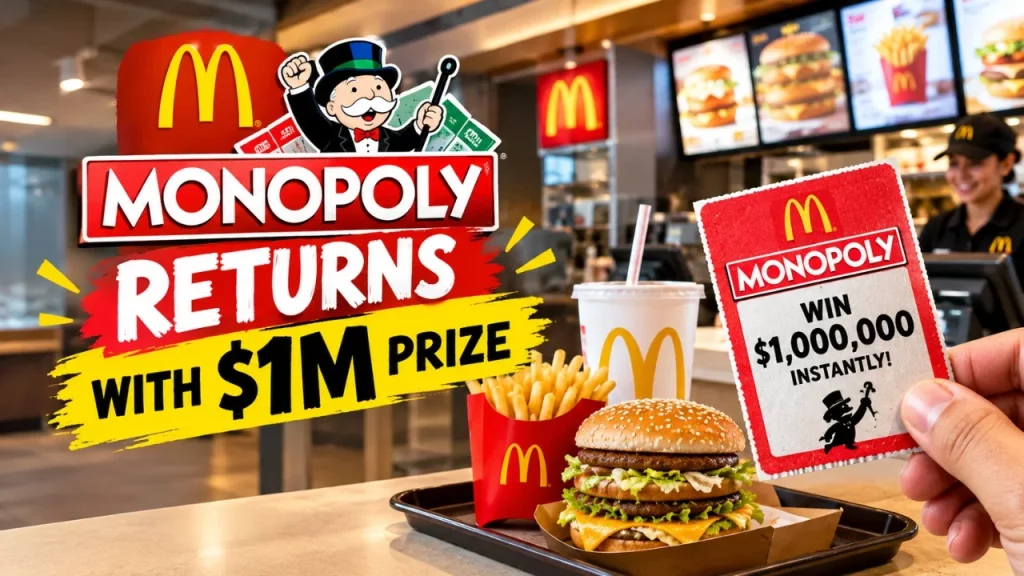
A man peels a thin strip of film off his medium fries carton in the parking lot, phone propped on the dashboard, scanning the code before he even touches a fry. The app chimes. He’s won something. He has no idea yet that “something” is almost certainly a free hash brown, and that the Jeep, the cruise, and the million dollars sitting at the top of the prize chart belong to a different universe of odds entirely.
- The advertised 1-in-5 odds describe winning anything, and the overwhelming majority of those wins are small food items or loyalty points, not cash or travel.
- Top-tier prizes like vehicles, cruises, and the $1 million award exist in extremely limited numbers across the entire print run, which is why your realistic odds of landing one are vanishingly small.
- The $1 million prize is paid as $50,000 a year for 20 years with no interest, meaning its true present-day value after tax is far below a literal million dollars.
- Strict independent auditing and randomized piece distribution — a direct legacy of a fraud scandal from the 1990s — are the reason big prizes are deliberately scarce today.
What the odds chart doesn’t tell you
When a promotion says 1-in-5 odds of winning, that statistic is built by lumping every prize tier into a single pool. A free small coffee and a $1 million annuity are mathematically treated the same way in that headline number, even though they could not be further apart in value. In practice, the vast majority of winning peels redeem for low-cost menu items — fries, a drink, a cookie — or digital loyalty points that nudge you toward a future free item. Cash and travel prizes make up a sliver of that 1-in-5 figure, not a meaningful share of it.
This is not unique to any one year’s promotion; it’s structural. Food-tier prizes are cheap for the company to give away and easy to print in huge volume, so they dominate the odds pool by design. Meanwhile the handful of true jackpot pieces are produced in a fixed, audited quantity that doesn’t scale with how many game pieces are in circulation overall.
Why the big prizes are so rare
To understand just how deliberately scarce those top prizes are, it helps to look at why the game is designed this way in the first place. In the late 1980s and through the 1990s, an employee of the marketing firm that produced the game pieces ran a scheme to steal winning pieces for high-value prizes and funnel them to accomplices instead of releasing them into real circulation. The fraud went on for years before it was uncovered, and it became one of the more notorious promotional-marketing scandals in American retail history.
The aftermath reshaped how these games are run. Independent auditing firms now oversee the production and random distribution of game pieces, high-value pieces are tracked individually rather than mixed in loosely, and the entire process is designed so that no single person or print run can quietly reroute a winning piece. That additional layer of control is also exactly why big prizes are issued in such small, fixed quantities today — tight auditing works best when there are few high-value pieces to track, not thousands of them scattered unpredictably through the supply chain.
The real lesson of the game’s history is that trustworthy odds and generous odds cannot both be maximized at once — tightening the first necessarily shrinks the second.
What the $1 million prize is actually worth
Suppose, purely as an illustration, someone did win the top prize structured as $50,000 paid annually for 20 years with no interest added over that period. On paper that’s $1,000,000. In practical terms, it’s much less, for two separate reasons.
First, taxes. Each $50,000 installment is ordinary taxable income in the year it’s received, and depending on the winner’s other income and tax bracket, a meaningful chunk of each payment — potentially a third or more — could go to federal and state taxes before it ever reaches a bank account. Over 20 years, that compounds into a large gap between the stated prize and the actual take-home total.
Second, and more significant: money paid out over two decades with zero interest is worth dramatically less than the same amount handed over today, because of inflation and lost investment opportunity. A dollar received in year twenty has far less purchasing power than a dollar received today, and because there’s no interest offsetting that erosion, each later installment is effectively worth less in real terms than the one before it. Financial planners typically describe this kind of structure using “present value” — the idea that a future dollar is worth less than a current dollar, and the gap widens the longer you wait.
Put simply: a no-interest, 20-year, $50,000-a-year prize is worth noticeably less in real, spendable, inflation-adjusted terms than a lump sum of the same headline total paid immediately. Winners who understand this often weigh whether a reduced lump-sum alternative, if offered, beats waiting out two decades of flat payments.
Instant win versus collect-to-win — and why some sets are a trap
Game pieces generally fall into two categories. Instant-win pieces resolve immediately upon scanning — you either won that specific prize or you didn’t. Collect-to-win pieces require gathering a matching set, such as several pieces that together spell out a city or landmark name, before any prize is paid.
The catch with collect-to-win sets is piece scarcity. Game designs routinely make one or two pieces in each set deliberately rare — sometimes rare enough that they’re released in far smaller numbers than the other pieces in that same set. A player can easily accumulate four pieces out of five and never see the fifth, because it was never printed in comparable volume. For the biggest prizes, this scarcity is intentional and audited, not an accident of bad luck — which means no amount of extra app visits meaningfully improves your odds of completing those sets.
What happens to unclaimed prizes, and the free alternative
Winning pieces, like most promotional game pieces, carry claim deadlines, and prizes that go unclaimed by that date are typically forfeited rather than reissued. Separately, nearly every promotion of this kind legally requires a no-purchase-necessary entry method, usually via mail-in request, which carries the same prize pool and odds as pieces obtained through purchase. It’s slower and less convenient, but it exists precisely so entry isn’t legally tied to spending money.
What this means for you
- Expect food and small loyalty rewards, not cash — that’s where almost all real winners land.
- Treat the $1 million headline figure as a gross number, not a take-home one, once taxes and 20 years of flat payments are factored in.
- Don’t chase collect-to-win sets if you’re missing the rare piece; scarcity is built in, not bad luck.
- Track claim deadlines closely, and remember the no-purchase mail-in route exists if you want to play without buying anything.

Tom Fletcher
The latest from the Australian and global BBQ scene — comps, cooks and culture.