McCain Foods Falcon Agrifriz Acquisition: Why a Gujarat Potato Plant Is Now a Big Deal
The real story isn't the plant — it's that nobody will say what McCain paid, and why two outlets quote two different numbers.
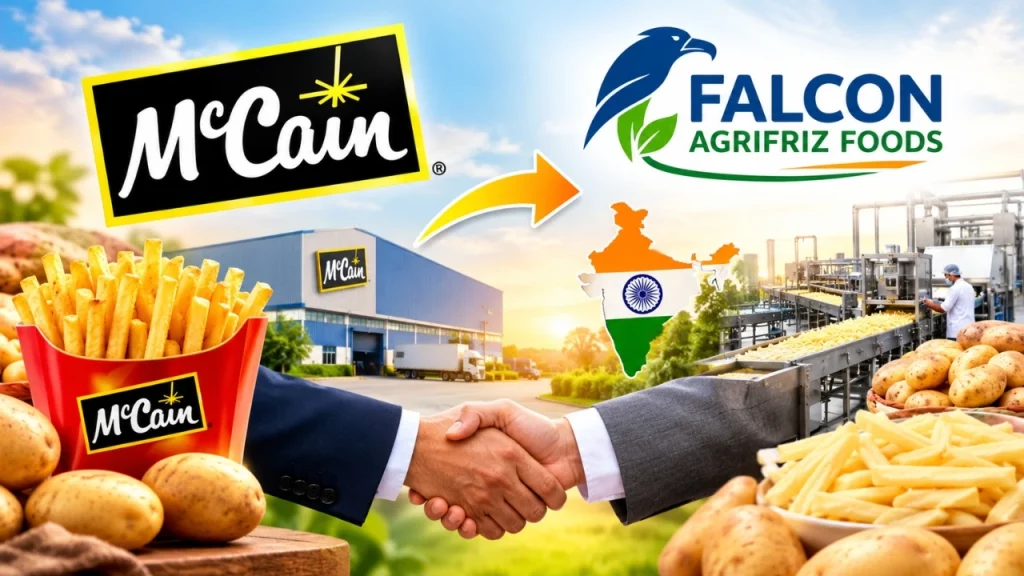
Nobody involved in this deal will say what McCain Foods actually paid for Falcon Agrifriz’s Gujarat potato plant. Not McCain, not Falcon, not the state government officials who showed up for photos. One widely circulated figure puts the investment at roughly ₹1,050 crore. A separate account, running the numbers in US dollars, lands near $155 million. Those two figures are not simply the same number in two currencies — and the gap between them is the most revealing thing about this acquisition.
1. Why the Rupee Figure and the Dollar Figure Don’t Match
At a glance, ₹1,050 crore and $155 million look like they could be rough currency equivalents of the same transaction. They are almost certainly not describing the same thing. The rupee figure tracks closely with language used around Falcon’s original construction of the plant — the capital it sank into building a 25-acre frozen-fry facility from scratch roughly two years ago. The dollar figure, by contrast, appears tied to coverage of the acquisition itself, framed by a different outlet with its own sourcing and its own conversion assumptions.
That distinction matters enormously. An investment figure describing what it cost to build a factory is not the same as a purchase price describing what a buyer paid to take it over. Conflating the two makes it look like reporters disagree about the deal’s size, when in reality they may simply be describing two different financial events — construction cost versus acquisition cost — using the only hard numbers each had access to.
2. Why No One Will Disclose the Actual Purchase Price
Both companies have confirmed the transaction is still moving through customary closing conditions, and both have declined to put a number on the deal itself. That silence is standard practice for private, closely held acquisitions, especially ones involving a multinational food company and a privately owned Indian conglomerate — neither side has a regulatory obligation to publish a sale price, and both have commercial reasons not to. Disclosing the real number would hand competitors, and every farmer and vendor who supplies the plant, leverage in future negotiations.
Until the deal formally closes, any investment figure in circulation should be read as context, not confirmation. The ₹1,050 crore and $155 million figures tell you the scale of capital that has moved around this plant over its short life. Neither tells you what McCain wrote on the check.
3. Falcon Group: Why Sell a Plant It Just Finished Building
Falcon Agrifriz did not build this facility as a legacy asset — it built it as part of a broader diversified conglomerate’s bet on India’s processed-food boom. Groups like Falcon typically operate across agribusiness, infrastructure, and manufacturing simultaneously, and a two-year-old factory, however modern, is often treated less as a permanent holding and more as a completed project ready to be monetized once it proves it can run at scale.
Selling a freshly built plant to a buyer like McCain is, in that light, less a retreat than an exit on favorable terms. Falcon absorbed the construction risk, got the lines running, locked in farmer supply, and then sold the operating asset to a multinational with distribution, brand reach, and capital that a regional conglomerate cannot match. For a diversified group, that is a conventional playbook: build, de-risk, sell to a strategic buyer, redeploy capital elsewhere.
4. The Canada-India Backdrop That Frames the Timing
This deal is not landing in a vacuum. Canada-India relations spent much of the past two years frozen by a diplomatic expulsion crisis that curtailed trade diplomacy, cooled investment conversations, and left Canadian companies with Indian operations treading carefully. The recent thaw — marked by a Canadian trade mission under Prime Minister Mark Carney and a visit tied to Canadian minister Sidhu — has reopened exactly the kind of government-to-government channel that large agribusiness acquisitions rely on for comfort, even when the deal itself is purely commercial.
A Canadian company buying control of a strategic Indian food-processing asset right as formal trade relations are being rebuilt is not a coincidence worth ignoring. It signals that McCain sees political tailwinds returning at the same moment it sees commercial opportunity in India’s growing frozen-food appetite, and it gives both governments a tangible, non-controversial example of bilateral investment to point to while harder diplomatic issues remain unresolved.
5. What Happens to the Farmers and Workers If the Deal Doesn’t Close as Promised
The plant’s value is inseparable from its supply chain: more than a thousand contracted potato farmers and roughly 450 employees whose livelihoods are currently tied to agreements Falcon struck, not McCain. If the acquisition closes exactly as announced, those contracts are expected to transfer with the plant, continuing under terms farmers already know.
But “customary closing conditions” is doing real work in every statement issued so far. If financing details, regulatory approval, or valuation disagreements cause the deal to stall or collapse, farmers would be left holding contracts with Falcon — a seller that has already signaled its intent to exit frozen-fry processing. A partial close, or one that renegotiates pricing or volume commitments, could also mean farmers accept different terms than what was originally promised when they signed on. For contract farmers, the safest assumption is that nothing is guaranteed until the deal is formally finalized and new agreements are issued in McCain’s name.
6. Who’s Actually Speaking for McCain — and Who Isn’t
Notice who has been quoted publicly on this deal: regional and divisional leaders, not McCain’s global chief executive, Max Koeune. That pattern is itself a signal. When a multinational’s top global executive stays silent on an acquisition, it usually means the deal is being treated as a regional portfolio move — important to India operations, but not large enough in McCain’s global context to warrant a CEO-level statement.
That doesn’t make the deal unimportant locally. It makes it important in a specific way: a calculated regional expansion rather than a headline-grabbing global strategic shift. For India’s frozen-fry market, a quiet regional deal can still be decisive, because control of a 25-acre processing facility with an active fries line is control of real market share — regardless of how loudly headquarters chooses to announce it.
7. So Who Actually Controls India’s Frozen Fry Market Now?
Strip away the mismatched numbers and the diplomatic backdrop, and the practical answer is this: pending closing, McCain is positioned to absorb one of Gujarat’s newest and most capable frozen-fry facilities, consolidating processing capacity that a domestic conglomerate built and de-risked. Until the deal legally closes, Falcon technically still controls the plant, the farmer contracts, and the workforce — control that is set to transfer, but hasn’t yet.
The undisclosed purchase price isn’t a gap in reporting; it’s a deliberate commercial choice by two private parties with every incentive to keep the real number out of public view. What’s verifiable is the direction of travel — toward tighter multinational control of India’s frozen-potato supply chain, timed to a diplomatic reset that makes a Canadian company’s expansion in India easier to justify on both sides of the relationship.

Tom Fletcher
The latest from the Australian and global BBQ scene — comps, cooks and culture.