Maple Syrup vs Sugar: Which Sweetener Is Healthier for Everyday Use?
The gram-for-gram numbers on calories, sugar, GI and fructose load show maple syrup's edge is real but small — and void for some people.
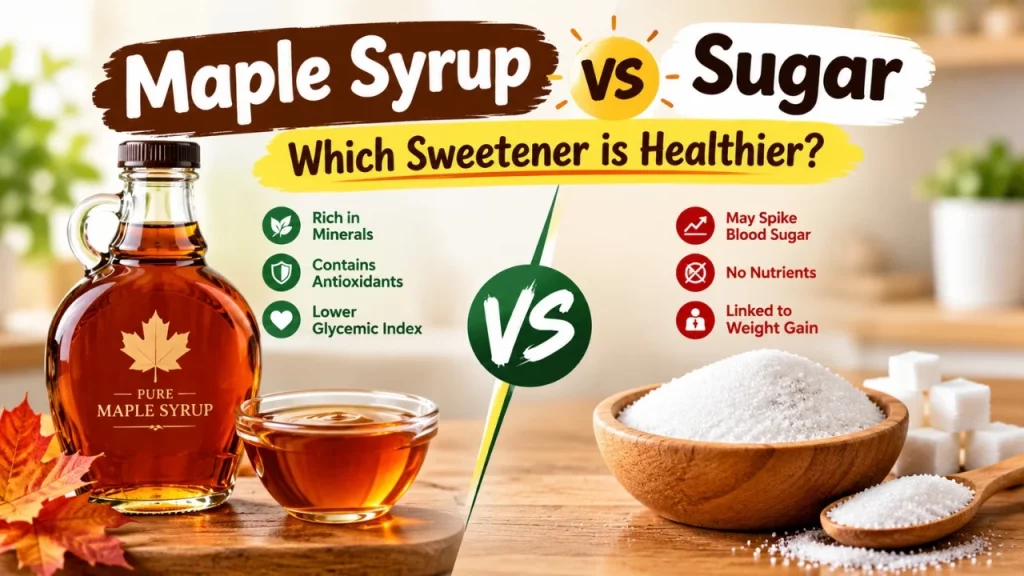
Most people assume that swapping table sugar for maple syrup is an automatic upgrade — same sweetness, fewer consequences. The numbers complicate that story. Maple syrup does edge out sugar on a few measures, but the gap is smaller than the marketing suggests, and for some people it closes entirely.
So, directly: is maple syrup healthier than sugar? For a healthy person using a tablespoon here and there, yes, modestly — lower glycemic index, a trace of minerals, slightly less sugar by weight. For someone managing diabetes, insulin resistance, fatty liver, or fructose sensitivity, the honest answer is no — the swap doesn’t change the metabolic load enough to matter. Here’s how to work that out for yourself, with the actual figures.
Step 1: Line up the real per-tablespoon numbers
Marketing comparisons tend to round everything to “less processed” and skip the arithmetic. Here it is, per tablespoon:
| Sweetener | Calories | Total sugars | Glycemic Index |
|---|---|---|---|
| Table sugar (12.5 g) | 48 kcal | 12.6 g | ~65 |
| Maple syrup (20 g) | 52 kcal | 12 g | ~54 |
| Honey (21 g) | 64 kcal | 17 g | ~61 |
Maple syrup has essentially the same calorie count as sugar per tablespoon and only slightly less sugar by weight. The GI difference — 54 versus 65 — is real and not trivial, but it’s a difference in how fast the sugar hits the bloodstream, not in how much sugar you’re eating.
Tip: If you’re counting calories or total sugar intake, treat the two as functionally equal. The place maple syrup actually separates from sugar is glycemic speed, not quantity.
Step 2: Check whether the fructose-to-glucose ratio is actually different
This is the detail most comparisons skip. Table sugar is sucrose, a 50:50 bond of glucose and fructose. Maple syrup is also overwhelmingly sucrose — roughly the same proportion — so once your gut breaks it down, you get close to the same 50:50 fructose-to-glucose split as plain sugar. Honey is the outlier here: it’s naturally fructose-heavy, closer to 55:45 fructose-to-glucose, with no sucrose bond to break first.
This matters because fructose, not glucose, is the sugar component most implicated in liver fat accumulation and triglyceride buildup. A study on fructose-induced triglyceride accumulation in liver cells found fructose exposure drove triglyceride buildup in vitro, an effect a cocoa-derived compound partially blunted — evidence that fructose’s metabolic footprint in the liver is distinct from glucose’s, independent of which sweetener delivered it. Since maple syrup delivers nearly the same fructose dose per gram as sugar, its lower GI doesn’t reduce your liver’s fructose exposure.
Tip: If your concern is fructose load specifically — not just blood sugar spikes — maple syrup offers no real advantage over sugar. Honey’s higher fructose share actually makes it the worse choice on this specific axis, despite sitting mid-table on GI.
Step 3: Work out if the minerals actually add up
Maple syrup contains manganese and some riboflavin that sugar lacks entirely — this part is true and often repeated. The question nobody runs the numbers on is whether a realistic serving matters. A tablespoon or two a day puts you in the range of a fifth of the adult Daily Value for manganese, with riboflavin contributing only a couple of percent. That’s a genuine, non-zero nutritional contribution — but it arrives bundled with 50-plus calories of added sugar, the same category of intake every dietary guideline tells you to minimize. Manganese deficiency is also rare in people eating a varied diet, so this upside mostly benefits people who were already getting enough.
Tip: Don’t let the mineral content change your decision about how much to use. It’s a genuine but minor bonus, not a reason to pour more.
Step 4: Identify who should not treat this as a health swap
This is where the GI argument breaks down for specific groups:
- People with diabetes or insulin resistance: a lower GI slows the glucose spike but doesn’t eliminate it, and total carbohydrate load still drives insulin response more than GI alone.
- People with fatty liver: since maple syrup’s fructose share mirrors sugar’s, the liver still processes nearly the same fructose dose. A trial in children with obesity and metabolic syndrome found that cutting dietary fructose from 11.7% to 3.8% of daily calories over just nine days lowered apoC-III (from 8.7 to 6.5 mg/dl) and produced less atherogenic lipoprotein profiles — a result driven by fructose quantity, not source. Swapping sugar for maple syrup doesn’t meaningfully cut that quantity.
- Fructose-sensitive individuals: same logic — near-identical fructose delivery means near-identical symptoms.
- Children: added sugar guidelines are about total grams, and maple syrup’s modest reduction per tablespoon doesn’t change that math meaningfully.
One clinical trial deserves a fair hearing on the other side: a randomized, double-blind crossover trial had 42 overweight adults with mild cardiometabolic alterations replace 5% of daily calories from sugar with maple syrup for 8 weeks, and found improvements in glucose area-under-curve and other cardiometabolic markers compared with an artificially flavored sucrose syrup. That’s a real, controlled result — but it was in adults with mild metabolic issues, not diagnosed diabetes or fatty liver, and the comparison syrup was flavored sucrose, not plain sugar. It supports a modest benefit for healthy-ish adults; it doesn’t extend to the higher-risk groups above.
Tip: If you fall into any of those four groups, the relevant number isn’t GI — it’s total added sugar and total fructose grams per day. Reduce both; don’t just change which bottle delivers them.
Step 5: Settle the honey comparison while you’re at it
Readers keep putting honey in this debate, so here’s where it lands: more calories per tablespoon than either sugar or maple syrup (64 kcal), more total sugar (17 g), a GI in between the other two (~61), and a fructose-heavy ratio that makes it the least favorable of the three for anyone managing liver fat or fructose intake specifically.
Common mistakes
- Treating GI as a proxy for total sugar — they measure different things.
- Assuming maple syrup’s fructose load is lower than sugar’s; it isn’t, because both are sucrose-based.
- Counting the mineral content as a meaningful nutritional source rather than a small bonus on top of added sugar.
- Applying a result from adults with mild metabolic issues to people with diagnosed diabetes or fatty liver.
- Using more maple syrup than sugar because it “feels healthier,” which erases any calorie advantage.
Sources

Tom Fletcher
The latest from the Australian and global BBQ scene — comps, cooks and culture.