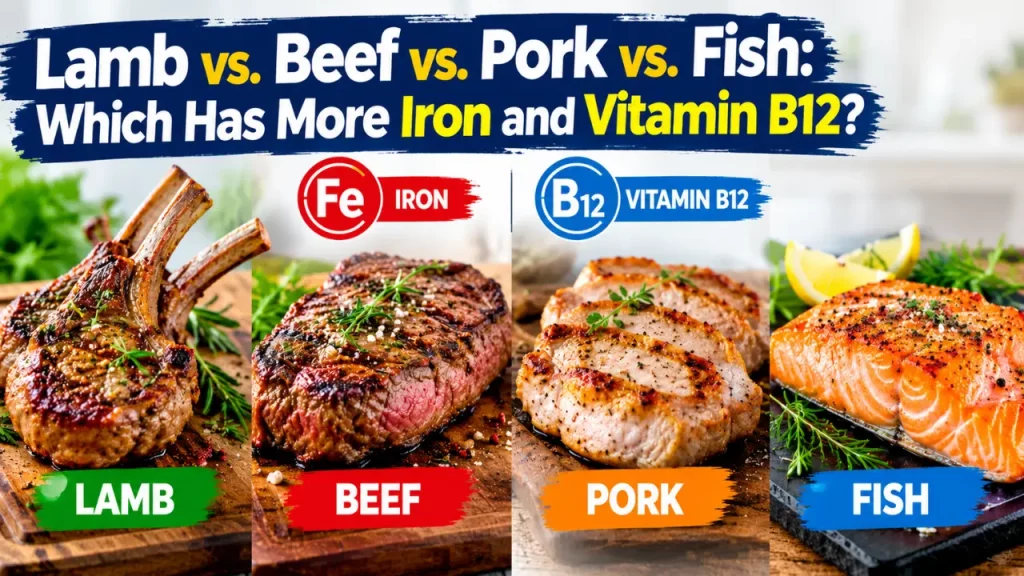
Lamb vs. Beef vs. Pork vs. Fish: Which Has More Iron and Vitamin B12?
Raw nutrient tables mislead — here's what a real cooked steak, chop, or tin actually delivers, and who should eat less of it.
A number on a nutrition label is a promise the frying pan breaks.
Picture tonight’s dinner: a steak searing, a pork chop going pale at the edges, a tin of sardines sitting unopened on the counter because you can’t decide if it’s worth it. Every comparison chart you’ve seen says beef wins on iron, pork loses, and sardines can rival red meat on B12. What none of those charts tell you is what happens between the raw weight on the package and the much smaller, much more concentrated piece of food actually on your fork. That gap is where the real answer to “which has more” lives.
What a Realistic Plate Actually Gives You
Meat loses water as it cooks, which shrinks the portion and concentrates some nutrients — but heat does something else at the same time: it changes the chemical form of the iron itself. A study measuring heat treatment and salt effects on heme iron in meat found that heating minced pork to 80°C for two hours cut heme iron content by 62%, converting it toward the harder-to-absorb non-heme form. So a well-done chop isn’t just smaller than its raw weight suggested — its iron is also less bioavailable than the raw-food table implied.
Actual cooked measurements make this concrete. A food composition study that analyzed heme and nonheme iron in cooked animal products found cooked beef loin contains 1.1 mg of heme iron and 1.3 mg of non-heme iron per 100 g — 2.4 mg total. Cooked chicken breast, by contrast, holds just 0.4 mg total per 100 g, and a chicken drumstick about 0.9 mg. Scale that up to a realistic 170 g cooked beef portion — roughly a six-ounce steak after it’s lost water on the grill — and you’re looking at about 4.1 mg of iron, against the daily targets of 8 to 18 mg already familiar from other coverage of this topic. That’s a meaningful chunk of a day’s iron, but it’s one steak, not the open-ended “beef is highest” statement the raw tables leave you with.
The same study found pork liver, often ignored in cut-of-meat comparisons, carries 12.6 mg of total iron per 100 g cooked, with about 2.3 mg as heme — and that cooked pork and chicken blood curds average 9.2 mg and 15.4 mg of heme iron per 100 g respectively, dwarfing any muscle cut. Nobody puts blood curd next to a ribeye on a comparison chart, but it quietly beats everything else on this list.
The B12 Ceiling Nobody Mentions
Here’s the part the raw-percentage charts skip entirely: your body cannot absorb all of a large B12 dose in one sitting, no matter how big the number on the label looks. B12 absorption depends on a limited supply of intrinsic factor in the stomach, and that pathway tops out at roughly 1.5 to 2 micrograms absorbed per meal. So when a can of sardines or a cut of liver advertises a B12 percentage several times your daily requirement, most of that surplus simply passes through unabsorbed rather than banking itself for later. Eating two tins of sardines in one meal to “double up” on B12 doesn’t double your actual uptake — it mostly produces more B12 in the toilet than in your blood. Spreading B12-rich foods across two meals a day, rather than loading one plate, gets you closer to your real daily target.
When More Red Meat Is the Wrong Answer
All of this assumes you want more iron, which isn’t true for everyone. People with genetic hemochromatosis absorb dietary iron excessively because of low hepcidin activity, and a dietary review on managing iron absorption in genetic hemochromatosis recommends they abstain from red meat from mammals entirely, avoid offal and blood-based foods, cap poultry at around 200 g a week, and lean instead toward a largely vegetarian, fruit-and-vegetable-heavy diet with at least 600 g of produce daily. For this group, “eat more beef for iron” is actively bad advice. A separate genetic analysis looking at hepcidin-regulating genes and pancreatic cancer risk found associations between variants in iron-metabolism genes and disease risk, echoing earlier epidemiological links between red meat, iron, and pancreatic cancer — it’s a genetic association study, not proof of cause, but it reinforces that iron regulation matters beyond simple overload symptoms.
Older adults and anyone on long-term proton pump inhibitors or metformin face the opposite problem: reduced stomach acid or altered gut absorption means B12 uptake can stay poor no matter how much meat, liver, or sardines they eat. For these groups, portion size isn’t the limiting factor — absorption capacity is, and no amount of extra fish fixes that.
The Plant Plate’s Hard Limit
Pairing iron-rich food with vitamin C is genuinely useful advice, but it only ever works one direction. Vitamin C has no effect on B12 absorption at all, and no plant food — not spinach, not lentils, not fortified cereal pretending otherwise — contains naturally occurring B12. Vegetarians and vegans can maximize non-heme iron absorption with citrus or peppers alongside beans, but they get precisely zero B12 from any amount of vegetables, however iron-rich. That nutrient has to come from animal foods, fortified products, or a supplement; there’s no dietary workaround.
The Tin of Sardines Trade-off
Canned fish is genuinely efficient for both iron and B12 in a small, affordable portion. Research on oily fish and iron absorption from a phytate-rich meal, a small crossover trial in 21 young women with low iron stores, found that adding sous vide salmon significantly boosted absorption of non-heme iron from a bean-based meal — fish seems to carry the same absorption-boosting “meat factor” found in red meat. But canning adds salt for preservation, and the same chemistry that lets sodium stabilize heme iron during meat processing means canned sardines and tuna typically run high in sodium per serving. For someone managing blood pressure, that tin solves one nutrition problem while adding another.
Back to the Pan
So the steak searing on the stove, the quiet tin on the counter — neither one is simply “better” in the way a raw-food chart implies. The steak gives a real, substantial iron dose once you account for its cooked weight, but less of it is absorbable than the raw number suggested, and it’s the wrong move entirely if you carry a hemochromatosis diagnosis. The tin delivers B12 efficiently, but only up to what your stomach can actually process in one sitting, and it comes salted. The honest answer was never which food wins on paper — it’s which one fits the body eating it.
Sources
- Managing Genetic Hemochromatosis: An Overview of Dietary Measures (2021)
- The effect of processing temperature and salts on heme-nonheme-iron ratio in meat (2001)
- Hepcidin-regulating iron metabolism genes and pancreatic ductal adenocarcinoma (2021)
- Heme and nonheme iron content of animal products commonly consumed in Thailand (2002)
- Oily fish increases iron bioavailability of a phytate rich meal in young iron deficient women (2008)
