How Many Mojitos Before You’re Legally Impaired? The Real Numbers
A numbers-based look at how many mojitos it actually takes to cross 0.08%, and why the sugar makes it harder to tell.
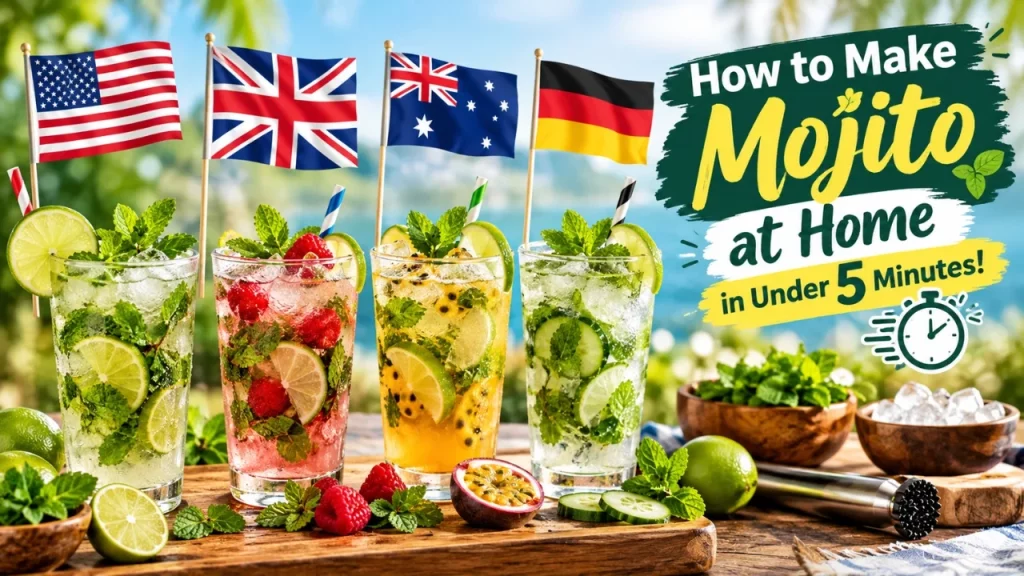
Three mojitos feel like nothing until the breathalyzer disagrees with you.
The honest answer: most people cross 0.08% somewhere between their second and fourth mojito, but the sugar in the drink can make that line feel invisible until you’re already over it.
What’s actually in the glass
A home-poured mojito usually means a generous splash of white rum, not a measured shot. That matters, because the whole conversation about “how many drinks” only works if you know what a drink actually is. Researchers studying real drinking episodes build their blood alcohol concentration (BAC) estimates from exactly that kind of data — self-reported drinks, time spent drinking, and body weight — then check the math against an actual breath test.
In one such study, a validity study comparing estimated and measured BAC tested 109 drinkers outside bars and found that estimated BAC (eBAC) formulas explained only about 54–55% of the variation in people’s real breath alcohol readings, and on average they overestimated it. The factors that actually moved the number were time spent drinking, number of standard drinks, and body weight. Translation: formulas are a rough guide, not a guarantee, and two people who drank “the same” can land in very different places.
Why a mojito isn’t a gentle drink
People treat mojitos as the “light” cocktail because it’s mostly ice, soda, and mint. But the rum pour at home is rarely a careful 1.5-ounce bar measure — it’s often closer to double that once you’re mixing by eye. That single habit can quietly turn what you think is one drink into something closer to the alcohol load of one and a half or two.
For comparison, a 2018 analysis looked at the other extreme: a study estimating BAC from supersized alcopops found that a single can containing 5.5 standard drinks, consumed over two hours, put young adults well over the 0.08 g/dL legal driving limit, and a second can risked alcohol poisoning. Nobody’s mojito is an alcopop can. But it’s a useful reminder that “one drink” and “one serving” are not the same thing once pour sizes get generous, and mojitos are an easy drink to over-pour because the sweetness masks the rum.
Does the sugar change how fast it hits?
This is the part recipe articles never touch. A small crossover study gave 12 healthy volunteers — seven women, five men — six different alcoholic drinks after a six-hour fast, with men getting 36 grams of ethanol and women 24 grams each time. The study measuring blood ethanol after six beverage types found that the total alcohol exposure in the blood (measured as area under the curve) differed significantly between pure ethanol and three sweeter or carbonated drinks — red wine, sparkling wine, and a sweet alcopop-style drink — with that difference being statistically meaningful (p<0.01).
Even more interesting: blood sugar and insulin spiked after beer and especially after the sweet alcopop, rising by roughly double and fourfold respectively within 60 minutes (p<0.05). That's a small, early study — 12 people, one crossover trial — so it shouldn't be treated as the final word. But it does suggest that sugary, carbonated drinks interact with your body's sugar handling in a way that plain spirits don't, which is exactly the chemistry a mojito brings to the table: sugar, lime, and carbonated soda on top of rum.
Your weight, your sex, and your dinner plate
BAC formulas lean hard on body weight because alcohol distributes through body water, and smaller bodies have less water to dilute it in. That’s why the same two mojitos can leave one friend fine to drive and another friend over the limit. The eBAC validity study above confirmed weight as one of the handful of variables that reliably tracked with real BAC readings, alongside how long someone had been drinking and how many drinks they’d had.
Food matters too, though not in the EVIDENCE as a mojito-specific test — what the research does support is that real-world drinkers badly misjudge their own numbers. In a field study at restaurants on Australia’s Sunshine Coast, a study breathalyzing 544 restaurant diners found that 40% of participants said they simply don’t drink and drive — meaning the other 60% were making a judgment call about their own BAC, over dinner, with food on the table, exactly the scenario where a mojito or two feels harmless. The study didn’t need a lab to make its point: people’s self-assessment and the breathalyzer don’t always agree.
When “it’s just a mojito” isn’t true
Lower body weight pushes BAC up faster for the same number of drinks — that’s basic to every formula mentioned above. But there’s a group for whom the math changes entirely: people who’ve had weight-loss surgery. A study comparing women who’d had sleeve gastrectomy, women who’d had gastric bypass, and women awaiting bariatric surgery found that research on alcohol pharmacokinetics after sleeve gastrectomy surgery showed bypass surgery in particular could turn what should be the equivalent of two drinks into a peak BAC more like four. That’s not a rounding error — it’s double. If you’ve had this kind of surgery, “I’ve only had one mojito” carries a very different risk than it does for someone who hasn’t.
The same caution applies to anyone taking medications that interact with alcohol, anyone drinking quickly rather than over a couple of hours (time spent drinking was one of the factors that reliably predicted real BAC in the validity study), and anyone under about 130 pounds, where even a standard pour reaches a higher concentration per pound of body water.
Quick recap
- BAC estimate formulas are useful but imperfect — they explain roughly half the real-world variation in breath alcohol readings.
- Home-poured mojitos often contain more rum than a standard bar measure, so “two mojitos” can be closer to three standard drinks.
- Sugary, carbonated drinks show measurably different alcohol absorption curves than straight spirits in small clinical testing, plus bigger blood sugar and insulin spikes.
- Body weight, sex, and time spent drinking are the factors most consistently tied to real BAC outcomes.
- Weight-loss surgery, especially gastric bypass, can roughly double peak BAC compared with what the same drinks would produce before surgery.
- Self-judgment is unreliable — in one restaurant study, a large share of diners were deciding to drive based on how they felt, not what a breathalyzer would show.
Takeaway: treat a home mojito as closer to a drink-and-a-half than “just one,” and let your body weight, your pour, and your medical history — not how buzzed you feel — decide when to stop.
Sources
- Using calculations to estimate blood alcohol concentrations for naturally occurring drinking episodes: a validity study (2005)
- Estimated blood alcohol concentrations achieved by consuming supersized alcopops (2018)
- The influence of six alcoholic beverages on ethanol concentration in the blood and breath (2006)
- Are you okay to drive? Commuting behavior and blood alcohol concentrations among restaurant diners (2017)
- Sleeve gastrectomy surgery: when 2 alcoholic drinks are converted to 4 (2018)