Haddock vs. Tilapia vs. Cod: Which Fish Is Healthiest for Your Diet?
Pregnant, on dialysis, inflamed, or broke—here's which fish actually fits your situation, with the real numbers behind the advice.
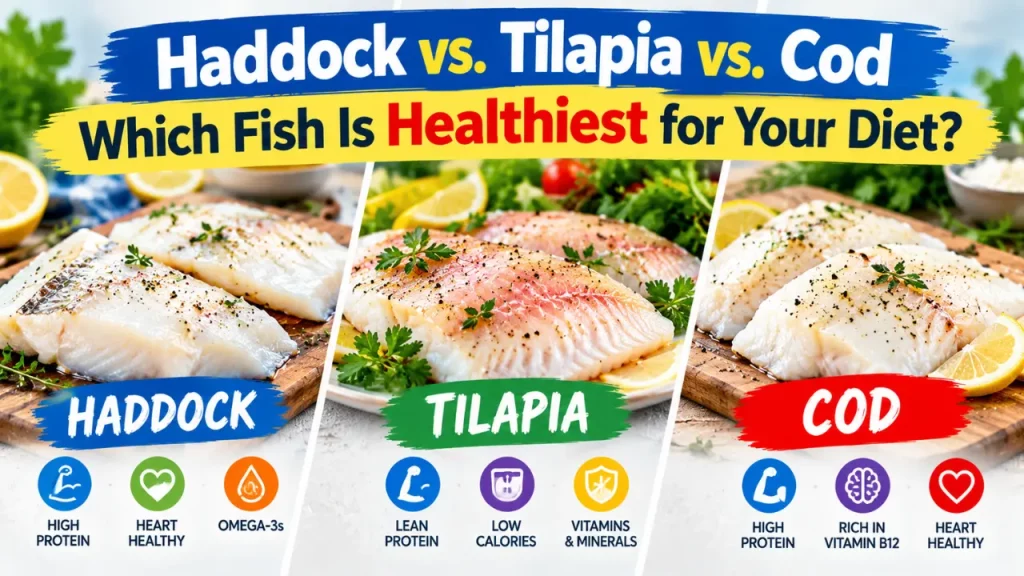
The seafood case at the grocery store has three trays lined up under the same crushed ice: haddock, cod, tilapia, all priced within a dollar or two of each other. You’re shopping for Sunday dinner, and the guest list in your head is complicated. Your daughter is seven months pregnant. Your father is two years into kidney disease and watching every mineral on his plate. You’ve been reading about inflammation and wondering if the cheap fish you buy every week is quietly working against you. And honestly, money is tight this month too. Four people, one cart, three fish. Picking “whichever one looks freshest” isn’t going to cut it tonight.
The Quick Answer First
If you need one ranked answer: haddock and cod are nearly interchangeable as the top two picks for most people, with haddock having a very slight edge for sensitive eaters because of its lower mercury load and milder flavor, and cod carrying marginally more omega-3 fat. Tilapia lands third on pure nutrition, not because it’s unhealthy, but because it supplies noticeably less of the omega-3 fat that makes fish worth eating in the first place. Where tilapia wins outright is cost and accessibility — and for a strict budget, that’s a legitimate reason to choose it. The right answer genuinely changes depending on who’s eating. That’s the part worth working through properly.
The Tilapia Inflammation Claim, Checked Against the Data
The story repeated online goes like this: tilapia is high in arachidonic acid, arachidonic acid is a building block for inflammatory compounds, therefore eating tilapia makes your body more inflamed than eating other fish. It’s a tidy chain of logic, and that’s exactly the problem — none of the evidence actually used to build this article includes a human feeding trial that gave people tilapia and then measured inflammatory markers in their blood. The claim is built on biochemical plausibility, not on an outcome study showing it happens in real diets. Until that trial exists, the honest answer is that the tilapia-inflammation link is unproven, not confirmed, and not disproven either. If you already manage an inflammatory condition, the more defensible move is to simply choose whichever of the three fish you’ll actually eat regularly instead of swapping fish out over a claim that hasn’t been tested directly.
The real dividing line between these three fish isn’t mercury or inflammation — it’s which specific nutrient on your personal medical chart you can least afford too much of.
The Contaminant Question Mercury Testing Doesn’t Answer
Mercury gets all the attention because it’s the number on the FDA list, but it’s not the only chemical that accumulates in fish tissue. Dioxins and dioxin-like PCBs build up in fat, and farming conditions seem to matter as much as species. A study of farmed Greek seafood found dioxin-and-PCB toxic equivalents of 0.88 picograms per gram wet weight in sea bream, 0.68 in sea bass, and 0.43 in rainbow trout — a twofold spread between species raised in the same region under similar systems, according to research on farmed fish produced in Greece. An Italian study of farmed European sea bass found the rearing method mattered even more than the species: fish raised in extensive coastal lagoons carried dioxin-like PCB levels of 28.5 picograms TEQ per gram of fat, more than double the 13.1 found in sea-cage fish and more than triple the 9.13 found in intensive inland tanks, per an analysis of Italian sea bass farms. None of these studies tested tilapia, cod, or haddock directly, so treat this as context rather than a verdict on any one of the three. What it does establish is that “farmed” alone isn’t the red flag people assume — the farming system and its location drive the exposure far more than the species label does. It also cuts the other way: wild fish aren’t automatically cleaner, as a bioassay of wild perch and roach from Italian lakes still turned up measurable dioxin-like compounds, according to a lake fish contamination study. A broader survey of fish products on the Polish market reached a reassuring middle ground, finding that most tested products carried contaminants at low levels while still delivering protein, iodine, selenium, and vitamin D3 intact, per a Polish fish market nutrition and contaminant survey. The takeaway for your cart: skip the blanket “farmed bad, wild good” rule and worry less about tilapia specifically than about buying from any fishery with poor oversight, farmed or wild.
What Kidney Patients Actually Need to Weigh
For your father on a renal diet, the math that matters isn’t mercury or omega-3 alone — it’s the ratio of phosphorus to the beneficial fat, weighed against protein, sodium, and potassium load. A study built specifically to help kidney patients choose fish measured phosphorus, protein, sodium, potassium, and EPA+DHA across fourteen species, and found phosphorus ranging from 50.86 to 227.52 milligrams per 100 grams, protein from 14.7 to 30.6 grams per 100 grams, and EPA+DHA swinging wildly from just 3.83 up to 1667.35 milligrams per 100 grams, according to research evaluating fish species for chronic kidney disease diets. That study didn’t test cod, haddock, or tilapia by name, so nobody should lift exact numbers for these three from it. What it does hand your father’s dietitian is the right question to ask: not “is this fish healthy” but “what’s the phosphorus-to-omega-3 ratio, and how does that fit today’s protein allowance.” Lean whitefish like these three generally sit away from the extreme ends of that spectrum rather than at them, but a renal diet is specific enough that this calls for an actual lab value from a dietitian, not a guess from a grocery aisle.
The Budget Math
For you, tilapia’s real advantage has nothing to do with nutrients — it’s that farmed tilapia is produced at a scale and cost that wild-caught cod and haddock can’t match, which is why it consistently undercuts both on price per pound. Since all three deliver a comparable, high protein count per serving, that price gap translates almost directly into a lower cost per gram of protein for tilapia. If a tight budget is the deciding factor this month, that’s a sound reason to choose it — not a consolation prize.
Back at the Seafood Case
Standing there with four different people’s needs in your head, the answer isn’t one fish, it’s three different trays going into the cart for three different plates: haddock for your pregnant daughter, cod for your father’s dietitian to run the numbers on, tilapia for the nights money is tight and nobody at the table has a condition to manage. None of them is the villain the internet made tilapia out to be, and none of them is a free pass either. The fish you choose should match the person eating it, not the headline you half-remember from a scroll through your phone.
Sources

James Carter
The EverBBQ editorial desk — covering BBQ news, features and everything off the grill.