Green Tea vs Black Tea vs White Tea vs Oolong: Which Cup Truly Suits You?
Real mg-level caffeine numbers and evidence-based guidance on which tea fits your pregnancy, anxiety, anemia, medication, or weight-loss situation.
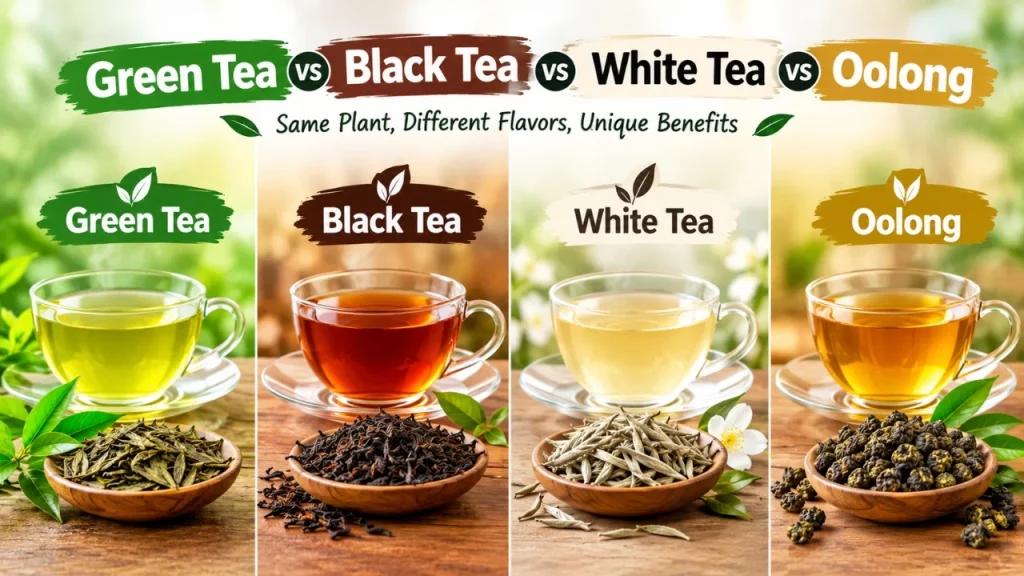
Your doctor just said “watch your caffeine” on the way out of the appointment, and now you’re standing in the tea aisle holding four boxes — green, black, white, oolong — trying to translate that advice into an actual decision. The labels don’t help. None of them say how much caffeine is in the cup you’re about to pour, and none of them mention the blood thinner in your medicine cabinet or the iron supplement you take every morning. You put all four boxes in the cart, because at this point, you need numbers, not vibes.
The Numbers Nobody Puts in One Table
Here’s the part most comparisons skip: an honest, side-by-side range. Caffeine content shifts with leaf age, brew time, and water temperature, so treat these as the commonly measured spread per 8-ounce cup rather than a fixed dose — but the spread itself is the useful part, because it shows the real gap between teas, not just “more” or “less.”
| Tea | Typical caffeine per 8 oz cup | Relative to black tea |
|---|---|---|
| White | ~15–30 mg | roughly a third to half |
| Green | ~25–45 mg | roughly half to two-thirds |
| Oolong | ~30–50 mg | roughly two-thirds |
| Black | ~40–70 mg | baseline |
That means a strong cup of black tea can carry close to double the caffeine of a light white tea infusion, and even within one type, a long steep can push a green tea toward the low end of black tea’s range. If your doctor’s actual concern is “stay under 200 mg a day,” white or green tea gives you far more room to drink several cups without approaching that line.
If You’re Pregnant or Breastfeeding
This is where the mg-level gap matters most. A clinical lactation review of green tea notes that infants of mothers with very high caffeine intake have shown fussiness, jitteriness, and disrupted sleep — reason enough to keep total daily caffeine, from all teas combined, on the lower end rather than stacking multiple high-caffeine cups. The same review makes a separate, important point: giving tea directly to infants can interfere with iron absorption and cause anemia, though anemia in breastfed infants has not been reported simply from a mother drinking tea. In practice, that means white or lightly steeped green tea, kept to one or two cups, is the more conservative choice during pregnancy and breastfeeding — not because black or oolong are dangerous, but because their higher and less predictable caffeine load gives you less margin for error.
If You’re Anemic or Iron-Deficient
Tea tannins binding to iron is a real, measurable effect — just not one studied directly in pregnant or anemic people in the evidence here. The clearest demonstration comes from an animal study on starlings: birds fed an iron-enriched diet developed significantly higher liver iron levels over six months, but birds given the same diet alongside black tea leaves did not — the tannins blocked the absorption. It’s a bird study, not a human trial, so treat it as supporting evidence for a mechanism rather than a prescription. Still, if you’re managing low iron, it’s sensible to separate tea from iron-rich meals and supplements by an hour or two, and to lean toward white tea, which is the least oxidized and generally lowest in tannin concentration among the four.
There’s a second, less-discussed mineral angle. A trace-element analysis of brewed infusions found that black tea leached roughly 759 micrograms of aluminum per gram of leaf, and green tea slightly more, around 919 micrograms per gram — both notably higher than hibiscus infusions in the same study. For most healthy adults this isn’t a concern, but anyone with reduced kidney function, who is advised to limit aluminum intake, has a concrete reason to ask a doctor before making green or black tea a daily habit.
If You’re on Blood Thinners or Thyroid Medication
This is the gap where caution matters more than certainty. Tea’s natural compounds and its tannin content can plausibly interfere with how the gut absorbs some thyroid medications, and the catechins concentrated in green tea have been studied for effects on blood clotting pathways in laboratory settings. Neither mechanism is something this evidence set can quantify in humans with precision, so the honest guidance is procedural, not dosed: take thyroid medication on an empty stomach, separated from tea by at least an hour, and mention your tea habits — especially green tea extract or concentrated brews — to whoever manages your blood thinner, since this is exactly the kind of interaction a pharmacist can check against your specific prescription.
If You Bought the Oolong for Stress or Weight Loss
This is where marketing tends to outrun the data. There is no strong human evidence here that oolong tea raises or lowers cortisol — that claim circulates widely but isn’t backed by the research reviewed for this piece. What is true is simpler and less exciting: oolong contains caffeine, and caffeine itself can produce a short-term stress-hormone bump in anyone sensitive to it, regardless of which of the four teas it comes from.
Weight loss claims deserve the same scrutiny. A review of quercetin and EGCG describes real mechanisms — these polyphenols can reduce food intake and preadipocyte proliferation while increasing fat oxidation in studied models — but the review frames this as an emerging, mechanism-level picture, not a guarantee that a daily cup melts fat. A separate review of green tea catechins makes the same caveat explicit: EGCG’s effects are documented at micromolar concentrations in lab settings, which don’t automatically translate to what you absorb from a steeped cup. Green tea is the strongest candidate of the four for these catechin-driven effects, since it’s richest in EGCG, but “strongest candidate” is not the same as “proven weight-loss tool.”
Quick tip: if caffeine sensitivity is your main concern, steep time matters as much as tea type — a 5-minute black tea steep can out-caffeinate a 2-minute oolong steep, so shortening your brew time is a faster fix than switching teas entirely.
Back at the Aisle
So the four boxes in the cart aren’t really competing — they’re answering different questions. White tea is the gentlest choice for pregnancy, breastfeeding, and iron concerns. Green tea carries the most catechin research behind it, with real but modest, not miraculous, effects. Oolong sits in the middle on caffeine and lacks solid cortisol evidence either way. Black tea has the most caffeine and the clearest tannin-iron interaction, worth timing around meals and supplements. None of that fits on a label — but it fits in one cart, and now it fits in one decision.
Sources

James Carter
The EverBBQ editorial desk — covering BBQ news, features and everything off the grill.