French Fries vs Masala Fries vs Patatas Bravas: Which Potato Dish Wins?
The real winner depends on your potato bin, your spice tolerance, your blood pressure, and whether you can eat raw egg.
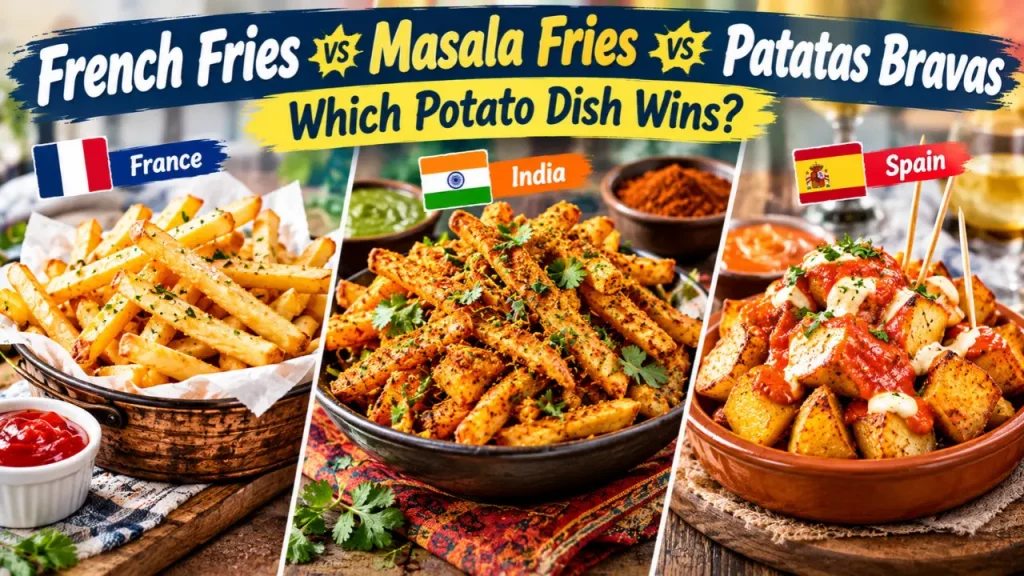
Which fry would actually survive contact with your kitchen, your gut, and your last blood pressure reading? That’s a different question from “which one tastes best,” and it’s the one most comparisons never bother to ask. The honest answer isn’t a single dish — it’s a decision tree built on three things: which potato you have on the counter, how much capsaicin your stomach can tolerate, and what your doctor has told you to watch.
The Russet Camp: French Fries and Masala Fries
French fries and masala fries are really the same potato wearing different clothes, and that potato should almost always be a starchy russet (or an equivalent high-dry-matter variety like Agria). Russets have low moisture and high starch, which means the inside steams into a fluffy, almost mashed-potato texture while the outside dries out enough to crisp properly in hot oil. Waxy potatoes — Yukon Gold, red potatoes, Maris Piper used fresh — hold too much water and too little starch, so they often come out dense, soggy-centered, or rubbery instead of fluffy. Masala fries inherit this same requirement, because the chaat masala, chili powder, and lemony tang clinging to the surface need a genuinely crisp, starchy exterior to stick to and to contrast against; a soft, waxy fry just goes limp under the spice coating instead of crackling.
The Waxy Outlier: Patatas Bravas
Patatas bravas flips the script. The dish is built around cubed potatoes that are fried or roasted, then smothered in a smoky tomato-based bravas sauce and often an aioli. Here, waxy to medium-starch varieties — Kennebec, Maris Piper, or Yukon Gold — actually work better than russets, because the cubes need to hold their shape under a wet sauce rather than collapse into mush. A russet cube, once it absorbs tomato sauce and aioli, tends to disintegrate at the edges; a waxy cube keeps its corners and a slight bite, which is the textural point of the dish. In other words, the variety that’s wrong for a fry is often the right one for a cube.
| Dish | Best potato | Main add-on fat/sauce | Main sodium source | Biggest health flag |
|---|---|---|---|---|
| French fries | Russet | Frying oil only | Added salt | Frequency of frying, oil reuse |
| Masala fries | Russet | Frying oil + light chili/lemon coating | Chaat masala (salt-forward spice blend) | High sodium load + capsaicin on sensitive stomachs |
| Patatas bravas | Waxy (Kennebec, Maris Piper, Yukon Gold) | Frying oil + tomato sauce + aioli (raw egg yolk + oil) | Sauce salt + aioli | Raw egg allergen/vegan conflict + combined fat from oil and aioli |
Once you add toppings, the three dishes stop being nutritionally comparable in any simple way. Plain fries carry only the fat absorbed during frying and whatever salt is sprinkled on afterward. Masala fries add a dry spice blend that’s typically salt-forward by design, which matters directly to anyone managing high blood pressure, since chaat masala is essentially a concentrated sodium seasoning stacked on top of already-salted fried potato. Patatas bravas adds two separate fat sources — the tomato-based bravas sauce and a traditional aioli made from raw egg yolk emulsified with olive oil — so its total fat and calorie load from toppings alone usually exceeds what either fried-potato dish carries on its own. That aioli is also the dish’s biggest exclusion risk: it’s unsuitable for anyone with an egg allergy, and it isn’t vegan unless specifically reformulated without egg.
Who should actually skip which dish
- GERD or acid reflux: masala fries’ chili and lemon combination is the most likely of the three to trigger reflux symptoms, since both capsaicin and citric acid are common reflux aggravators.
- Egg allergy or vegan diets: classic patatas bravas aioli is off the table unless it’s made with an egg-free emulsifier instead of yolk.
- High-sodium or high blood pressure diets: masala fries are the riskiest default order, because chaat masala is layered on top of already-salted fried potato rather than replacing the salt.
Does Double-Frying Make Any of Them Worse for You?
The “fry twice for crispness” trick is a texture fix, not a health neutral. Frying — and especially repeated frying in oil that’s been reused — speeds up oxidation and the buildup of degraded fat compounds in the cooking oil, which is why fried-food frequency, not just fried-food existence, is what shows up in long-term health data. A prospective analysis across two large US cohorts found that eating fried food four or more times a week was linked to higher risk of developing type 2 diabetes and coronary artery disease compared with eating it rarely, in a prospective fried-food and cardiometabolic risk study. A separate review of the evidence concluded there is consistent support for higher chronic-disease risk specifically at that four-times-a-week-or-more threshold, in a review of fried food and cardiovascular health. Genetics also interacts with this: in a gene-diet cohort study on fried food and BMI, people in the highest third of genetic obesity risk who ate fried food four-plus times weekly had BMI differences of 1.0 (women) and 0.7 (men) compared with those eating it less than once a week, versus smaller differences of 0.5 and 0.4 in people with lower genetic risk — meaning the same frying habit doesn’t cost everyone the same. There’s also an emerging, more unsettling signal: a population study of 140,728 people found frequent fried food consumption — fried potatoes specifically called out as the strongest contributor — was associated with 12% higher risk of anxiety and 7% higher risk of depression, and a companion animal experiment in the same study on fried food, acrylamide, and brain inflammation showed acrylamide exposure produced anxiety-like behavior in zebrafish by disrupting lipid metabolism in the brain — a finding from lab animals, not humans, but one that points at acrylamide (formed during high-heat frying) as a specific suspect rather than frying in general.
Air-Fryer Verdict: Does the Taste Ranking Actually Change?
Switching to an air fryer or oven changes the calorie math more than it changes the flavor hierarchy. Russet-based french fries and masala fries still outperform waxy potatoes in an air fryer, because the same starch-to-moisture ratio that makes them crisp in oil still drives browning in hot circulating air — you lose some of the deep-fry shatter but keep the fluffy interior. Patatas bravas is the dish most changed by the switch: without a hot oil bath, waxy potato cubes roast rather than fry, which actually suits the dish, since the sauce and aioli were always meant to coat a firmer, less greasy base. If your goal is lower fat with minimal taste penalty, bravas is the easiest of the three to convert; masala fries lose the most, since some of their appeal comes from oil-crisped edges holding the spice coating.
The Verdict
There is no single winner. Pick plain russet french fries if you want the lowest additive load and are managing sodium or fat intake. Pick masala fries only if you don’t have reflux or hypertension concerns, since the spice blend stacks sodium and capsaicin on top of fried starch. Pick patatas bravas made with waxy potatoes if you want better texture under sauce and can tolerate or substitute the egg-based aioli — but recognize it usually carries the heaviest combined fat load of the three once the sauce and aioli are counted. The deciding factor was never really flavor; it’s which risk profile matches your body.
Sources
- Fried food consumption, genetic risk, and body mass index: gene-diet interaction analysis in three US cohort studies (2014)
- Fried-food consumption and risk of type 2 diabetes and coronary artery disease: a prospective study in 2 cohorts of US women and men (2014)
- Fried Food Consumption and Cardiovascular Health: A Review of Current Evidence (2015)
- High fried food consumption impacts anxiety and depression due to lipid metabolism disturbance and neuroinflammation (2023)

James Carter
The EverBBQ editorial desk — covering BBQ news, features and everything off the grill.