English vs American Scrambled Eggs: Which Style Wins?
The real winner depends on exact coagulation temperature and whether your eggs are washed, chilled, and vaccinated — not on your spatula technique.
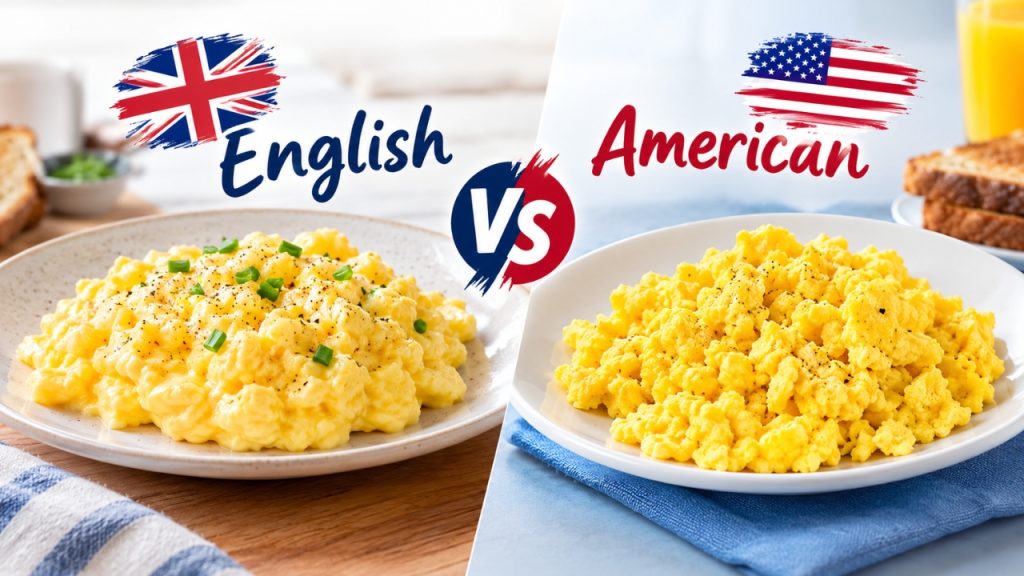
The pan is barely warm, the whisk hovers mid-air, and a cook in London nudges the curds with a wooden spoon every ten seconds, patient as a watchmaker. Three thousand miles away, a diner cook cracks the same six eggs into a hot skillet, folds hard for ninety seconds, and plates them glossy and fluffed. Both call it scrambled eggs. Only one of them is making a food-safety decision without realizing it.
The honest answer to which style “wins” isn’t about taste at all. It’s about six degrees of temperature and a set of regulatory differences between UK and US eggs that most comparisons never mention. Once you know both, picking a winner for your own kitchen stops being a guess.
Step 1: Learn the exact window where curds turn from silk to rubber
Egg proteins unfold and link together — coagulate — in stages as heat rises. Whites begin firming around 144–149°F (62–65°C). Yolks start setting a little higher, roughly 149–158°F (65–70°C). By about 160°F (71°C), curds are fully set and food-safety agencies consider the egg cooked through. Push much past 180°F (82°C) and the protein network tightens so much it squeezes out moisture — that’s the rubbery, weeping curd everyone complains about.
Without a thermometer, judge it by look and sound: curds that are glossy, slightly wet, and silent against the spoon are still in the creamy 149–160°F zone. Curds that look matte, bounce off the pan, and squeak slightly have crossed past 160°F and are heading toward dry.
The entire English-versus-American debate collapses into one fact: it’s a six- to eight-degree gap between silky and rubbery, and whichever style you cook, your job is simply to stop before you cross it.
Tip: pull the pan off the heat while the eggs still look slightly underdone — residual heat in the curds finishes the job in the next 20–30 seconds.
Step 2: Check what’s actually different about your eggs before you choose doneness
This is the part other comparisons skip. UK eggs carrying the British Lion mark come from hens vaccinated against Salmonella Enteritidis, are sold unwashed with their natural protective bloom intact, and aren’t required to be refrigerated. US eggs are washed and chilled (which strips the cuticle and means they must stay refrigerated), and there is no nationwide mandatory vaccination program comparable to the UK scheme.
None of the evidence directly pits “UK egg” against “US egg” in a single trial — but a run of case-control studies on human Salmonella infections, done in different countries, all point the same direction: undercooked or raw eggs are a real and sometimes large risk factor. A Dutch study found raw-egg consumption raised the odds of Salmonella Enteritidis infection roughly threefold (Netherlands Salmonella risk-factor study). A German study found the odds ratio for raw eggs was 4.4 when comparing Enteritidis to other serotypes, and jumped to 30.3 when comparing all salmonella patients to healthy controls (South-West Germany Salmonella study). In the US, eating eggs prepared outside the home carried over six times the odds of Salmonella Heidelberg infection, accounting for an estimated 37% of cases in that study (FoodNet Salmonella Heidelberg study). A Canadian study found undercooked eggs raised the odds of Heidelberg infection more than sevenfold (Canadian Salmonella Heidelberg study), and a separate FoodNet study of Enteritidis cases again flagged undercooked eggs eaten at home as an independent risk factor (FoodNet Enteritidis re-assessment). These are all observational case-control studies, not controlled experiments, and the size of the risk swings a lot between them — but the direction never flips.
Tip: vaccination and clean shells lower the odds of contamination before the egg ever reaches your pan — they don’t erase the risk, so “softer is safer in the UK” is a matter of degree, not a guarantee.
Step 3: Decide who should skip the soft English curd entirely
Given that undercooked eggs show up repeatedly as an infection risk factor across countries, certain people should stick to the firmer, fully-set American-diner endpoint regardless of where they live: young children, pregnant people, anyone immunocompromised or elderly, and — this is the key point — anyone cooking with standard, washed, refrigerated grocery eggs that lack a vaccination guarantee. For that group, the slow, glossy, barely-set English curd is the wrong choice, no matter how good it tastes.
Tip: if you want the creamy English texture and you’re in a higher-risk group, use pasteurized shell eggs — they tolerate the lower end of the temperature window safely.
Step 4: Stop blaming the pan for nutrient loss
No study in this evidence base measured protein, choline, or vitamin D retention by scrambling style, and there’s a simple reason: these nutrients survive coagulation. Denaturing a protein changes its shape, not its amino-acid content, and the fat-soluble vitamins ride along with the yolk fat whether you stir gently for four minutes or fold hard for ninety seconds. The visible difference between English and American eggs is moisture and curd size — a texture story, not a nutrition story.
Step 5: Settle the real score
Because both styles start from identical eggs, the base protein and fat are the same before the pan is even hot. The only thing that shifts the final plate is what’s folded in.
| Factor | English style | American style |
|---|---|---|
| Typical add-in | splash of milk or cream, butter | butter, often cheese |
| Egg protein | unchanged by stirring speed | unchanged by folding speed |
| Extra fat/protein source | cream or milk (modest) | cheese (larger addition) |
| Where the “winner” is decided | what you add, not how you stir | what you add, not how you fold |
So the real verdict: with equal eggs and equal butter, the two styles are nutritionally a tie. The moment one cook adds cheese and the other adds a splash of milk, the cheese version pulls ahead on fat and protein per serving — but that’s an ingredient choice, not a technique winning.
Common mistakes
- Cranking the heat to rush English-style eggs, which blows straight past 160°F and turns silky curds rubbery in seconds.
- Assuming any supermarket egg is safe at soft-English doneness just because it’s fresh-looking.
- Judging doneness by color alone instead of touching or listening for the squeak of overcooked curd.
- Serving soft-set eggs to children, pregnant people, or immunocompromised guests without asking what kind of egg was used.
- Crediting the cooking style for nutrient differences that actually come from the cheese or milk folded in.
Sources
- Risk factors for Salmonella Enteritidis and Typhimurium infections in The Netherlands (2006)
- Egg consumption as the principal risk factor for sporadic Salmonella Heidelberg infections, FoodNet (2004)
- Frozen chicken nuggets/strips and eggs as risk factors for Salmonella Heidelberg in Canada (2005)
- Re-assessment of risk factors for sporadic Salmonella Enteritidis infections, FoodNet (2007)
- Serovar-specific risk factors for Salmonella Enteritidis in South-West Germany (2000)