Eggs vs. Oatmeal: Which Is Better for a Healthy Breakfast?
The real answer depends on toppings, cooking method, your cholesterol response, and what "healthy" means for your body.
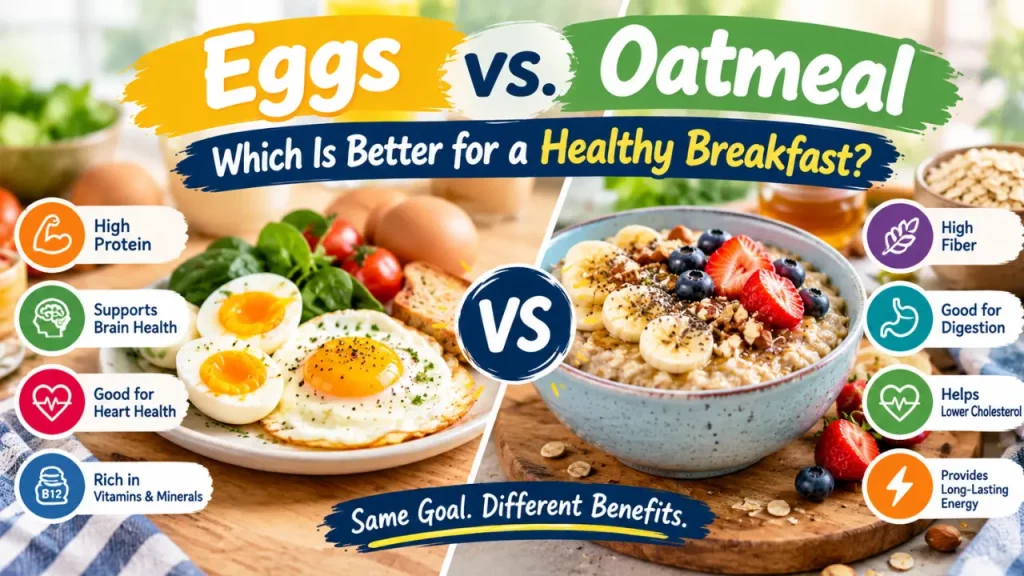
The common assumption is that this is a simple protein-versus-fiber showdown — eggs bring the protein, oatmeal brings the fiber, and whichever nutrient you personally value more should decide your breakfast. That framing makes for a tidy headline, but it skips almost everything that actually determines whether a bowl of oatmeal or a plate of eggs is doing you any good on a given morning. The honest answer is that neither food is “better” in the abstract. What matters is how each one is prepared, what sits next to it on the plate, and how your own body happens to respond to it.
1. The food on your plate is rarely just the food you named
Nobody eats plain boiled egg whites or plain dry oats for breakfast very often. Eggs usually arrive with butter, cheese, bacon, or white toast. Oatmeal usually arrives with brown sugar, dried fruit, flavored syrup packets, or a flood of maple syrup. Once you add those, the comparison you started with has already been replaced by a different one: bacon-and-cheese-eggs versus sugar-and-dried-fruit-oatmeal. Most coverage of this topic compares the base ingredients as if they appear on their own, then lets readers draw conclusions that don’t hold up once real-world toppings enter the picture.
A practical way to think about it: the “egg or oatmeal” decision matters far less than the “what did you put on it” decision. A vegetable-and-egg scramble cooked in a small amount of olive oil and a bowl of plain oats with nuts and cinnamon are both solid choices. Fried eggs swimming in butter next to white toast, or instant oatmeal loaded with added sugar, are both mediocre choices — regardless of which base food you picked.
2. Cooking method changes the nutrition profile more than people assume
Eggs scrambled in a generous pat of butter or fried in bacon grease pick up considerably more saturated fat than eggs poached in water or boiled in the shell. Oatmeal cooked in whole milk versus water, or instant flavored packets versus steel-cut oats simmered plain, likewise end up as very different foods despite sharing a name. Articles that compare “an egg” to “a bowl of oatmeal” without specifying preparation are comparing two moving targets, not two fixed foods.
This also affects fiber and starch digestion. Steel-cut and rolled oats break down more slowly than instant oats, which are processed into finer pieces that the body digests faster. That difference in texture, not some hidden difference in the oats themselves, is a major reason some people feel fuller longer on one type of oatmeal than another.
3. The cholesterol question is more nuanced than “eggs raise cholesterol”
Eggs carry a reputation for being high in dietary cholesterol, and for decades that drove blanket advice to limit them. The nuance that gets lost is that dietary cholesterol and blood cholesterol are not the same thing, and people’s bodies respond to dietary cholesterol differently. Some people are “hyper-responders” whose blood cholesterol rises noticeably when they eat more cholesterol-containing foods; many others see little to no change because their liver compensates by producing less cholesterol internally. There is no blood test most people get before breakfast that tells them which category they fall into, which means a blanket rule — “eggs are fine” or “eggs are risky” — cannot honestly apply to everyone.
Oatmeal, by contrast, contains no cholesterol and brings soluble fiber that has a modest cholesterol-lowering effect for many people. That is a real advantage for oatmeal, but it’s a population-level tendency, not a guarantee for any one individual sitting down to breakfast.
4. Fiber is the clearest nutritional gap, but it cuts in a specific way
Eggs contain essentially no dietary fiber. Oatmeal’s fiber comes largely from a soluble fiber called beta-glucan, which slows digestion, feeds gut bacteria, and is linked with steadier post-meal blood sugar and better satiety for many eaters. This is one of the few places where the two foods are genuinely not interchangeable — if fiber intake is a concern, oatmeal has an advantage that eggs simply cannot offer, no matter how they’re cooked.
That said, fiber from oatmeal alone is not a complete solution to a low-fiber diet, and people who eat oatmeal once and then nothing but refined carbohydrates the rest of the day won’t see much benefit. Fiber’s effects build from consistent daily intake across meals, not from a single bowl.
5. Protein quality matters as much as protein quantity
Eggs are often called a “complete protein,” meaning they contain all nine essential amino acids in proportions the body uses efficiently. Oats contain protein too, but in smaller amounts and in a profile that is less complete on its own. This is a real distinction, but it mostly matters for people trying to hit specific protein targets — athletes, people recovering from illness, older adults working to preserve muscle mass. For someone just trying to eat a reasonably balanced breakfast, pairing oatmeal with milk, yogurt, or nuts closes much of that gap, since the amino acids from different plant and dairy sources complement each other across a meal.
6. Satiety is personal, and the research on it disagrees
Some people report feeling fuller longer after an egg breakfast than after an equivalent oatmeal breakfast, and some research on satiety does point toward protein and fat being more filling per calorie than carbohydrate-heavy meals. But other people report the opposite, especially when the oatmeal is made with milk, nuts, or seeds that add protein and fat on top of its fiber. Individual differences in gut hormone response, habitual diet, and even how quickly someone eats all affect how long a breakfast keeps hunger away. A single study result about “eggs versus oatmeal and fullness” cannot be generalized to every reader’s body, and treating it as settled science is one of the more common shortcuts in coverage of this topic.
7. Allergies, intolerances, and practical constraints get skipped entirely
Egg allergy is common enough in children, and some adults carry it into later life, making the entire comparison moot for them. Oats are naturally gluten-free but are frequently processed in facilities that also handle wheat, which matters a great deal for people with celiac disease or gluten sensitivity who need certified gluten-free oats specifically. Cost, prep time, and kitchen access matter too — oatmeal requires only hot water or a microwave, while eggs generally need a stove, a pan, and a few more minutes of attention. None of this shows up in a nutrient-chart comparison, but for a lot of people it’s the deciding factor on a weekday morning.
Neither eggs nor oatmeal deserves the crown this question keeps trying to hand out. The better question is what you’re adding, how it’s cooked, how your own body tends to respond to cholesterol and fiber, and what else you eat across the rest of the day. Pick the one that fits your health goals, your schedule, and your gut — or, just as reasonably, rotate between both.

Tom Fletcher
The latest from the Australian and global BBQ scene — comps, cooks and culture.