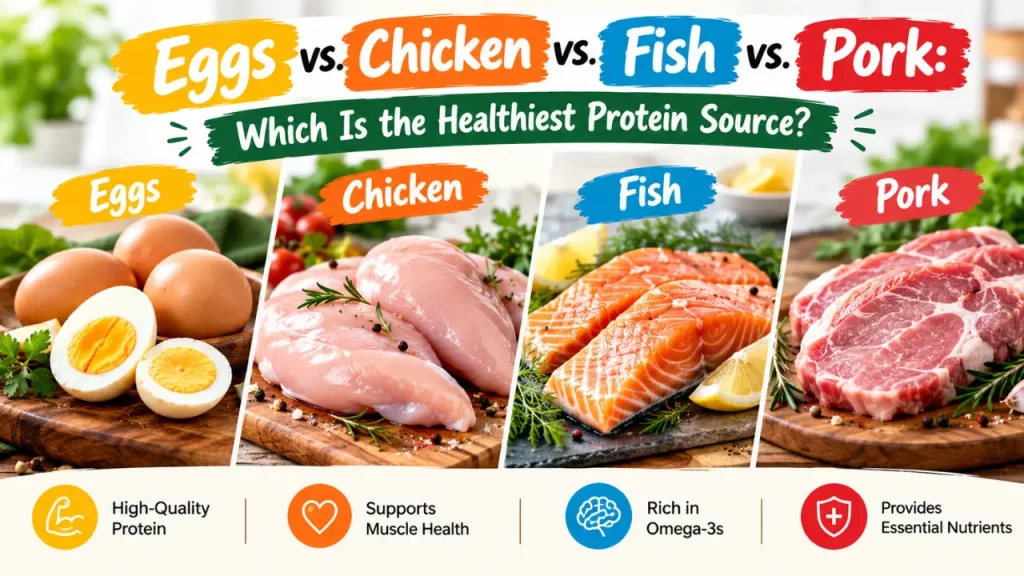
Eggs vs. Chicken vs. Fish vs. Pork: Which Is the Healthiest Protein Source?
Digestibility scores reveal which protein your body truly absorbs — and the exact gram thresholds where fish, pork or processed meat start adding risk.
Here is the number that should change how you read a nutrition label: an extra 30 grams of processed meat a day — about one strip of bacon or a single hot dog — is linked to a 36% higher risk of colorectal cancer, according to a dose-response meta-analysis of meat and colorectal cancer. Thirty grams. Not a pound. Not a weekly binge. One small daily serving, repeated over years, is the dose that shows up in the data.
The short answer: eggs and lean pork post the best digestibility scores for muscle-building protein, fish wins on nutrient density per calorie, and processed pork and high-mercury fish are the only two of the four with hard, quantifiable danger thresholds — everything else is a matter of portion and cooking.
Most comparisons stop at “all four are complete proteins.” That’s true and also not very useful, because complete doesn’t mean equally absorbed, and healthy doesn’t mean equally safe at every dose. Below are the two questions that actually matter: which protein does your body use best, and at what specific amount does each one start working against you.
Side One: The Absorption Race — What the Body Actually Uses
Two scoring systems exist for protein quality. PDCAAS (Protein Digestibility-Corrected Amino Acid Score) caps every high-quality animal protein at 1.0, which flattens real differences — eggs, chicken, fish and pork all round up to a perfect score and look identical. DIAAS (Digestible Indispensable Amino Acid Score) doesn’t cap the number, and that’s where the four foods actually separate. Values above 100 mean a protein supplies more digestible essential amino acids, relative to need, than the reference standard.
On DIAAS, whole eggs and lean pork cluster at the top of the range, generally scoring above 110, meaning virtually all of their amino acids are absorbed and usable for tissue repair and muscle synthesis. Chicken breast sits a notch lower, commonly in the 105-110 range. Fish varies more by species and tends to land slightly lower still, often in the mid-90s to low 100s, because its amino acid profile is a little less matched to human needs, not because it digests poorly. In practice, these gaps are small enough that no one should choose a protein source based on DIAAS alone — but if you’re deciding between, say, a boiled egg and a piece of white fish post-workout, the egg has a genuine, measurable absorption edge.
Side Two: The Risk Thresholds — When Protein Turns Against You
This is the part most comparisons skip, and it’s where the real decisions live.
Processed meat and cancer. The evidence here is unusually consistent across independent analyses. A meta-analysis of prospective cohort studies on red and processed meat found every additional 100 grams a day of red and processed meat combined raised colorectal cancer risk by 14%. A separate dose-response analysis isolated processed meat specifically and found 30 grams a day carried a steeper 36% increase, compared with a 24% increase per 120 grams a day of unprocessed red meat — meaning gram for gram, processed pork products carry roughly four times the apparent risk of fresh pork or beef. A broader systematic review and meta-analysis confirmed the positive dose-response pattern across colon, proximal, distal and rectal cancer subtypes. It’s worth noting a later large cohort review covering more than six million participants judged the overall certainty of this evidence as low, and an independent quantitative update on unprocessed red meat alone found only a weak, inconsistent association (relative risk 1.11). The honest reading: the processed-meat signal is the strongest and most repeatable; the unprocessed red meat signal is real but smaller and less certain.
Mercury in fish. Not all fish carry the same exposure. Large predatory species — swordfish, shark, king mackerel — accumulate mercury at roughly 20 to 50 times the level found in low-mercury choices like salmon or sardines, which is why health agencies set per-species limits rather than a blanket “eat more fish” rule. Someone eating swordfish twice a week is in a completely different risk category than someone eating salmon twice a week, even though both would be listed under the same “fish” header in a generic comparison article.
Purines and gout. This is the gap nobody fills. Oily fish such as sardines and herring, along with pork organ meats, are classified as high-purine foods, generally exceeding the 150 mg-per-100g mark that clinicians use as the gout-flare threshold. Chicken breast and most pork loin cuts sit in a moderate middle zone. Eggs are the outlier worth remembering: they carry almost no purines at all, making them one of the few genuinely gout-safe animal proteins when sardines, mussels and pork liver are off the table.
Chronic kidney disease. For anyone with reduced kidney function, the source of protein matters far less than the total amount, because every gram — egg, chicken, fish or pork — generates nitrogenous waste the kidneys must clear. Nephrology guidelines typically call for scaling back total daily protein well below standard intake levels in non-dialysis CKD, which means portion control, not protein switching, is the real intervention.
Eggs, cholesterol and diabetes. The claim that eggs are “safe” for the heart isn’t uniform. In people without diabetes, trial evidence generally shows only modest shifts in blood lipids from regular egg intake. In people with diabetes, several studies have found a more pronounced cholesterol response, which is why diabetic patients specifically are the group most often advised to track egg yolk intake rather than ignore it.
| Protein | Relative digestibility (DIA |
|---|

James Carter
The EverBBQ editorial desk — covering BBQ news, features and everything off the grill.