Crab vs. Lobster: Which Seafood Has More Protein and Less Fat?
Protein and fat are nearly a tie — sodium, purines and cooking method are where gout, heart and blood pressure patients should actually look.
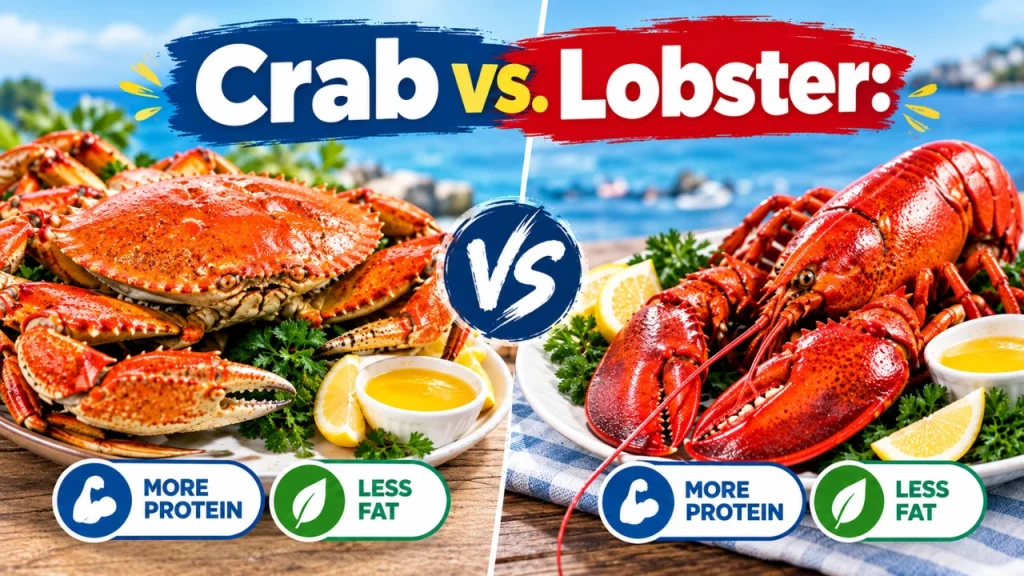
The real difference between crab and lobster isn’t on the nutrition label — it’s in the pot, the can, and the butter dish. Per 100 grams, these two shellfish land close enough in protein and fat that picking a “winner” misses the point. The numbers that actually change outcomes for someone managing gout, high blood pressure, heart disease or fatty liver are sodium, saturated fat, and what happens between the dock and the dinner plate.
Which has more protein and less fat — crab or lobster?
Based on official USDA figures for blue crab cooked in moist heat, 100 g delivers 17.9 g protein, 0.74 g total fat, and 83 kcal, with saturated fat at just 0.2 g USDA FoodData Central, crab blue cooked. That’s already a lean, high-protein food by any standard. Different published nutrient datasets put lobster’s protein and calories slightly above or slightly below those crab numbers depending on species and reference source — which is exactly why so many articles stall out calling it “basically a tie.” It is. The more useful question is what changes once you add the pot, the can, or the butter.
Does cooking or canning actually change crab’s protein and fat?
Barely — but it quietly reshapes sodium. Canned blue crab shows the identical protein (17.9 g), fat (0.74 g), and calorie count (83 kcal) per 100 g as moist-heat cooked crab USDA FoodData Central, crab blue canned. Macro-wise, canning changes nothing. Sodium is a different story entirely.
| Per 100 g | Crab, cooked (moist heat) | Crab, canned |
|---|---|---|
| Protein | 17.9 g | 17.9 g |
| Total fat | 0.74 g | 0.74 g |
| Sodium | 395 mg | 563 mg |
How much does sodium really jump between fresh and canned crab?
By about 43% per serving. Fresh, moist-heat-cooked crab carries 395 mg sodium per 100 g (112 mg per 1 oz/28 g), while canned crab carries 563 mg per 100 g (160 mg per 1 oz/28 g) — a jump of 168 mg per 100 g, roughly the same proportional increase at the ounce level (48 mg more per 28 g) USDA FoodData Central, crab blue canned. For someone managing high blood pressure, that’s the difference between a modest sodium contribution from a crab salad and a meaningfully larger one from the same amount of canned crab meat — before any added salt, sauce, or crackers enter the picture. There’s no equivalent USDA breakdown in this dataset for lobster boiled in salted water versus steamed, which is a genuine blind spot in the available nutrition data — but the crab comparison shows just how much the preparation method alone can move sodium without changing a single gram of protein or fat.
Does crab’s cholesterol matter more than its saturated fat for heart health?
For most people, the saturated fat number matters more than the cholesterol number. Crab’s saturated fat is extremely low at 0.2 g per 100 g, with monounsaturated fat at 0.13 g and polyunsaturated fat at 0.26 g USDA FoodData Central, crab blue cooked. A review of dietary interventions on arterial stiffness found that replacing saturated fat with the mono- and polyunsaturated fats typical of seafood reduces the risk of arterial stiffening, a key early marker of cardiovascular risk review on dietary fat and arterial stiffness, Nutrients 2023. A small randomized crossover trial in 20 healthy adults also found that replacing meat protein with lean seafood improved fasting and after-meal blood lipid markers compared with lean beef crossover RCT on lean seafood and lipid risk factors, AJCN 2015. Neither study tested crab or lobster specifically, and the second was small and done in healthy subjects, not people with existing heart disease — but both point the same direction: it’s the saturated fat you add at the table, not the shellfish itself, that moves cardiovascular risk markers the most.
Is crab or lobster the safer choice for gout?
Neither USDA entry used here breaks out purine content, which is the honest reason so many articles dodge this question. What is documented is that seafood consumption has been studied as a risk factor for gout across multiple cohort studies, with effects that differ by gender and alongside other factors like alcohol, meat, and dairy intake systematic review of gender-specific gout risk factors, Advances in Rheumatology 2019. Because species-level purine values aren’t part of the standard nutrient panels used here, the responsible answer for someone with gout isn’t “pick crab over lobster” — it’s to treat both as moderate-purine proteins and control portion size rather than assume one shellfish is categorically safer than the other.
Can people with fatty liver disease (NAFLD) eat crab or lobster?
Likely yes in sensible portions, based on how lean protein and lean fish affect related metabolic markers, though no study here tested crab or lobster in NAFLD patients directly. An 8-week multicenter trial of 273 people with metabolic syndrome found that 100 g per day of white fish lowered LDL cholesterol, waist circumference, and diastolic blood pressure WISH-CARE randomized trial, white fish and metabolic syndrome, 2014 — metabolic syndrome and NAFLD share overlapping drivers like excess saturated fat and insulin resistance. A national US risk-factor analysis also listed low dietary omega-3 intake from seafood among 12 modifiable risk factors tied to preventable deaths comparative risk assessment of US dietary risk factors, PLoS Medicine 2009. The caveat: these trials used plain fish, not butter-dipped or fried shellfish, and NAFLD-specific shellfish trials don’t exist in this evidence base.
How much protein and fat survive once you factor in shell waste and butter?
Far less than the per-100g label suggests. The USDA figures above are for edible meat only — once you account for a whole steamed crab or a cluster of legs, a large share of the purchased weight is shell, not meat, so the real protein delivered per “serving as bought” is lower than the clean 17.9 g per 100 g implies. Then there’s the dip: since crab’s own saturated fat is just 0.2 g per 100 g, a butter dip or deep-fry breading can out-contribute the shellfish itself to total saturated fat on the plate, which is precisely the mechanism the arterial-stiffness research flags as the one to watch dietary fat and arterial stiffness review, Nutrients 2023.
Does crab or lobster really have more omega-3s?
The contradiction in other sources likely comes down to which fat fraction they’re reporting, not a real disagreement about the shellfish. USDA’s crab entry shows 0.26 g polyunsaturated fat per 100 g, a category that includes omega-3s but isn’t broken into EPA and DHA milligrams in this dataset USDA FoodData Central, crab blue cooked. Without a matching EPA/DHA line for lobster in the same format, a precise milligram-for-milligram ranking isn’t something this evidence can honestly support — what the broader research does support is that seafood-derived omega-3s, as a category, are linked to lower mortality risk at the population level US dietary risk factor mortality analysis, PLoS Medicine 2009.
So what should someone with gout, heart disease, or high blood pressure actually order?
Steamed or boiled crab and lobster without added salt or butter are close enough nutritionally that the cooking method matters more than the species. For high blood pressure, favor fresh over canned crab given the roughly 43% sodium increase shown above. For heart disease, skip the butter dip rather than the shellfish — the saturated fat you add dwarfs what’s naturally in either animal. For gout, treat both as moderate-purine proteins and control portions rather than assuming one is safer. For fatty liver concerns, plain prepar

James Carter
The EverBBQ editorial desk — covering BBQ news, features and everything off the grill.