Cod vs. Haddock vs. Tilapia: Which White Fish Is Best for a Healthy Diet?
The right white fish depends on your blood pressure, pregnancy, inflammation risk, or muscle goals — not on a single "winner."
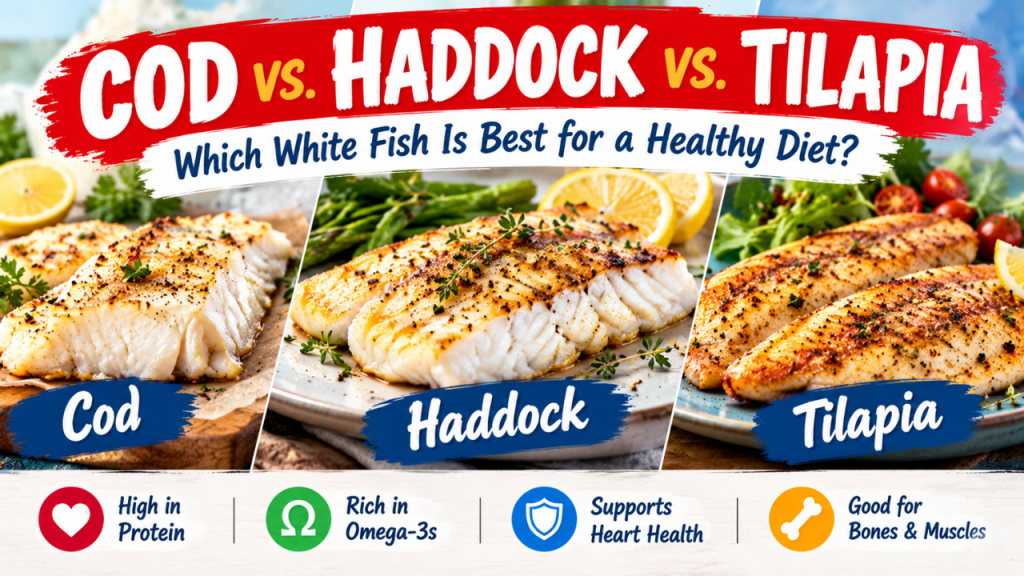
Are you buying fish for your blood pressure, your pregnancy, your inflammation, or your gym goals? That question — not “which fish has the most protein” — is the one that actually decides whether cod, haddock, or tilapia belongs on your plate. All three are lean, low-mercury, FDA-listed “Best Choices” seafood, so that part of the debate is settled. What’s not settled is which one fits your specific situation, and that’s where most comparisons stop short.
Which fish is best if you’re pregnant?
Haddock edges ahead for pregnancy nutrition because of its vitamin B-12 content, but the margin matters less than people assume. Per 100 g cooked, haddock supplies 2.13 µg of B-12 and 31.7 µg of selenium, compared with tilapia’s 1.86 µg B-12 and 54.4 µg selenium, according to USDA data on cooked haddock and USDA data on cooked tilapia. Selenium actually favors tilapia here — almost double haddock’s amount. Since both nutrients support fetal development and low mercury is the main safety concern (already shared by all three fish), the practical answer is: whichever one you’ll actually eat twice a week is the right choice. Just skip smoked or salt-cured haddock during pregnancy, for reasons explained below.
Which fish is best for heart disease or high blood pressure?
For straightforward cardiovascular risk, cod and tilapia pull in opposite directions depending on which number you’re managing. If sodium is your concern, tilapia wins clearly: 56 mg per 100 g versus cod’s 134 mg and haddock’s 261 mg, per USDA data on cooked Pacific cod. That’s not a small gap — haddock carries nearly five times tilapia’s sodium and almost double cod’s, even before any curing or smoking. But if saturated fat is the bigger worry, cod and haddock win decisively: cod has just 0.05 g saturated fat per 100 g and haddock 0.11 g, while tilapia has 0.94 g — roughly 8 to 19 times more. For most people with hypertension managed by diet, the sodium difference matters more day-to-day than fish-derived saturated fat, which is tiny across all three compared with red meat or dairy. The honest takeaway: tilapia is the better pick for sodium-sensitive hypertension, cod is the better pick if your doctor has flagged saturated fat specifically.
Does haddock’s “low sodium” reputation hold up?
Not once you account for how it’s often sold. Plain, dry-heat-cooked haddock already carries 261 mg of sodium per 100 g — nearly double cod’s 134 mg — according to USDA’s haddock entry. That’s before factoring in smoked or salt-cured haddock, a traditional preparation especially common in the UK and Scotland, which is brined or cured specifically to preserve and flavor the flesh. Curing adds sodium chloride directly into the fish tissue, meaning a cured fillet can run meaningfully saltier than the plain cooked values above — a detail that gets lost when articles simply label haddock “low-sodium” based on fresh fillets alone. If you have hypertension and you’re buying haddock, the fresh or frozen plain fillet and the smoked one are not nutritionally interchangeable, even though they look identical on a menu.
Is tilapia actually bad for inflammation?
The evidence is real but thinner than the warnings suggest. A review of tilapia fatty-acid composition studies found that farmed tilapia tends to have an elevated omega-6 to omega-3 ratio and contains arachidonic acid, an omega-6 fat that can promote inflammatory pathways when consumed in excess, according to a 2009 review on omega-6 and omega-3 fatty acids in tilapia. That same review, however, found that wild tilapia generally has more omega-3s than farmed tilapia, and that feed adjustments on farms can shift the ratio — meaning “tilapia” isn’t one fixed nutritional profile. The review’s own conclusion is cautious: people should weigh their individual fatty-acid needs rather than treat tilapia as uniformly inflammatory. In practice, this means tilapia is a reasonable concern for someone already managing chronic inflammation, autoimmune flare-ups, or established cardiovascular disease, where minimizing omega-6 intake is a specific goal — but it is not evidence that occasional tilapia is harmful for a generally healthy person. If inflammation management is central to your diet, cod’s 0.11 g polyunsaturated fat per 100 g and haddock’s 0.2 g are reasonable neutral picks; tilapia’s 0.6 g polyunsaturated fat is higher in volume but includes more of that omega-6 share.
Does it matter where your tilapia was farmed?
Yes, and this is rarely discussed outside contaminant panels focused only on mercury. A small 2024 study testing 24 retail tilapia samples in Tema, Ghana, detected antibiotic residues at notable frequencies: tetracycline in 62.5% of samples, oxytetracycline in 58.3%, amoxicillin in 54.2%, and erythromycin in 20.8%, according to a 2024 study on antibiotics in farmed tilapia. This is one local market, not a global audit, and regulations differ enormously by country — tilapia farmed under US or Canadian aquaculture oversight faces different antibiotic and feed restrictions than tilapia from regions with looser enforcement. The takeaway isn’t “avoid all tilapia” — it’s that tilapia’s contaminant risk varies by origin far more than cod’s or haddock’s does, since wild-caught cod and haddock aren’t raised on managed feed and antibiotic regimens at all. Checking the country-of-origin label on tilapia is a more useful safety step than checking mercury alone, since all three fish are already low-mercury.
Which fish wins for muscle-building goals?
It depends whether you’re counting total protein or protein per calorie. Tilapia delivers the most raw protein, 26.2 g per 100 g, versus cod’s 20.4 g and haddock’s 20 g, per USDA data cited above. But per calorie, cod is actually the most efficient: 84 kcal for 20.4 g protein works out to about 0.24 g of protein per calorie, versus roughly 0.22 for haddock and 0.21 for tilapia. If you’re bulking and calories aren’t a constraint, tilapia’s density wins. If you’re building muscle on a calorie deficit or cutting phase, cod gives you marginally more protein for the same calorie cost.
So which fish should you actually buy?
Match the fish to the goal rather than searching for one universal winner.
| Your priority | Best pick | Key number |
|---|---|---|
| Hypertension / sodium control | Tilapia | 56 mg sodium per 100 g vs. haddock’s 261 mg |
| Chronic inflammation or heart disease | Cod or haddock | 0.05–0.11 g saturated fat per 100 g vs. tilapia’s 0.94 g |
| Pregnancy | Either haddock or tilapia | B-12 2.13 µg (haddock) vs. selenium 54.4 µg (tilapia), per 100 g |
| Calorie-conscious muscle building | Cod | ~0.24 g protein per calorie |
| Maximum total protein, calories unrestricted | Tilapia | 26.2 g protein per 100 g |
Buying smoked or cured haddock changes the hypertension calculation entirely, and buying imported tilapia without a clear origin label reintroduces a contaminant risk that mercury testing alone won’t catch.
Which of these situations matches yours — are you shopping for blood pressure, pregnancy, or the gym?
Sources

James Carter
The EverBBQ editorial desk — covering BBQ news, features and everything off the grill.