Clams vs. Oysters vs. Mussels: Which Has More Iron and Vitamins?
Clams top the iron and B12 charts, but absorption, zinc overload, and heavy-metal buildup change who should actually eat them.
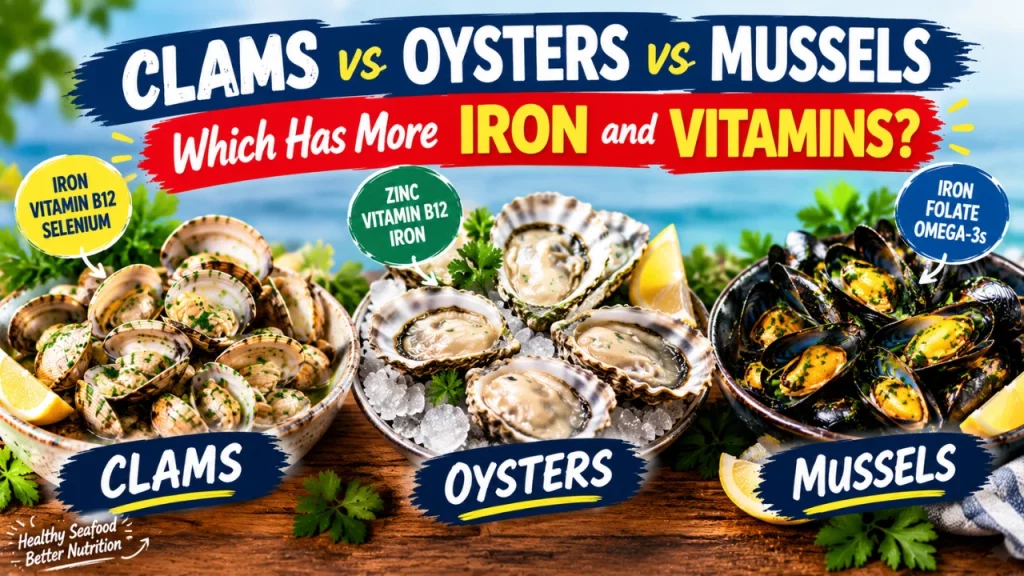
Clams carry more iron per 100 grams than a slice of liver, but almost none of us is built to absorb all of it — and the same shellfish that fixes one person’s iron deficiency can tip another person into copper deficiency or metal overload.
The short answer: clams lead on iron and B12, oysters dominate zinc by a wide margin, and mussels sit in the middle on nearly everything — but the number on the label is not the number your body keeps.
1. Who actually wins, in real numbers
Raw clams carry roughly 13.98 mg of iron per 100 g, compared with about 6.66 mg in raw Eastern oysters and 3.95 mg in raw blue mussels — clams are better than double the oysters and more than triple the mussels. Clams also run away with vitamin B12, a point already well covered elsewhere, so it won’t be repeated here. Oysters are the outlier on zinc, at roughly 78.6 mg per 100 g versus about 1.4 mg in clams and 1.6 mg in mussels — oysters aren’t just “zinc-rich,” they are in a different category entirely, carrying over 50 times the zinc of the other two.
Mussels don’t win any single column, but they’re the only one of the three that pairs moderate iron and zinc with meaningful omega-3 content, which is the “balanced all-rounder” case made elsewhere. What’s missing from that comparison — and what actually determines whether these numbers matter for your health — is how much of that iron and zinc your gut lets through, and what happens once it does.
2. Why the iron number keeps changing depending on who you ask
The same clam can show iron values from about 13.98 mg to 29.45 mg per 100 g depending entirely on preparation, not species. Raw clams sit near 13.98 mg per 100 g. Canned, drained clams climb to roughly 23.8 mg per 100 g because canning concentrates minerals as water and volume are lost. Clams cooked by moist heat go further still, to around 29.45 mg per 100 g, for the same reason — water cooks out, iron stays in, and the per-100g denominator shrinks around it.
This matters practically: a chart listing “clams: 23.8 mg iron” and another listing “clams: 29.45 mg iron” aren’t disagreeing about biology, they’re describing canned versus steamed clams. If you’re choosing shellfish for iron, the prep method moves the number more than switching from clams to mussels does.
3. The absorption gap nobody puts on the label
A gram of iron on a nutrition panel is not a gram of iron in your bloodstream. Controlled human studies using radiolabeled iron found that heme iron — the form in shellfish flesh — is absorbed at around 15% in a typical mixed meal, with nonheme iron absorbed far less efficiently, around 7%, according to research measuring mucosal uptake and absorption of heme and nonheme iron. A separate set of absorption studies found heme iron bioavailability ranging from about 13% when eaten alone up to roughly 25% when delivered as red blood cell concentrate, and around 21.3% when red blood cell concentrate was eaten with beef, according to research on animal proteins and heme iron bioavailability.
Other work shows just how much that figure can swing depending on digestive conditions: one trial found heme iron absorption from hemin alone at 16.4%, dropping to 13.1% with added mucin, and in a separate arm, trypsin addition pushed absorption from 5.1% down to 2.9%, according to research on trypsin and mucin effects on heme iron bioavailability. In plain terms: the “%DV” printed on an iron figure assumes close to full absorption, but real human trials show anywhere from roughly 3% to 25% actually gets retained, depending on what else is happening in the gut that day. A 23.8 mg iron serving of canned clams is not delivering 23.8 mg of usable iron to your body — it’s delivering somewhere closer to a tenth of that, give or take, depending on the conditions above.
4. What pushes that absorption number up or down at your own table
Calcium doesn’t appear to blunt heme iron absorption the way some people assume — a controlled trial adding calcium as cheese to a high-bioavailability meal found no significant change in either nonheme uptake or heme iron absorption, according to the same uptake and absorption study. So pairing clams with a cheese-based sauce isn’t the iron-blocking move it’s sometimes made out to be.
Prebiotic fiber, on the other hand, measurably helped: women who consumed a prebiotic mix daily for 12 days saw heme iron bioavailability rise by 56% compared with before the intervention, with no change to nonheme iron absorption, according to a study on prebiotics and iron bioavailability. Separately, loading a diet with meat modestly increased nonheme iron absorption, from a geometric mean of 4.81% on a freely chosen diet to 6.47% with maximum meat intake, though the increase fell just short of standard statistical significance, according to research on meat intake and nonheme iron absorption. The takeaway for a real plate: fiber-rich sides may help more than dairy hurts, and piling on extra meat alongside shellfish gives a small, inconsistent boost at best.
5. The oyster zinc number that’s actually a warning label
Oysters’ roughly 78.6 mg of zinc per 100 g isn’t just high — it’s close to double the commonly cited tolerable upper intake level of 40 mg per day for adults, a threshold set specifically because chronic zinc excess interferes with copper absorption. A single generous serving of raw oysters can realistically approach or exceed that daily ceiling on its own, before counting any other zinc source in the day’s meals.
This is the overlooked risk: zinc and copper comp
