Cheesecake vs. Apple Pie: Which American Dessert Is More Popular?
The real answer changes by age, region, occasion, and budget—here's the decision framework instead of another survey.
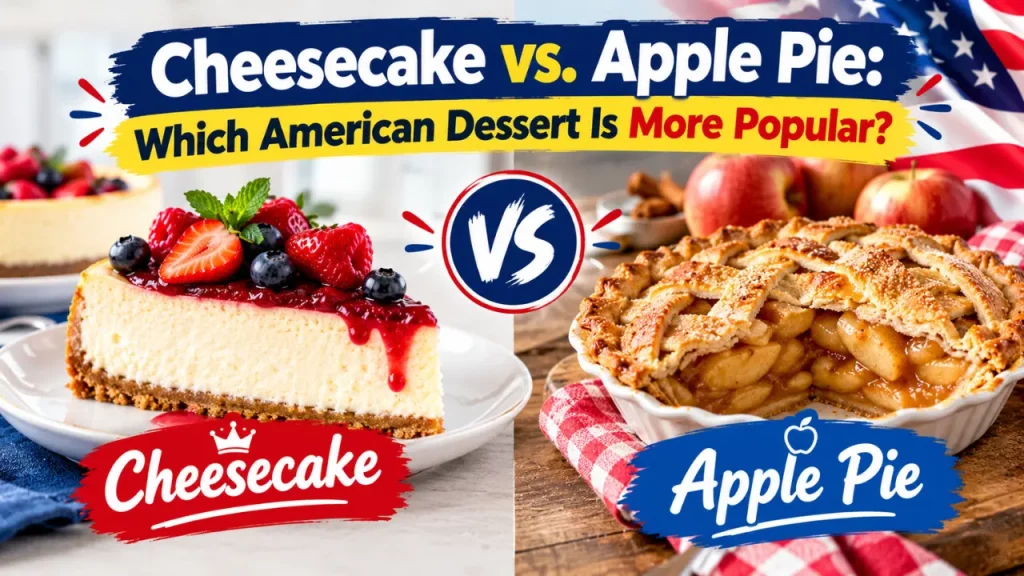
Ask someone which dessert is more American, and most people answer before you finish the question: apple pie, obviously. It feels like settled history, the dessert equivalent of the flag. But “more popular” is doing a lot of hidden work in that sentence, because popularity isn’t one contest. It’s several different contests running at once, and apple pie doesn’t win all of them. Surveys that ask people to name the “most American” dessert do tend to crown apple pie, while surveys that track restaurant menus and online recipe searches usually hand that particular win to cheesecake, and anything measured specifically at Thanksgiving gets beaten by pumpkin pie before either of them has a chance. None of those numbers tell you what to actually serve at your dinner party next Saturday. That requires a different kind of answer.
This is a decision guide, not a scoreboard. Work through the steps below based on your actual situation, and you’ll land on the right dessert faster than any poll could get you there.
Step 1: Identify who is actually going to eat it
Age is probably the single biggest hidden variable in this whole debate, and it rarely gets named directly. Apple pie carries decades of nostalgia weight — it’s tied to grandmothers, holidays, and a specific mid-century image of American domestic life, which means older generations tend to reach for it instinctively, almost as a default. Cheesecake, by contrast, has spent the last two or three decades being reinvented constantly: flavored, layered, turned into bars, bites, no-bake versions, and Instagram-friendly swirls. That constant reinvention is exactly what appeals to younger eaters, who tend to treat dessert as a novelty and variety experience rather than a tradition to preserve. If your crowd skews over fifty, apple pie reads as comfort. If it skews under thirty-five, cheesecake reads as more interesting, and interesting often beats comforting when people are choosing for themselves rather than inheriting a tradition.
Tip: at a mixed-age gathering, don’t force a choice — a half sheet of each in smaller slices resolves more arguments than any single decision does.
Step 2: Match the dessert to the occasion, not just the day
Favorite is a one-time survey answer. Frequency is a completely different popularity metric, and it’s the one that actually predicts what ends up in your kitchen or on your plate. Apple pie is seasonal by nature — it clusters hard around fall and the winter holidays, when apples are cheap and the oven is already on for something else. Cheesecake has no season at all, which is precisely why it shows up constantly at birthdays, office parties, and random Tuesday bakery runs throughout the year. Measured by how often each dessert is actually eaten rather than how often it’s named a favorite, cheesecake likely wins the frequency contest simply because it never goes out of season, even though apple pie might still win the one-time “what’s more American” question.
Tip: if you’re planning a recurring event — a monthly potluck, a standing family dinner — pick based on frequency logic, not symbolism. Symbolism fades after the third serving in six months.
Step 3: Run the numbers on price and effort before you order or bake
This is the gap that almost never gets addressed directly: what does a slice actually cost you, in money or time? At a restaurant, cheesecake is routinely priced as a premium item, often sitting at the top of the dessert menu, while apple pie is usually priced as a modest, old-fashioned option near the bottom. At home, the math flips. Apple pie is cheap to make — flour, butter, apples, sugar, items most kitchens already have — but it demands real technique: a dough that has to be worked, chilled, rolled, and baked without weeping or shrinking. Cheesecake needs a springform pan and a water bath if you’re doing it properly, plus cream cheese, which costs more per batch than apples do, but the actual assembly is closer to mixing and pouring than it is to pastry craft.
Quick tip: if you’re baking for cost efficiency, apple pie wins on raw ingredient price; if you’re baking for guaranteed results with less skill risk, cheesecake wins on effort-to-outcome ratio, because a cracked cheesecake still tastes fine, while a soggy or torn pie crust is harder to disguise.
Step 4: Understand why restaurants push cheesecake so hard
If you’ve ever wondered why cheesecake dominates restaurant dessert menus while apple pie feels more like a diner relic, the answer is almost entirely economics, not taste. Cheesecake can be baked in large batches days in advance, sliced to order, and held in a refrigerator for a stretch of time without losing quality — that shelf life is a dream for any kitchen trying to control food cost and labor. It also plates beautifully with almost no extra work: a drizzle, a few berries, done. Apple pie is harder to hold at peak quality for days, its crust suffers in a fridge, and it doesn’t photograph or plate with the same effortless polish. Home bakers operate under the opposite incentives — they’re not worried about holding stock for a week, they’re cooking for one occasion, which is exactly why pie remains a home-kitchen favorite even as it loses ground on commercial menus.
Tip: if you’re baking for an event more than a day ahead, let the restaurant logic guide you too — cheesecake holds up; pie is best eaten within a day of baking.
Step 5: Account for dietary restrictions before you decide at all
For a reader who simply doesn’t like fruit desserts, the entire debate collapses immediately in favor of cheesecake — there’s no fruit requirement at its core, and it can be flavored a dozen different ways without ever touching apples. For dairy-restricted eaters, the result flips hard the other way, since cheesecake is built on cream cheese and apple pie can be made dairy-free with only minor substitutions in the crust. For gluten-restricted eaters, both desserts require a crust adjustment, but cheesecake’s crust is a thinner, smaller component of the dish, making a gluten-free swap less noticeable than trying to replicate a full double-crust pie.
Popularity isn’t a single contest with one winner — it’s at least four separate contests, favorite, frequency, menu presence, and symbolism, and each one can crown a different dessert depending on who’s asking.
Common mistakes people make when deciding
- Treating a “most American” survey answer as proof of what people actually eat most often, when frequency and favorite status measure completely different things.
- Choosing based on nostalgia for a crowd that’s mostly under thirty-five, where novelty usually beats tradition.
- Baking cheesecake the morning of an event instead of a day ahead, which wastes its biggest practical advantage.
- Ignoring dietary restrictions until after the dessert is already decided, forcing a last-minute substitution that changes the whole recipe.
- Assuming restaurant menu dominance reflects genuine preference rather than shelf-life and plating economics.

Mick Hudson
Low-and-slow recipes, rubs, sauces and fire management from our pitmaster team.