Cane Sugar vs. Corn Syrup: Which Sweetener Belongs in Your Kitchen?
The real numbers on fructose, glycemic index, substitution ratios, and why corn syrup — not cane sugar — runs the American pantry.
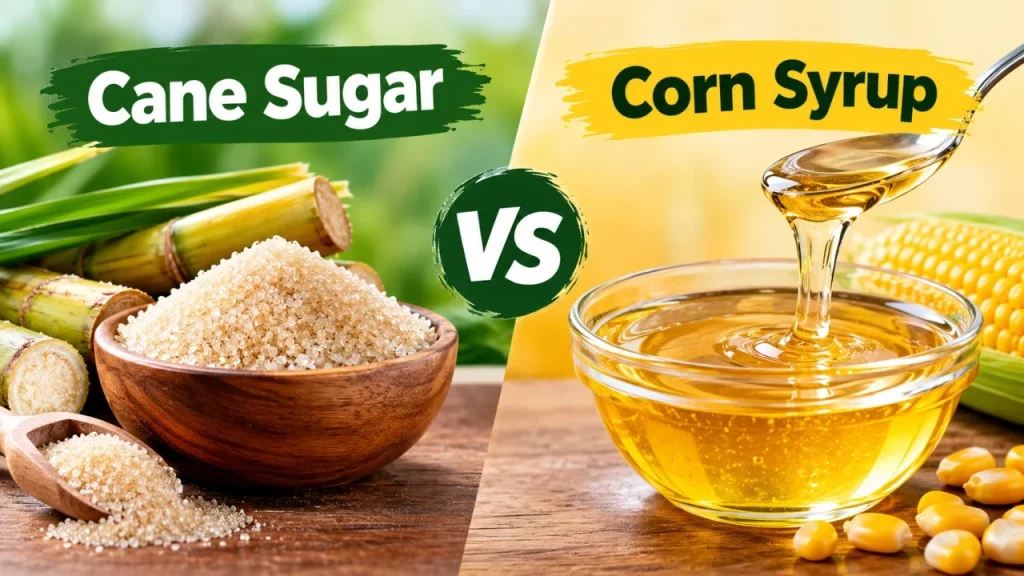
The common assumption is that cane sugar is the “real” sweetener and corn syrup is the cheap industrial stand-in cooked up to replace it — so if you could, you’d just swap one for the other without a second thought and call your kitchen healthier for it. That’s only partly true. The two aren’t interchangeable cup for cup, they behave differently in your body, and the reason corn syrup ended up in the American pantry in the first place has almost nothing to do with taste or health. It’s policy.
- Cane sugar (sucrose) is roughly 50% fructose and 50% glucose; plain corn syrup is nearly all glucose with close to 0% fructose; high-fructose corn syrup (HFCS) sits at 42% or 55% fructose depending on the blend.
- Glucose has a glycemic index around 100; sucrose’s is lower, around 65 — meaning corn syrup spikes blood sugar faster, even though it delivers less fructose to the liver.
- Swapping them in a recipe isn’t 1-to-1: corn syrup is a liquid, roughly 328 grams per cup versus 200 grams per cup for granulated cane sugar, so the swap changes both sweetness and moisture.
- Corn syrup has dominated U.S. kitchens since the 1980s largely because of sugar import tariffs and quotas that keep domestic cane and beet sugar prices artificially high, while corn is subsidized and abundant.
What’s actually in the jar
Table sugar is sucrose, a single molecule made of one glucose and one fructose unit stuck together — chemically, it’s locked at roughly 50% fructose by weight. Plain corn syrup, the stuff in a Karo bottle, is made by breaking down cornstarch into glucose chains and contains essentially no fructose. High-fructose corn syrup is a separate product where enzymes convert some of that glucose into fructose, producing the 42% fructose version (used mostly in baked goods and some beverages) and the 55% version (used mostly in sodas, which is close enough to sucrose’s natural fructose load that the two behave similarly in the body).
The glycemic index gap matters more than people realize. Pure glucose has a glycemic index near 100, the reference point the whole scale is built around. Sucrose comes in lower, around 65, because half of it is fructose, which doesn’t spike blood glucose the same way. That means a tablespoon of plain corn syrup will raise blood sugar faster than the same amount of cane sugar — but it will also dump a smaller fructose load on your liver, which is the organ that actually processes fructose, since muscle and most other tissues can’t use it directly.
Why American kitchens run on corn, not cane
The U.S. grows very little sugarcane and protects what it does grow. Since the 1980s, a system of import tariffs and quotas has kept foreign cane sugar out of the domestic market and propped up prices for U.S. sugar growers. At the same time, federal corn subsidies and the country’s enormous corn surplus made corn syrup consistently cheaper to produce and ship than cane sugar. Food manufacturers followed the price, not a health philosophy — which is also why the 2025 debate over reformulating Coca-Cola to use cane sugar instead of HFCS wasn’t really a flavor argument so much as a cost and politics one. Mexican Coke and other cane-sugar versions have existed for years specifically because sugar policy differs outside the U.S., not because the recipe is healthier in any measurable way.
The actual swap: grams, cups, and tablespoons
Because corn syrup is a liquid and cane sugar is a dry crystal, substituting one for the other changes a recipe’s texture, not just its sweetness. As a rough, bakeable guideline:
| If the recipe calls for | Use instead | Then adjust |
|---|---|---|
| 1 cup (200 g) cane sugar | About 1 1/4 cups (roughly 410 g) corn syrup | Reduce another liquid in the recipe by about 1/4 cup to offset the added moisture |
| 1 cup (328 g) corn syrup | About 1 cup (200 g) cane sugar | Add back roughly 1/4 cup liquid (water, milk, juice) to replace lost moisture |
| 1 tablespoon corn syrup | About 1 tablespoon cane sugar | Add a small splash of water, since sugar won’t dissolve as smoothly as syrup |
This works fine for sauces, glazes, and most baking. It will not work for candy-making, caramel, or anything that needs to stay smooth and non-crystalline at high heat — corn syrup’s glucose chains physically block sugar crystals from forming, which cane sugar alone can’t replicate no matter the ratio.
Who should actually care — and who genuinely shouldn’t
For most people eating an occasional cookie or soda, the glucose-versus-fructose distinction is academic — both sweeteners deliver the same roughly 4 calories per gram, and the dose from moderate intake is too small to matter much. But the research on people who drink a lot of added sugar, particularly in liquid form, is specific enough to name who should pay closer attention.
People with or at risk of nonalcoholic fatty liver disease are the clearest case. A review of dietary fructose and nonalcoholic fatty liver disease found that fructose from sucrose and HFCS is linked to increased liver fat, inflammation, and possibly fibrosis, because the liver is the main organ that metabolizes fructose and converts the excess into fat. Since sucrose and 55% HFCS deliver similar fructose loads, this group doesn’t gain much by choosing cane sugar over corn syrup — the relevant number is total fructose, not the source.
People with fructose malabsorption are the one group where the glucose-versus-fructose split genuinely matters in the opposite direction: plain corn syrup, with close to 0% fructose, is often better tolerated than cane sugar or HFCS, since their symptoms come specifically from fructose overwhelming gut absorption.
People managing triglycerides, prediabetes, or type 2 diabetes should pay attention to total sweetened-beverage intake more than sweetener type. A review of sugar and HFCS in beverages linked regular intake of either to obesity, diabetes, cardiovascular disease, and metabolic syndrome, and a separate review of sugar-sweetened beverages and cardiometabolic disease found frequent intake altered glucose handling and insulin sensitivity over time. A controlled trial described in a review of calorie-sweetened beverages and fructose found that drinking two sugar-sweetened beverages a day for six months produced features of metabolic syndrome and fatty liver in participants — but trials cutting soft drink intake over six months to two years also reduced weight gain, suggesting the effect is reversible.
It’s worth adding a complication the sugar-type debate usually skips: a small randomized trial measuring fasting FGF21 after sugar-sweetened beverage consumption in healthy, lean men found that FGF21, a hormone tied to metabolic regulation, rose after seven weeks of daily sugar drinks regardless of whether the sugar was glucose, fructose, or sucrose. That’s a small, early study, but it pushes back against the idea that fructose alone is the villain — total added sugar volume may matter just as much as which sugar it is.
What to do with this
- For baking and cooking, use the weight-based swap (200 g cane sugar per 328 g corn syrup) and adjust liquid, not a flat cup-for-cup trade.
- Don’t substitute in candy or caramel recipes — corn syrup’s crystal-blocking job can’t be replaced by cane sugar.
- If you have fatty liver disease or high triglycerides, track total added sugar and fructose load, not just which sweetener is listed first on the label.
- If you have fructose malabsorption, plain corn syrup (not HFCS) is genuinely the gentler choice.
- For everyone else, the 2025 cane-sugar-Coke debate is mostly a tariff and marketing story, not a health one — the sugar in either version still counts as added sugar.
Sources
- Energy and fructose from beverages sweetened with sugar or high-fructose corn syrup pose a health risk for some people (2013)
- Dietary fructose in nonalcoholic fatty liver disease (2013)
- Frequent Sugar-Sweetened Beverage Consumption and the Onset of Cardiometabolic Diseases (2017)
- Calorie-sweetened beverages and fructose: what have we learned 10 years later (2013)
- Do Sugar-Sweetened Beverages Increase Fasting FGF21 Irrespective of the Type of Added Sugar? (2022)
