Butter vs. Olive Oil: Which Is Better for Everyday Cooking?
Exact substitution ratios, calorie-per-tablespoon math, and who should keep reaching for butter despite the olive oil hype.
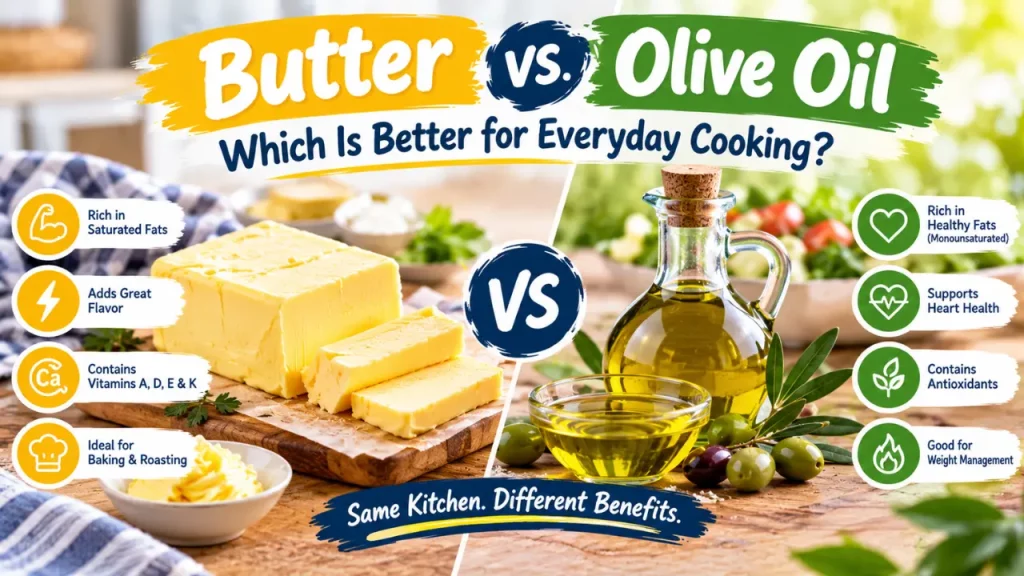
There is no universal winner between butter and olive oil — only a right fat for a specific recipe, a specific body, and a specific pan. Most comparisons stop at “olive oil has more monounsaturated fat” and call it a day. That leaves home cooks without the two things they actually need standing in the kitchen: how much olive oil replaces how much butter, and whether the health math changes for people who aren’t the average study participant.
Which one is actually better for everyday cooking?
It depends on whether you’re measuring for your arteries, your waistline, or your recipe’s texture — and those three answers don’t agree. Olive oil generally comes out ahead for cardiovascular markers in large population studies, butter is calorically cheaper per tablespoon, and butter is still structurally necessary in a lot of baking that olive oil cannot replicate. Treating this as a single contest misses that these are three separate questions.
How many calories am I actually saving by switching?
Less than most people assume, and the direction surprises people: butter runs about 102 calories per tablespoon, while olive oil runs about 119 calories per tablespoon — olive oil is actually the denser one, by roughly 17 calories per tablespoon. Swap butter for olive oil in a recipe that uses four tablespoons of fat, and you’ve added about 68 calories to the dish, not removed them. For someone actively managing weight, olive oil’s health advantages don’t come with a calorie discount; the benefit is in fat quality, not quantity. If calories are your main constraint, butter is the lighter choice by volume, even though olive oil wins on the type of fat it delivers.
What’s the exact ratio to swap butter for olive oil in a recipe?
For most savory cooking, swap butter and olive oil roughly 1-to-1 by volume — equal amounts work fine for sautéing, roasting, or finishing a sauce. Baking is where the ratio actually matters, because butter is solid and about 15–20% water, while olive oil is 100% fat and liquid at room temperature. A workable baking conversion:
| Butter called for | Olive oil to use |
|---|---|
| 1 cup | 3/4 cup |
| 1/2 cup | 6 tablespoons |
| 1/4 cup | 3 tablespoons |
| 1 tablespoon | 2 1/4 teaspoons |
The reduced amount compensates for the water butter would otherwise have contributed and for olive oil’s stronger fat concentration. This ratio works well in muffins, quick breads, and most cakes where butter was melted anyway. It does not work in laminated pastry, pie crusts, or anything relying on butter’s ability to stay solid and create steam pockets — olive oil simply can’t hold that structure, no matter the ratio.
Is heating olive oil past its smoke point really as dangerous as people say?
Not necessarily — the smoke point number alone overstates the risk, because olive oil’s natural antioxidants can protect it from breaking down even once it starts smoking. A 2025 study on virgin olive oil pretreatment found that phenolic compounds and antioxidant capacity were the actual drivers of oxidative stability under heat, with one Croatian olive variety showing a 16% improvement in oxidative stability index after a heat treatment that raised phenolic content, while a more heat-sensitive variety lost up to 28% of its stability under the same conditions (flash thermal pretreatment study on virgin olive oil oxidative stability). That’s a narrow, technical study about pre-processing olive paste, not a green light to deep-fry recklessly — but it supports the broader point: smoke point is a visual cue, not a precise toxicity line, and oil quality and antioxidant content matter as much as the thermometer reading. A lower-phenolic, lower-quality olive oil will degrade faster under heat than a fresh, high-phenolic one, even at identical temperatures.
Quick tip: if you’re pan-searing or roasting at high heat, reach for a fresher, more peppery extra-virgin olive oil rather than an older bottle — the bite usually signals higher phenolic content, which is the compound class actually protecting the oil from oxidation, not just flavor.
Who should still favor butter despite the health consensus?
People who need more calories or saturated fat for medical or metabolic reasons, and anyone relying on dairy fat’s food matrix rather than isolated fat, don’t automatically benefit from the blanket “olive oil is healthier” advice. A large analysis following over 200,000 US adults across three cohorts for up to 32 years found that dairy fat intake was not significantly associated with total cardiovascular disease risk when compared to an equivalent amount of calories from carbohydrates (dairy fat and cardiovascular disease risk in three US cohorts). That doesn’t make butter a health food, but it undercuts the idea that saturated dairy fat behaves identically to saturated fat from other sources.
Separately, researchers studying the “food matrix” effect have found that full-fat dairy products, especially fermented ones like yogurt and cheese, don’t produce the negative effects on blood lipids, insulin sensitivity, or blood pressure that their saturated fat content alone would predict (review of full-fat and fermented dairy effects on cardiometabolic disease, and a related review on whole-fat versus low-fat dairy and cardiovascular health). A Norwegian population study of over 11,000 adults similarly found that blood lipid associations with fermented dairy depended heavily on fat content and the specific food matrix, not saturated fat content in isolation (Tromsø study on fermented dairy and blood lipids). These studies focus mainly on yogurt and cheese rather than butter specifically, so the matrix effect shouldn’t be stretched too far — but it’s a real caveat to the simple “saturated fat is saturated fat” framing. People who need calorie density — endurance athletes, underweight patients, some ketogenic or therapeutic diets — also have a legitimate reason to keep butter in rotation, since its lower calorie-per-tablespoon count doesn’t apply when the goal is weight gain rather than loss, and its vitamin A and D content is already well established.
Do Italians really skip butter for olive oil?
No — that’s a regional oversimplification. Southern Italian cooking leans heavily on olive oil, but northern Italian cuisine, from Piedmont through Lombardy to the Veneto, has historically relied on butter for risottos, pasta sauces, and baking, largely because the north’s cooler climate favored dairy farming over olive cultivation. The “Italians use olive oil instead of butter” line flattens a country with two distinct fat traditions into one, and it’s worth knowing if you’re trying to cook authentically rather than just healthily.
Sources
- Dairy fat and risk of cardiovascular disease in 3 cohorts of US adults (2016)
- Associations Between Intake of Fermented Dairy Products and Blood Lipid Concentrations — The Tromsø Study (2021)
- Effects of Full-Fat and Fermented Dairy Products on Cardiometabolic Disease (2019)
- The importance of dairy products for cardiovascular health: whole or low fat? (2018)
- Improvement of Oxidative Stability and Antioxidative Capacity of Virgin Olive Oil by Flash Thermal Pretreatment (2025)
