Brussels Sprouts vs. Broccoli vs. Cauliflower: Which Is Healthiest?
The real answer depends on your meds, your thyroid, and your gut — not just the nutrition label.
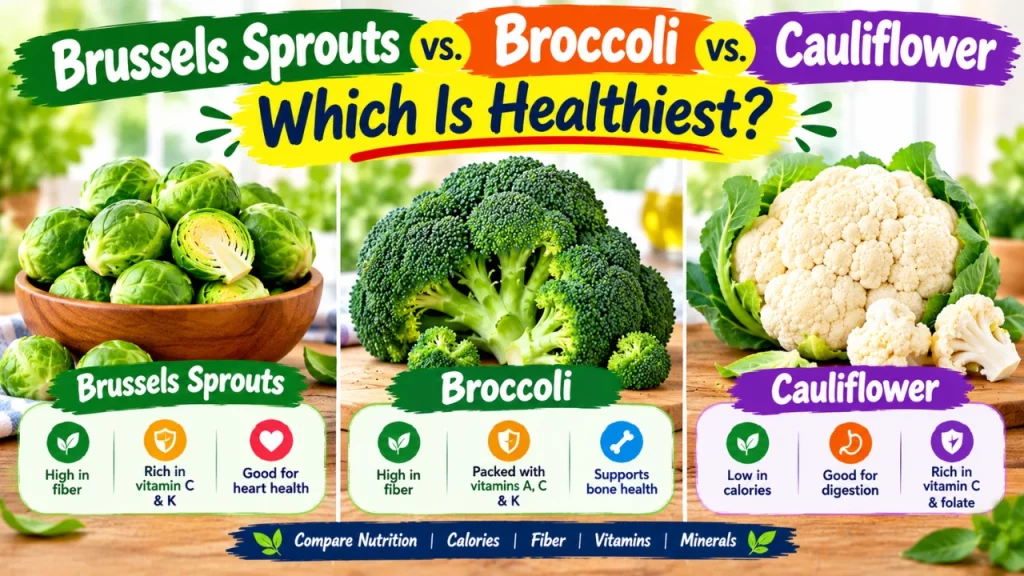
The assumption is that one of these three vegetables must simply be the best — more fiber, more vitamin C, more of whatever the spreadsheet rewards — and that whichever wins the label contest is the one you should pile on every plate. That assumption falls apart the moment you add real life to it: a warfarin prescription, a thyroid medication, or a gut that reacts badly to cabbage-family vegetables. For those people, “healthiest” isn’t about the best nutrition panel. It’s about which vegetable, cooked which way, fits their specific body.
The Quick Answer
There is no single winner across the board. Brussels sprouts carry the most vitamin K of the three, which matters enormously if you’re on a blood thinner. Broccoli offers a middle ground. Cauliflower is the gentlest choice for thyroid concerns and for sensitive guts, but it’s also the least nutrient-dense. The right pick changes depending on which of those three situations applies to you — and how you cook it changes the calculation again.
If You’re on Warfarin or Another Blood Thinner
This is where most articles stop talking, right as it gets useful. Here’s the actual mechanism: warfarin works by blocking your body’s use of vitamin K to make clotting factors. Eat a sudden pile of vitamin-K-rich vegetables, and you can blunt the drug’s effect, pushing your INR (the blood test that tracks clotting time) down when it shouldn’t move.
But “avoid vitamin K entirely” is outdated advice. A systematic review of vitamin K and warfarin interactions looked at both interventional trials and observational studies and found the evidence on dietary vitamin K disrupting INR control was genuinely mixed — not the clean cause-and-effect story patients are often told. A separate review focused on safe intake levels found that warfarin users generally tolerated 25 to 325 micrograms of vitamin K per day, with day-to-day swings up to 292 micrograms, and pegged around 150 micrograms a day as a practical sweet spot, according to a review of safe vitamin K intake for warfarin users.
The bigger risk isn’t eating cruciferous vegetables — it’s eating them inconsistently. Research on elderly patients found that cutting vitamin K intake by 80% raised INR by close to 30% within a week, and that for every extra 100 micrograms of daily vitamin K, INR dropped by about 0.2, per a review of vitamin K intake and anticoagulation in elderly patients. In other words: a sudden week of giant Brussels sprouts dinners, followed by a week of none, is the actual danger — not a steady modest habit. A practical framework proposed in a practical approach to managing vitamin K and warfarin suggests scoring vegetables by vitamin K density and keeping your weekly total roughly constant, rather than banning anything outright.
Since Brussels sprouts run notably higher in vitamin K than broccoli or cauliflower, they’re the vegetable where portion consistency matters most. If you want the lowest, steadiest vitamin K load, cauliflower is the easier one to eat freely. And remember that food isn’t the only lever: a case report found a patient’s INR jumped to 5.8 after starting gemfibrozil, a cholesterol drug, with no dietary change at all, according to a case report on gemfibrozil and warfarin interaction. Your vegetable choices matter, but they’re one variable among several your clinic is already tracking.
If You Have Hypothyroidism or Take Levothyroxine
This is the piece that almost never gets mentioned alongside the sprouts-vs-broccoli debate. All three vegetables contain goitrogenic compounds — substances that can interfere with how your thyroid uses iodine when eaten raw and in large quantities. This mostly becomes a practical concern for people with existing hypothyroidism, borderline iodine intake, or those on levothyroxine, rather than for the general population.
The standard, low-effort fix is cooking rather than eating these vegetables raw in bulk — heat substantially reduces the activity of goitrogenic compounds. If you take levothyroxine, the more pressing habit to fix isn’t the vegetable at all: taking the medication with food, including fiber-heavy vegetables, can blunt its absorption, which is why it’s typically taken on an empty stomach, separate from meals. Cauliflower, being milder and often eaten in smaller raw portions (think cauliflower rice or snacking florets), is the gentler choice here if you’re worried; Brussels sprouts, usually eaten cooked and in smaller servings than a bowl of broccoli, aren’t actually the riskiest of the three in practice.
If You Bloat Easily or Have IBS
The gas-producing culprit in all three vegetables is raffinose, a sugar your small intestine can’t break down, so it ferments in your colon instead. That part gets a passing mention elsewhere. What doesn’t get mentioned is that cooking reduces raffinose content more effectively than eating these vegetables raw — so if gas is your main concern, roasted or steamed wins over raw broccoli florets or shredded raw Brussels sprouts salads every time.
Practically: if you’re sensitive, skip the raw preparations entirely, cook vegetables fully rather than leaving them crisp-tender, and start with small portions of cauliflower before working up to Brussels sprouts, which tend to be the densest and most fermentable of the three per typical serving.
Does Chopping and Timing Really Change the Chemistry?
Yes, and this is the part that makes the biggest difference to anyone chasing sulforaphane, the compound behind most of the health buzz around these vegetables. Sulforaphane isn’t sitting in the vegetable ready to go — it’s formed when an enzyme called myrosinase converts a precursor compound after the plant’s cell walls are broken.
Chopping or shredding your vegetable and then letting it sit for roughly 10 to 40 minutes before cooking gives that enzyme time to work. Throwing whole or barely-cut florets straight into high heat does the opposite: it destroys the enzyme before it can do its job, so you lose much of the conversion. If you want the sulforaphane benefit from broccoli, cauliflower, or Brussels sprouts, the order of operations — cut first, rest, then cook — matters more than which vegetable you picked.
What About Broccoli Sprouts?
If sulforaphane is your main goal, mature broccoli isn’t actually the strongest option in the cruciferous family. Broccoli sprouts — the young seedlings, not full-grown heads — are widely recognized as containing far higher concentrations of the sulforaphane precursor than mature broccoli, cauliflower, or Brussels sprouts. If your priority is maximizing this specific compound rather than general nutrition, a small handful of sprouts added to a sandwich or salad does more on that front than a large serving of any of the three vegetables in this comparison.
The Protein Question
For anyone eyeing these vegetables as a training-diet add-on: don’t. All three land in the same low, single-digit range of grams of protein, and the differences between them aren’t meaningful enough to influence a bodybuilding or high-protein diet. None of them functions as a real protein source next to eggs, meat, dairy, or legumes — their value for muscle-focused eaters is fiber and micronutrients, not protein grams.
One Clear Takeaway
Pick the vegetable that matches your situation, not the one that wins the nutrition label. Keep Brussels sprouts portions steady (not huge, not skipped) if you’re on a blood thinner. Cook rather than eat raw in bulk if your thyroid is a concern. Cook fully and start small if gas is your issue. And if you want the sulforaphane payoff, chop first, wait, then cook — regardless of which of the three ends up on your plate.
Sources
- Interaction Between Dietary Vitamin K Intake and Anticoagulation by Vitamin K Antagonists (2016)
- A practical approach to minimize the interaction of dietary vitamin K with warfarin (2014)
- A Systematic Review of the Acceptable Intake Level of Vitamin K among Warfarin Users (2015)
- Dietary vitamin K intake and anticoagulation in elderly patients (2007)
- Interaction between gemfibrozil and warfarin: case report and review (2009)

James Carter
The EverBBQ editorial desk — covering BBQ news, features and everything off the grill.