Brown Sugar vs. White Sugar: What’s the Difference, and Which Is Healthier?
Real USDA milligrams, real glycemic data, and the actual weight math behind substituting brown sugar for white in a recipe.
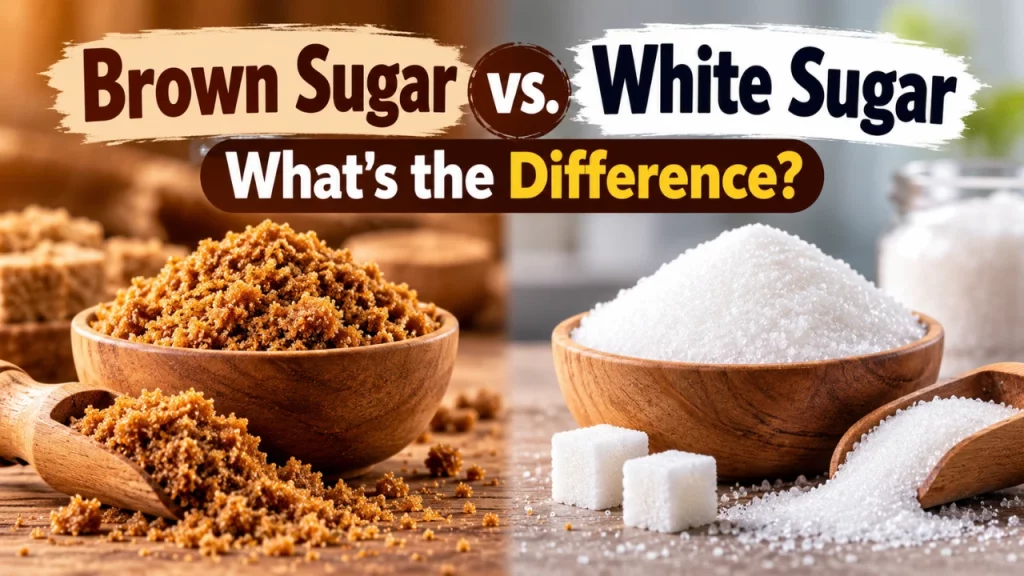
Does it actually matter which jar you reach for if you’re managing diabetes, or if you’re halfway through a cookie recipe that calls for the “wrong” sugar? Most explanations stop at vague reassurances — “brown sugar has trace minerals,” “they’re both sugar anyway” — without ever showing the numbers behind those claims. Here they are.
- Per 100 g, granulated sugar contains just 1 mg of calcium, 0.05 mg of iron, and 2 mg of potassium — amounts so small they barely register against daily needs of 1,000+ mg, 8-18 mg, and 2,600+ mg respectively.
- A packed cup of brown sugar is not the same weight as a loose cup of white sugar, which matters more for baking accuracy than any health claim does.
- No evidence in the literature distinguishes brown sugar’s blood sugar impact from white sugar’s — both are overwhelmingly sucrose, and sucrose is what the body responds to.
- Against honey, jaggery, coconut sugar, and high-fructose corn syrup, brown and white sugar are closer to each other than either is to some of those alternatives — though hard, sourced numbers for that full lineup are thinner than marketing suggests.
What’s Actually Different Between the Two
Brown sugar is refined white sugar with molasses mixed back in, which is also where its color, moisture, and faint caramel flavor come from. Both are overwhelmingly sucrose, both deliver essentially identical calories gram for gram, and the “trace minerals” brown sugar is famous for are too small to matter nutritionally — a point most comparisons make and then move past without ever putting a number on it. That’s the gap worth closing.
The Mineral Numbers, in Actual Milligrams
According to USDA FoodData Central’s entry for granulated sugar, 100 grams of plain white sugar contains 1 mg of calcium, 0.05 mg of iron, 2 mg of potassium, 0.3 mg of magnesium, 1 mg of sodium, and 0.01 mg of zinc. Scaled down to a 28-gram (1 oz) portion — roughly two tablespoons — those numbers shrink further: 0.28 mg calcium, 0.01 mg iron, 0.57 mg potassium, 0.09 mg magnesium, 0.28 mg sodium.
Brown sugar starts from the same base, with a small amount of molasses folded back in. Molasses itself does carry more meaningful mineral content than refined sugar, but the quantity added to make “brown” sugar is small relative to the whole. Even in a best-case scenario, the minerals contributed land in the same near-zero range shown above — a fraction of a milligram per serving, not the double-digit percentages of a daily value that headlines sometimes imply. To put it bluntly: if you’re trying to hit your iron or calcium targets, sugar of either color is not a strategy, it’s rounding error.
Why a Cup Isn’t a Cup: The Substitution Math
This is the part recipe articles skip entirely, and it’s not about health at all — it’s physics. White granulated sugar is made of small, free-flowing crystals that settle loosely when scooped. Brown sugar’s molasses coating makes the crystals sticky, so when you “pack” it into a measuring cup, as most recipes instruct, you’re compressing more mass into the same volume than you would with white sugar poured into that same cup. The practical consequence: swapping brown sugar for white (or vice versa) by cup-for-cup volume alone changes the actual weight of sugar entering the recipe, even though the volume measurement looks identical. If a recipe’s texture or spread depends on precise sugar weight — thin crisp cookies versus thick chewy ones, for example — a volume-for-volume swap introduces a variable most home bakers never account for. The fix is simple and doesn’t require guessing: weigh the sugar on a kitchen scale rather than trusting the cup, especially when substituting one type for the other.
What Diabetics’ Blood Sugar Actually Sees
This is the question with the least satisfying but most honest answer: there is no solid evidence that brown and white sugar should be treated differently in blood sugar management, because both are metabolized primarily as sucrose — a molecule that splits into glucose and fructose in digestion regardless of which jar it came from. A compartmental model of blood glucose regulation in type 2 diabetes that tracks how oral glucose moves through the gut, bloodstream, and insulin response doesn’t distinguish sugar sources — it models the glucose load itself, which is the same whether it arrives via brown or white sugar.
For a sense of scale, research on treating exercise-related hypoglycemia in children with type 1 diabetes found that 15 g of oral glucose produced roughly a 20 mg/dl rise in blood glucose, while 30-45 g was typically needed for adequate correction during activity. That’s a controlled pure-glucose scenario rather than table sugar specifically, but it illustrates how directly dose-dependent the blood sugar response is — a response driven by quantity of sucrose or glucose consumed, not by which mineral trace sits alongside it.
Clinical guidance for diabetic diets, reviewed in a paper on nutritional recommendations for diabetic diets, emphasizes carbohydrates with low glycemic index — whole grains, legumes, brown rice — as preferable, but it groups added sugar as a category to limit overall rather than ranking sugar types against each other. Separately, a small study of fiber supplementation in children with type 1 diabetes found a strong negative correlation between added fiber and post-meal blood sugar spikes, meaning what sugar is eaten with — fiber, fat, protein — moves the needle far more than whether that sugar is brown or white. There’s also a mechanistic concern worth flagging: a review proposing that fructose metabolism drives inflammation and visceral fat accumulation applies equally to both sugars, since both are roughly half fructose by composition. None of this is brown-versus-white evidence; it’s sucrose-versus-everything-else evidence, and it points the same direction for both jars.
Where They Rank Against Other Sugars
Honey, jaggery, coconut sugar, and high-fructose corn syrup get marketed as gentler alternatives, but the honest answer is that solid head-to-head mineral and glycemic data comparing all of them under one methodology is harder to find than the marketing claims suggest. What can be said plainly: all of these are still composed mostly of sucrose or a glucose-fructose mixture, and the mechanism described above for fructose and inflammation doesn’t care about the source plant. Treating any of them as a meaningfully “healthier” swap for brown or white sugar isn’t supported by the kind of real per-serving numbers shown earlier for granulated sugar — the mineral contributions, where they exist, remain small relative to daily needs.
What To Do With This
If you’re diabetic, treat brown and white sugar as interchangeable for blood sugar purposes — the dose of sucrose matters, not the color. If you’re baking, weigh rather than scoop when swapping one for the other, since packed density changes the actual gram amount even when the cup measurement looks the same. And if you’re choosing between jars for health reasons, the honest answer is that neither wins by a margin worth planning a diet around.
Sources
- USDA FoodData Central, Sugars granulated nutrient profile (2024 database)
- A comprehensive compartmental model of blood glucose regulation for healthy and type 2 diabetic subjects (2016)
- Self-monitoring adherence to physical activity in children and adolescents with type 1 diabetes (2006)
- Changes in nutritional recommendations for a healthy population and their influence on a diabetic diet (2016)
- Effects of fiber supplementation on glycemic excursions and incidence of hypoglycemia in children with type 1 diabetes (2014)
- Fructose-induced inflammation and increased cortisol: A new mechanism for how sugar induces visceral adiposity (2018)

Tom Fletcher
The latest from the Australian and global BBQ scene — comps, cooks and culture.