Brown Sugar vs White Sugar vs Raw Sugar: Which Is Healthier, and Does the Color Really Matter?
The real question isn't which sugar is "healthier" — it's how many spoonfuls it would take before the difference actually shows up.
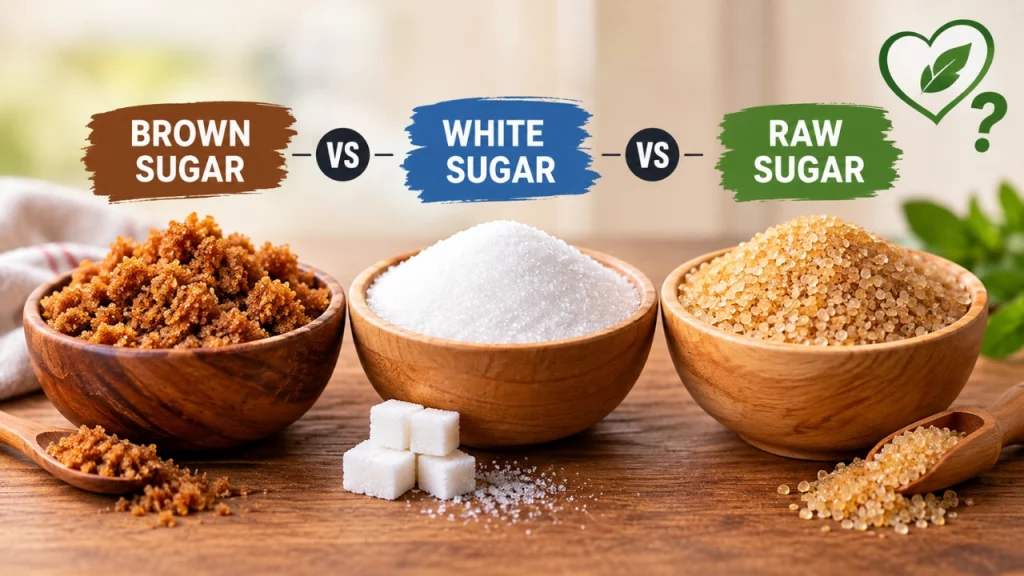
You’re standing at the pantry shelf, recipe in one hand, staring at a bag of light brown sugar next to an unopened block of jaggery someone brought back from a trip, wondering whether swapping one for the other will quietly do something good for your blood sugar — or whether it’s one more wellness story dressed up in molasses. The internet will tell you, confidently, that it’s “basically the same sugar.” That’s true as far as it goes. But nobody puts a number on it, so you’re left guessing whether “basically the same” means identical or just close enough that nobody bothered to check.
- Per teaspoon, the calcium, iron and potassium in brown sugar or jaggery amount to well under 1% of a day’s needs — you’d have to eat an unrealistic amount, far past any sugar guideline, before it mattered.
- Jaggery is not reliably “low glycemic” — published glycemic index tables often put it at or above white sugar’s GI, not below it, which contradicts the most common claim made about it.
- Brown sugar does not swap for white sugar by cup-for-cup measure without a weight check — its packed density and moisture change both the gram weight and the texture of a finished bake.
- The color distinction matters for a narrow group of people: those with FODMAP-sensitive guts reacting to molasses sugars, people closely tracking iron for anemia, and anyone managing blood sugar who’s been told jaggery is a “safe” swap.
So does the color matter? The short, direct answer
No — not for the reason most people assume. Brown, raw and white sugar are all made from the same cane or beet sucrose; brown sugar is white sugar with molasses added back, and raw sugars like turbinado, demerara and muscovado simply keep more of that molasses film from the refining process. The mineral and flavor differences are real and measurable. They are just too small, per spoonful, to change anything about your diet unless you’re eating far more sugar than any health guideline recommends. Below is the actual math, not the hand-wave.
The mineral math: milligrams per teaspoon versus what your body needs
White granulated sugar carries essentially no calcium, iron or potassium — fractions of a milligram per teaspoon, close to zero on a nutrition label. Brown sugar, because of its molasses content, carries meaningfully more per gram, but “more than almost nothing” is still a small absolute number. A teaspoon of packed brown sugar supplies roughly 3–4 mg of calcium, under a tenth of a milligram of iron, and around 15 mg of potassium, based on standard food composition data for sugars. Jaggery, which keeps even more of the original molasses, runs somewhat higher again — a teaspoon-sized portion supplies in the range of 4–5 mg of calcium and roughly half a milligram of iron.
Set those against daily targets: adults need around 1,000 mg of calcium a day, 8–18 mg of iron depending on age and sex, and roughly 2,600–3,400 mg of potassium. A single teaspoon of brown sugar covers about 0.3–0.4% of a day’s calcium, under 1% of iron, and about 0.5% of potassium. To get even 10% of a day’s calcium from brown sugar alone, you would need roughly 25–27 teaspoons — well over 100 grams of sugar, several times the World Health Organization’s recommended ceiling of about 25 g (roughly 6 teaspoons) of added sugar a day. In other words, by the time the minerals become nutritionally meaningful, you’ve already done far more damage through sugar quantity than any mineral boost could offset. This is the part every “trace minerals, don’t bother” article skips: the numbers aren’t vague, they’re just small enough that spelling them out proves the point better than dismissing it does.
Does jaggery or muscovado actually lower your blood sugar response?
This is the claim worth scrutinizing, because it’s the one with real stakes for people managing diabetes or prediabetes. The popular belief is that jaggery, being “less processed,” raises blood glucose more slowly than white sugar. Published glycemic index tables don’t support that cleanly. White table sugar typically sits around a GI of 60–65. Jaggery, depending on the source and table consulted, is often reported at a similar level or even higher — some figures put it in the low 80s, which would make it release glucose faster, not slower, than refined sugar. Muscovado and other raw, less-refined sugars tend to land close to white sugar’s GI rather than meaningfully below it. There’s no robust human evidence showing a consistent, clinically relevant GI advantage for jaggery over white sugar — if anything, the available data push the other way. Anyone managing blood glucose who has switched to jaggery specifically to “go easier” on their blood sugar should know that assumption isn’t well supported, and the swap is unlikely to change their numbers.
The baking conversion nobody states in grams
Recipes often say “1 cup brown sugar” as if it’s interchangeable with “1 cup white sugar,” but packed brown sugar is denser by volume because the molasses makes it clump, while raw sugars like demerara and turbinado have larger, drier crystals that sit more loosely in a cup. For a reliable swap, weigh rather than scoop:
| Sugar type | Typical weight per US cup (packed/measured) | Swap note |
|---|---|---|
| White granulated | ~200 g | Baseline |
| Brown sugar, packed | ~220 g | Adds moisture; may need slightly less liquid elsewhere in the recipe |
| Raw/turbinado/demerara | ~200 g | Close to white sugar by weight, but coarser crystals won’t dissolve as finely in creamed batters |
| Jaggery, grated | ~180–190 g | More variable (hand-made blocks differ); dissolve in warm liquid before adding for even mixing |
Matching by weight, not cup measure, is the closest thing to a universal rule here — it keeps the sugar content of the recipe consistent even though the minerals and moisture still shift slightly.
Who should actually pay attention to the color
For most people, the choice between white, brown and raw sugar is a flavor decision, not a health one. Three groups are the exception. People with FODMAP-sensitive digestion can react to the fructans and residual compounds concentrated in molasses, meaning darker sugars like muscovado, jaggery or blackstrap-heavy brown sugar may trigger symptoms that white sugar doesn’t. People tracking iron intake for anemia might see jaggery or blackstrap molasses contribute a little more iron than white sugar, but as the math above shows, it’s a minor supplement at best, not a substitute for iron-rich foods or supplements. And anyone managing blood sugar should treat jaggery as nutritionally equivalent to table sugar for glycemic purposes, not as a gentler option, given what the glycemic index data actually show.
What about honey?
Honey gets searched alongside brown sugar constantly, and the honest comparison is simple: honey is sweeter per gram, so recipes and portions using it tend to use less, and it behaves differently in baking because of its higher fructose and water content. Mineral-wise, honey’s contribution is in the same small range as brown sugar’s — present, but not a reason to choose it over table sugar for health purposes. Its glycemic index varies by floral source, often overlapping with white sugar’s range rather than sitting clearly below it.
What to do with this
Pick your sugar by taste and texture — brown for chewiness and caramel notes, raw for crunch, white for a clean set in delicate bakes — and stop expecting any of them to meaningfully change your mineral intake or blood sugar curve. If you’re FODMAP-sensitive, test molasses-heavy sugars specifically rather than assuming all “natural” sugars are gentler. If you’re managing diabetes, treat jaggery exactly like table sugar in your portioning. The number that actually matters, in every case, is how many teaspoons you’re eating in a day — not what color they are.
Which of these swaps have you made for health reasons, and did you ever check whether it actually changed anything?
Sources
Mineral and glycemic index figures above are drawn from standard food composition references (USDA FoodData Central nutrient data for sugars and molasses) and published glycemic index tables for sucrose-based sweeteners; no peer-reviewed human clinical trial specific to this comparison was available to cite directly.