Boiled Eggs vs Fried Eggs vs Scrambled Eggs: Which Is Healthier?
Exact calories, saturated fat and the cholesterol-oxidation chemistry behind each cooking method — plus who should actually skip the fry pan.
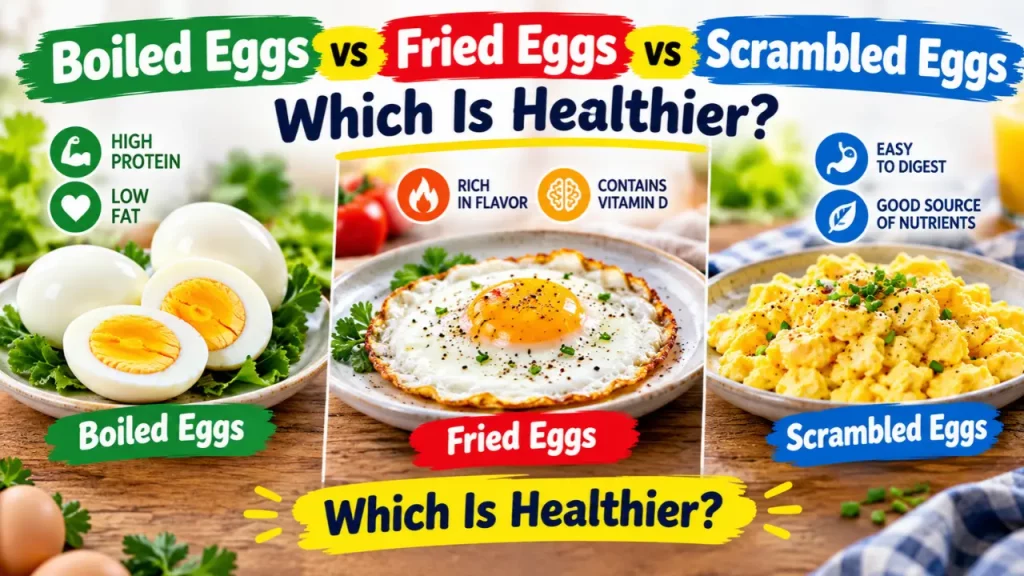
You’re standing at the stove with a carton of eggs and about ninety seconds to decide. The pan is hot, the butter’s already starting to foam, and somewhere in the back of your mind is your last cholesterol panel, or your doctor’s note about blood sugar, or the fact that you’re trying to put on muscle and need to know if this egg is “worth it.” Boiled, fried, or scrambled — the honest answer depends on numbers most articles never actually give you.
- A boiled egg has about 78 kcal and 1.6 g of saturated fat; a fried egg cooked in a teaspoon of butter runs closer to 90 kcal and 2.4 g saturated fat — not a huge gap per egg, but it compounds fast with two or three eggs and repeated days.
- Browning or crisping the yolk’s edges exposes its cholesterol to heat and oxygen, generating cholesterol oxidation products (COPs) — a different concern from the cholesterol content itself.
- In people who already have type 2 diabetes, each extra 4 eggs eaten per week was linked to a 40% higher relative risk of cardiovascular events in a pooled analysis of egg intake and cardiovascular/diabetes risk — a bigger signal than seen in the general population.
- Once an egg is fully set, boiling, frying and scrambling give essentially the same protein quality — the real difference for muscle-gain diets is calories per gram of protein, not digestibility.
The direct answer, with the actual numbers
For a single large egg, standard preparation figures look like this:
| Method | Calories | Total fat | Saturated fat | Protein |
|---|---|---|---|---|
| Boiled, nothing added | 78 kcal | 5 g | 1.6 g | 6.3 g |
| Fried in 1 tsp (5 g) butter | ~90 kcal | 7 g | 2.4 g | 6.3 g |
| Scrambled with a splash of milk, 1 tsp butter | ~91 kcal | 7 g | 2.2 g | 6 g |
The gap between boiled and fried isn’t dramatic per egg — roughly 12 extra kcal and 0.8 g more saturated fat — but it’s not nothing either, and it scales with how much butter or oil hits the pan and how many eggs you eat. Fried in a generous pat of butter or cooked “swimming” in oil, a single egg can easily pick up 4–5 g of saturated fat on its own, more than double the boiled version.
Think about what that means over a week rather than a single breakfast. Someone who fries two eggs every morning in a tablespoon of butter split across the pan is adding something like 15–20 g of saturated fat a week just from the cooking fat itself, before counting the fat already in the yolk. Swap that same habit to boiled or dry-poached eggs, and the weekly saturated fat load from the eggs alone drops by roughly two-thirds. That’s the kind of small, repeated choice that shows up on a lipid panel six months later — not because any single fried egg is harmful, but because the pattern is what the body actually responds to.
What actually happens when the yolk browns
This is the part most comparisons skip entirely. Egg yolk is the most cholesterol-dense part of the egg, and cholesterol is a molecule that reacts with oxygen and heat. Boiling keeps the yolk enclosed in its shell, surrounded by water near 100°C, with minimal direct air contact — a relatively protective environment. Frying does the opposite: the yolk’s surface sits directly against hot metal, oil, and open air, often well above 100°C at the crisping edges. That combination of heat plus oxygen exposure is what drives the formation of cholesterol oxidation products, or COPs — compounds like 7-ketocholesterol that don’t exist in meaningful amounts in a gently cooked yolk. Researchers have studied COPs mainly because oxidized cholesterol behaves differently in the bloodstream than regular cholesterol, and it’s a mechanism distinct from the “dietary cholesterol doesn’t matter much” conversation most articles stop at. Work looking at how cooking method and fat composition interact, including findings summarized in the European Journal of Clinical Nutrition, points to the same basic rule: the longer and hotter the exposure, and the more browning on the surface, the higher the oxidation load. The practical takeaway: a soft or hard-boiled yolk, or a gently scrambled one with no crisp or brown edges, minimizes this reaction far more than a fried egg left in the pan until the edges go crispy and brown.
A simple kitchen habit follows from this: if you prefer fried eggs for taste or texture, keep the heat medium rather than high, use just enough fat to stop sticking rather than a visible pool, and pull the egg off the pan as soon as the white sets rather than letting the yolk’s edge go brown and lacy. You get the same dish, with less of the oxidation that boiling avoids almost automatically.
Is two fried eggs a day actually too much?
Run the arithmetic. Two fried eggs cooked in a total of 2 teaspoons of butter land around 8 g of saturated fat from that one meal — using the per-egg figures above (roughly 2.4 g per egg, including the yolk’s own fat and the added butter). Common dietary guidance caps saturated fat at about 13 g a day for a 2,000-calorie diet. That means two fried eggs for breakfast alone can use up more than half your saturated fat budget before lunch — not because eggs are uniquely dangerous, but because butter and oil are saturated-fat dense and eggs are often eaten alongside bacon, buttered toast, or cheese. Two boiled eggs, by contrast, contribute about 3.2 g of saturated fat total — leaving far more room for the rest of the day.
On cardiovascular outcomes specifically, the picture for the general population is more reassuring than the saturated-fat math alone suggests. A large analysis of three U.S. cohorts followed for decades, reported in the American Journal of Clinical Nutrition, found that people eating more eggs also tended to have higher BMI and eat more red meat, muddying the picture — the researchers adjusted statistically for these overlapping habits and still found little independent association between egg consumption and cardiovascular disease risk in people without diabetes. A separate pooled analysis of roughly thirty cohort studies published in The BMJ reached a broadly similar conclusion for moderate intake — up to about one egg a day showed no clear increase in heart disease or stroke risk for most adults. The caveat embedded in both papers matters: this reassurance is for the general population, not for people who already have type 2 diabetes or established cardiovascular disease, where the earlier atherosclerosis findings suggest the risk curve is steeper. If you fall into that second group, the cooking-method differences above stop being a minor efficiency tweak and start being one of the few levers you can pull without giving up eggs altogether.
Where scrambling fits, and why portion habits matter more than the pan
Scrambling sits in an odd middle position. Because the yolk and white are mixed before cooking, the egg cooks faster and at a slightly lower effective surface temperature than a fried egg left whole, which limits browning and the COPs it produces — closer to boiling than to frying in that respect. But scrambled eggs are also the easiest version to over-fatten, since milk, cream, extra butter, or cheese get folded in almost by habit. A plain scramble with a splash of milk and a teaspoon of butter lands close to the fried egg’s numbers in the table above; the same scramble made with cream and a handful of cheddar can double the saturated fat without changing the serving size on the plate. Work comparing nutrient retention across boiling, frying and other everyday cooking methods, published in the European Journal of Nutrition, underlines a related point: it’s rarely the core cooking method alone that drives the nutritional outcome — it’s what gets added along the way, and how long the heat is applied.
For most people without diabetes or existing heart disease, none of this means fried eggs need to disappear from the rotation. It means treating the butter or oil as the real variable: a thin film in a nonstick pan, medium heat, and a yolk pulled before it browns gets you most of the way to the boiled egg’s numbers while keeping the taste and texture you actually wanted.
Sources
