Beef vs Pork vs Chicken: Which Has More Protein per 100 Grams?
Raw protein grams don't tell you which meat actually builds muscle or protects your health — quality, cost, and risk change the answer.
The butcher counter at 6 p.m. on a Tuesday is a small battlefield. A man in gym clothes picks up a pack of chicken breast, puts it down, picks up a ribeye instead, then grabs a pound of ground pork on the way out because it’s on sale. He’s doing math in his head — grams of protein, dollars, maybe cholesterol — and none of the numbers quite agree with each other. That confusion is the actual starting point for this article.
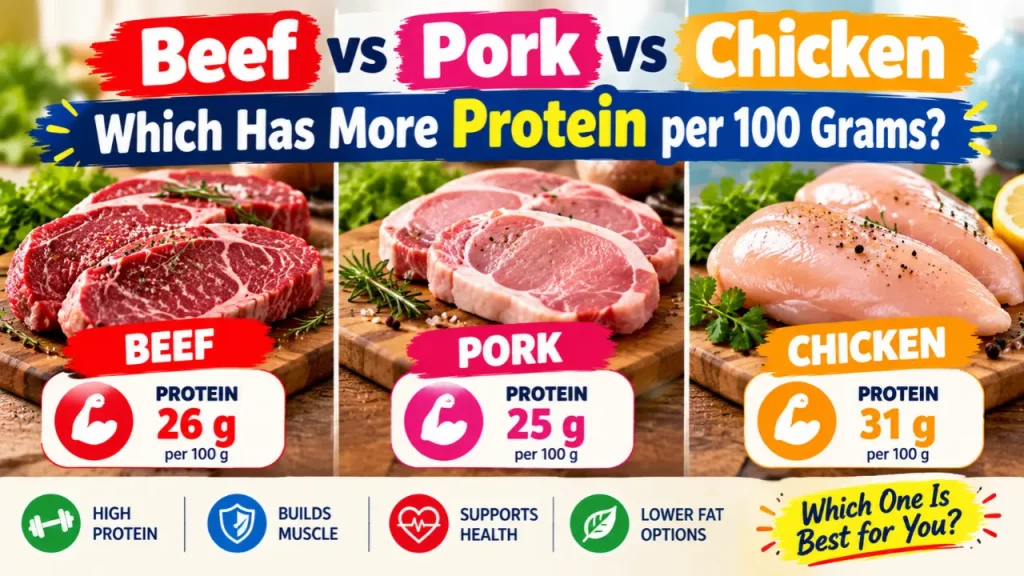
Here is the direct answer first: per 100 grams cooked, chicken breast generally delivers the most protein of the three, beef sirloin runs close behind it, and pork’s number depends heavily on the cut and how it was measured — which is exactly why pork loin chop numbers you’ve seen elsewhere (sometimes cited near 24g, sometimes near 31.6g per 100g) don’t match. But “which has more grams” is only the first question. The better question is which protein you actually absorb, build muscle from, and can keep eating for forty years without raising your risk of other problems.
Step 1: Compare like with like — and fix the pork chop contradiction
Most of the confusion around pork loin comes from mixing measurement methods: raw versus cooked, bone-in versus boneless, trimmed versus untrimmed fat, and different cuts labeled generically as “loin.” A bone-in chop weighed with the bone included looks lower in protein per 100g simply because bone isn’t protein. A boneless, trimmed chop cooked the same way as a chicken breast and a sirloin steak will land much closer to the chicken and beef numbers than the lower figure suggests. When sources disagree this much, the fix isn’t picking a side — it’s insisting on the same method: cooked weight, boneless, similarly trimmed, same portion.
Tip: When comparing packages at the store, check whether the per-100g protein figure is for raw or cooked meat. Cooking drives off water, which concentrates protein per gram — a steak that looks lower in protein raw can test higher once cooked.
Step 2: Judge quality, not just quantity
A gram of protein from chicken, beef, or pork is not automatically worth the same as a gram from anywhere else. Muscle building depends heavily on leucine, the amino acid that triggers muscle protein synthesis, and on how completely and efficiently the protein is digested and absorbed — the basis of the DIAAS scoring system nutrition scientists use. All three meats are complete animal proteins containing the full set of essential amino acids in ratios the body uses efficiently, which is why none of them is a “bad” protein choice in the way some single plant proteins can be. The practical point for lifters: a 100g serving of chicken breast, beef sirloin, or pork tenderloin will all support muscle repair effectively after a workout, so once you’re in that tier, the gram count on the label matters less than consistently hitting your daily total.
Tip: If you’re optimizing for muscle growth, stop chasing the single “highest protein” meat and instead focus on eating a palm-sized portion of any of these three at each main meal — consistency beats the last two or three grams of difference between cuts.
Step 3: Do the price-per-gram-of-protein math before you commit
Chicken breast usually wins on protein density, but it’s frequently the most expensive per pound of the three at the counter. Ground beef and bone-in pork or chicken thighs typically cost less per pound, and even though they carry more fat (and therefore slightly less protein per 100g), the protein you do get often costs less overall. Before deciding “chicken breast is the smart choice,” divide the price of the package by the grams of protein it actually contains, not by its weight — a cheaper, fattier cut can sometimes beat an expensive lean one on cost-per-gram-of-protein, even if it loses on the protein-per-100g scoreboard.
Tip: Keep a running mental note of price-per-pound for the cuts you buy most, since a sale on pork shoulder or chicken thighs can flip the cost equation for a week or two without changing the nutrition facts.
Step 4: Weigh the long-term health trade-offs
Protein grams don’t capture everything these meats bring to your diet. A meta-analysis of prospective studies on red and processed meat and colorectal cancer found that the highest intake group had a 22% higher relative risk of colorectal cancer than the lowest intake group (RR 1.22, 95% CI 1.11–1.34), and risk rose further with every 100 grams per day of additional intake (RR 1.14, 95% CI 1.04–1.24). Chicken was not part of that elevated-risk finding — the concern is specific to red and processed meat, which covers most beef and pork but not poultry.
There’s also a kidney angle rarely discussed alongside protein counts. A small crossover trial of nine patients with chronic kidney disease found that one week on a vegetarian versus meat diet comparison in CKD patients led to lower blood phosphorus and lower FGF23 levels on the vegetarian diet, even with equivalent nutrients. Reviews on dietary phosphorus sources in CKD explain why: 40–60% of phosphorus from animal protein is absorbed, while plant-based phosphorus bound to phytates is absorbed far less efficiently, and both are dwarfed by nearly 100% absorption of inorganic phosphorus additives in processed foods. One review on phosphorus homeostasis in CKD recommends moderate protein intake of 0.9–1.0 g/kg/day for affected patients rather than maximizing it, and a related review on organic versus inorganic dietary phosphorus notes that a higher phosphorus-to-protein ratio in the diet has been linked to increased death risk in long-term hemodialysis patients — a reminder that for this group, “more protein” isn’t simply better.
Tip: If you eat beef or pork most days, balance the week with poultry, fish, or plant proteins a few times rather than eliminating red meat outright — the dose-response data points to volume and frequency, not occasional servings, as the issue.
Step 5: Match the meat to your own risk profile
- People with chronic kidney disease, based on the CKD studies above, should discuss moderating total meat-based protein and phosphorus load with their doctor rather than maximizing protein from any animal source.
- People sensitive to gout flares are often advised to limit purine-rich meats, including organ meats and some red meat, though portion size matters more than cutting meat out entirely.
- Pregnant women should avoid undercooked pork specifically, since inadequately cooked pork carries a higher risk of parasitic and bacterial contamination than well-cooked poultry or beef.
Tip: When in doubt about a cut’s safety, cook to a food thermometer reading rather than color or time — this removes the guesswork pregnancy and food-safety guidance both depend on.
Common mistakes
- Comparing raw protein numbers to cooked ones and assuming one meat is “better” when the difference is just water loss.
- Treating protein-per-100g as the whole decision and ignoring price-per-gram-of-protein, which can reverse the ranking on a budget.
- Assuming all red meat carries identical cancer risk data to all pork or all beef cuts, when the colorectal cancer findings are about red and processed meat as a category, not every cut equally.
- Maximizing protein intake during kidney disease without accounting for the phosphorus that comes attached to it.
Sources
- Vegetarian compared with meat dietary protein source and phosphorus homeostasis in chronic kidney disease (2011)
- Understanding sources of dietary phosphorus in the treatment of patients with chronic kidney disease (2010)
- Phosphorus homeostasis in normal health and in chronic kidney disease patients (2007)
- Red and processed meat and colorectal cancer incidence: meta-analysis of prospective studies (2011)
- Organic and inorganic dietary phosphorus and its management in chronic kidney disease (2010)
