Beef vs. Pork Nutrition: Which Meat Gives You More Iron and B12?
Pork can match beef's iron and B12 — but only if you eat three times as much, and the math on fat and cholesterol gets ugly fast.
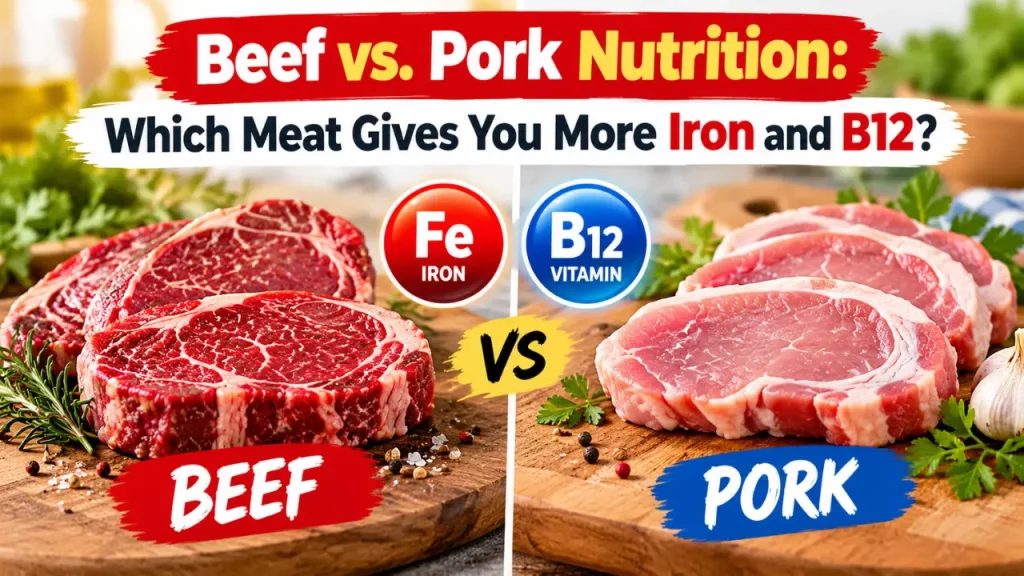
If you swapped tonight’s beef dinner for pork, how many extra ounces would you need to put on the plate just to break even on iron and B12? Most comparisons stop at the 100-gram nutrition label and never answer that question, which is the only one that actually matters at dinner.
Matching beef’s iron and B12 with pork means eating roughly three to three-and-a-half servings of pork for every one serving of beef — and by the time you do, you’ve taken on more saturated fat and far more cholesterol than the beef ever had.
Per 3-ounce (85 g) cooked serving, a typical cut of ground beef (93% lean) carries about 2.2 mg of iron, 2.1 mcg of vitamin B12, 4.6 mg of zinc, 3.3 g of saturated fat, and 70 mg of cholesterol. The same size serving of cooked pork loin carries about 0.7 mg of iron, 0.6 mcg of B12, 1.9 mg of zinc, 1.6 g of saturated fat, and 65 mg of cholesterol. Beef’s iron advantage is heme iron, which the body absorbs far more efficiently than the nonheme iron in plants, and beef’s B12 lead over pork is large and well established — but neither of those facts tells you what happens once you try to close the gap with your fork.
Beef: More Iron and B12, in a Smaller Amount of Food
One 3-ounce serving of beef delivers its iron and B12 in a single sitting. Meat protein itself also helps the body absorb iron more efficiently — a controlled feeding study found that freeze-dried beef muscle increased nonheme iron absorption by 180% compared with egg albumin, an effect tied to the muscle protein itself, not just the heme iron inside it. That “meat factor” works for pork too, since it’s also muscle tissue, but it can’t make up for pork’s much lower starting iron content.
The catch is the saturated fat and cholesterol that typically ride along with beef, especially in higher-fat grinds or fattier cuts. A four-week randomized controlled feeding trial that compared diets built around red meat, white meat, or nonmeat protein found that LDL cholesterol and apolipoprotein B rose more on the high-saturated-fat version of each diet, regardless of whether the protein source was red meat, white meat, or plant-based — meaning the saturated fat content of the overall diet mattered more than whether the protein on the plate was beef. That’s an important nuance: it doesn’t clear beef of all responsibility, but it means the “beef is automatically worse for your heart” assumption oversimplifies a study that actually tested this directly.
Pork: Leaner Per Ounce, but You Need a Lot More of It
Lean pork cuts like tenderloin are genuinely low in fat, which is why pork gets a reputation as the “healthier” red meat. But low fat per ounce doesn’t mean low food volume to hit the same iron and B12 numbers beef delivers in one serving.
Do the actual math: beef’s 2.2 mg of iron per 3 ounces versus pork’s 0.7 mg means you’d need about 3.1 servings of pork loin — roughly 9 ounces, or 255 g — eaten in a day just to match the iron in one 3-ounce beef serving. B12 is an even steeper climb. At 0.6 mcg per 3-ounce serving against beef’s 2.1 mcg, you’d need about 3.5 servings, or roughly 10.5 ounces (about 300 g) of pork loin, to match a single beef serving’s B12.
Scale pork up to that 3.5-serving level and the fat and cholesterol numbers flip against it. Saturated fat climbs to about 5.6 g, nearly 70% more than the 3.3 g in the single beef serving it was supposed to replace. Cholesterol climbs to roughly 228 mg, more than three times beef’s 70 mg. The only place pork pulls ahead at that volume is zinc, reaching about 6.7 mg against beef’s 4.6 mg — a real win, but one bought with triple the meat and triple the calories.
| Nutrient (per 3 oz / 85 g cooked) | Beef (93% lean) | Pork loin | Pork needed to match beef |
|---|---|---|---|
| Iron | 2.2 mg | 0.7 mg | ~3.1 servings (9 oz) |
| Vitamin B12 | 2.1 mcg | 0.6 mcg | ~3.5 servings (10.5 oz) |
| Zinc | 4.6 mg | 1.9 mg | ~2.4 servings to match |
| Saturated fat | 3.3 g | 1.6 g | 5.6 g at 3.5 servings |
| Cholesterol | 70 mg | 65 mg | 228 mg at 3.5 servings |
Zinc Is the Mineral Nobody Mentions
Zinc rarely comes up in these comparisons, but it matters for immune function just as much as iron matters for oxygen transport. Ounce for ounce, beef more than doubles pork’s zinc content — 4.6 mg versus 1.9 mg per 3-ounce serving. It’s the one spot where even a modest beef habit outperforms pork without any serving-size gymnastics. Pork only catches up once you’re eating multiple servings a day, at which point you’re no longer comparing a snack-sized trade-off, you’re restructuring your whole diet around pork volume.
Processed Pork Changes the Entire Equation
Everything above assumes fresh pork loin, not bacon, ham, or sausage. Processed pork products are cured and blended with added fat, water, and salt, which dilutes the iron, B12, and zinc per ounce even further below what fresh loin offers, while adding substantial sodium that fresh pork and fresh beef don’t carry. If the comparison shifts from “beef versus pork loin” to “beef versus bacon,” the serving math above gets even worse for pork — you’d need more ounces than the fresh-pork estimates to match beef’s iron and B12, and you’d be taking on meaningfully more sodium to get there.
Who Should Not Make This Swap
None of this math is a blanket argument for eating more beef. People with hemochromatosis, a condition in which the body absorbs and stores too much iron, should not use beef’s heme-iron advantage as a reason to increase red meat intake — heme iron is absorbed efficiently precisely because the body has limited ability to regulate it, which is the opposite of what someone with iron overload needs. People already managing high LDL cholesterol should also be cautious: the feeding trial above found saturated fat intake drives LDL and apoB increases, and larger reviews of heart-healthy eating patterns, including Cochrane’s assessments of the Mediterranean dietary pattern for cardiovascular prevention and its earlier primary-prevention review, consistently favor diets built around moderate meat intake rather than maximizing any single cut for its mineral content. Iron absorption itself is also inhibited by calcium, phytates, and polyphenols and boosted by vitamin C, a web of interactions reviewed extensively in iron absorption research — meaning what you eat alongside either meat changes these numbers more than people assume.
The Verdict
If iron and B12 are your actual goal, beef gets you there in a normal serving; pork needs three to three-and-a-half times the volume, and that volume brings more saturated fat and far more cholesterol than the beef serving it was meant to replace. Pork loin remains the better everyday choice for someone simply trying to limit fat intake, but it is not a one-for-one iron or B12 substitute no matter how the per-ounce numbers are framed. For most people without hemochromatosis or LDL concerns, a modest, unprocessed beef serving a few times a week, paired with other iron and B12 sources, is the more efficient path — not an all-pork or all-beef diet, but an honest look at how much food it actually takes to get the nutrients you’re after.
Sources
- Effects of red meat, white meat, and nonmeat protein sources on atherogenic lipoprotein measures (2019)
- Mediterranean-style diet for the primary and secondary prevention of cardiovascular disease (2019)
- ‘Mediterranean’ dietary pattern for the primary prevention of cardiovascular disease (2013)
- Meat protein fractions enhance nonheme iron absorption in humans (2006)
- <a href=”https://doi.org/10.1021/ac

Mick Hudson
Low-and-slow recipes, rubs, sauces and fire management from our pitmaster team.