Beef Ribeye vs Sirloin vs Brisket: Which Cut Has the Most Protein?
Raw-weight USDA data crowns a winner, but cooking method, trim, and your specific goal can flip the real-world answer entirely.
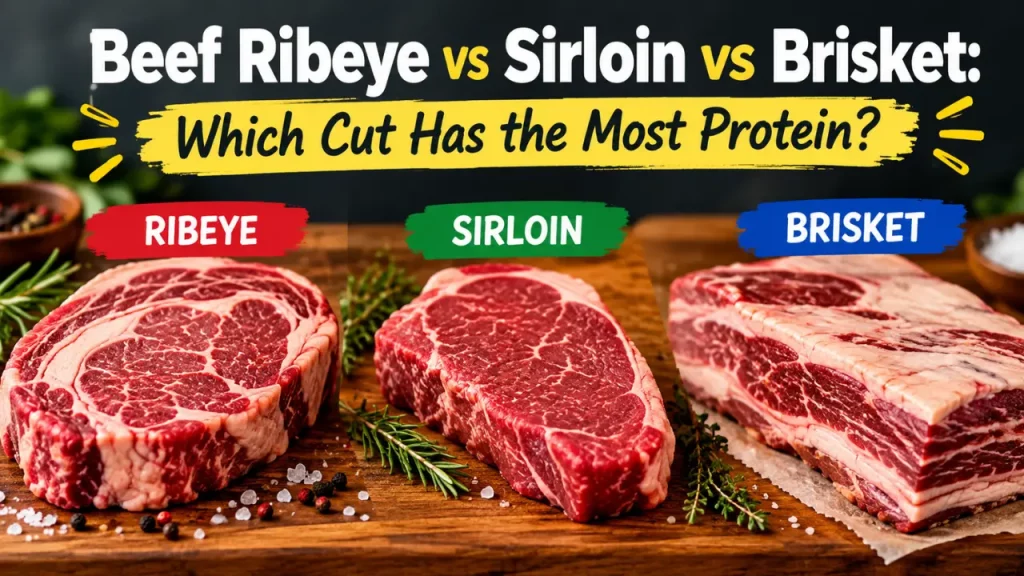
The common assumption goes like this: pull up a nutrition label, compare grams of protein per 100 grams, pick the biggest number, and call it a day. For these three cuts, that would make top sirloin the obvious champion. But that assumption falls apart the moment you factor in how the meat was cooked, how much sodium got added, how much the package shrank on the stove, and what you’re actually trying to achieve with your fork — cutting, bulking, staying in ketosis, or just not overspending at the butcher counter.
So let’s answer the headline directly first, using raw-weight USDA figures, then complicate it the way your actual kitchen will.
The Lab Answer: Sirloin Wins on Paper
Per USDA data on raw top sirloin steak, 100 grams contains 22 g of protein and only 5.71 g of fat. USDA’s entry for raw, boneless choice ribeye shows 18.7 g of protein per 100 g, but with 20 g of fat — nearly triple sirloin’s fat load. The only USDA brisket entry available, raw corned beef brisket, lists 14.7 g of protein and 14.9 g of fat per 100 g, plus a detail almost nobody mentions: 1,220 mg of sodium per 100 g, versus 42.5 mg in ribeye and 42.8 mg in sirloin. That’s roughly 28 to 29 times more sodium, a direct result of the curing brine used to make corned beef — it is not representative of a fresh, uncured brisket, and that distinction matters if you’re comparing cuts for blood pressure reasons rather than just protein.
| Cut (raw, 100 g) | Protein | Fat | Sodium | Est. calories* | Protein per 100 kcal |
|---|---|---|---|---|---|
| Top sirloin | 22 g | 5.71 g | 42.8 mg | ~139 kcal | ~15.8 g |
| Ribeye, boneless, choice | 18.7 g | 20 g | 42.5 mg | ~255 kcal | ~7.3 g |
| Corned beef brisket (cured) | 14.7 g | 14.9 g | 1,220 mg | 198 kcal (actual) | ~7.4 g |
*Calories estimated from protein (4 kcal/g) and fat (9 kcal/g) using the gram values above; brisket’s listed 198 kcal actual energy value lines up closely with this estimate, confirming the math.
The surprising part isn’t that sirloin wins — that’s already well known. It’s that ribeye and cured brisket land in almost the same protein-per-calorie bracket, around 7.3 to 7.4 g per 100 kcal, despite getting there through completely different routes: ribeye through fat, brisket through sodium-heavy curing moisture. Two very different cuts, one very similar efficiency problem.
The Real-World Answer: Cooking, Cost, and Your Goal Change the Math
USDA figures are raw weight. Almost nobody eats raw steak. Once heat is applied, water cooks out of the muscle fibers, and the remaining protein becomes more concentrated per 100 grams — even though the total grams of protein in your actual portion barely change, assuming nothing leaches out. That matters a lot for how these three cuts behave differently on the stove. Sirloin and ribeye are typically pan-seared or grilled fast and hot, losing maybe a fifth of their raw weight to evaporation and rendered fat, which is why a 170 g raw ribeye often lands on the plate closer to 130–140 g. Brisket, by contrast, is almost always cooked low and slow — braised, boiled, or smoked for hours — and loses far more volume as connective tissue breaks down and fat renders out over time. A raw 100 g portion of corned beef brisket can shrink by a third or more by the time it’s sliced, which means the sodium figure above, already alarming on paper, becomes even more concentrated per cooked bite than the raw-weight table suggests.
This is where a one-number comparison stops being useful. Research on sodium intake and kidney function, including work published in the Journal of Renal Nutrition, has looked specifically at how cured and processed meats contribute to daily sodium load in ways that fresh cuts don’t — relevant if you or someone you’re cooking for is managing blood pressure, fluid retention, or kidney disease. For that person, the protein-per-calorie numbers in the table are almost irrelevant; the sodium column is the only one that matters, and it points firmly away from cured brisket, or at minimum toward soaking and rinsing it before cooking to pull some of that sodium out.
Why the Fat Isn’t Just a Number to Subtract
It’s tempting to treat ribeye’s extra fat as a simple penalty against its protein score, but fat composition in beef is more nuanced than the grams-on-a-label view allows. Marbling — the intramuscular fat that gives ribeye its flavor and tenderness — is influenced heavily by how the animal was raised and finished, a topic examined in cattle research such as the work in the Journal of Animal Science and in comparative studies in Animal Bioscience looking at how fat deposition patterns differ across cuts and feeding regimes. The practical takeaway for a home cook is that two ribeyes from different sources, or even different grades, won’t carry identical fat-to-protein ratios, so the 20 g fat figure above is a single data point, not a guarantee. Sirloin, being a leaner, more heavily worked muscle, carries far less of this variability — its fat content stays comparatively low cut to cut, which is part of why it’s an easier cut to plan macros around if you’re tracking numbers closely.
Matching the Cut to Your Actual Goal
If you’re cutting calories while preserving muscle, sirloin’s protein-per-calorie advantage is real and worth leaning on — it lets you hit a protein target without burning through your calorie budget on rendered fat. If you’re bulking and calories are not the constraint, ribeye’s fat content is a feature, not a flaw: it’s a dense, efficient way to add calories alongside decent protein, and the flavor payoff makes it easier to actually eat the extra food consistently, which matters more for adherence than any spreadsheet. If you’re following a ketogenic approach where fat is the point, ribeye again pulls ahead of sirloin on structural merit alone. And if your goal is simply feeding a family on a budget, brisket’s low per-pound price, even after accounting for cooking shrinkage, often makes it the most calorie- and protein-efficient purchase of the three, provided the sodium load isn’t a personal concern — and choosing an uncured, fresh brisket and seasoning it yourself sidesteps most of that issue entirely, something a review of meat curing methods in Foods discusses in more detail regarding how curing salts change a cut’s nutritional profile versus fresh preparation.
There’s also a perception gap worth naming: consumers tend to treat “lean” and “high protein” as interchangeable, when they’re only loosely correlated once cooking method and portion size enter the picture — a disconnect noted in consumer-focused nutrition research such as that published in Nutrition & Dietetics. Sirloin is both lean and high-protein-per-calorie; ribeye is high-protein but not lean; cured brisket is neither especially lean nor especially protein-dense once sodium and cooking losses are accounted for. Knowing which of those three boxes you actually need checked is a better starting point than scanning for the single biggest protein number on a label.
Sources
- https://fdc.nal.usda.gov/food-details/2646172/nutrients
- https://fdc.nal.usda.gov/food-details/170199/nutrients
- https://fdc.nal.usda.gov/food-details/2727574/nutrients
- https://doi.org/10.1093/jas/skaf436
- https://doi.org/10.1053/j.jrn.2015.05.005
- https://doi.org/10.3390/foods12010129
- https://doi.org/10.1111/j.1747-0080.2008.00262.x
- https://doi.org/10.5713/ab.260060

James Carter
The EverBBQ editorial desk — covering BBQ news, features and everything off the grill.