Beef Chili vs. Turkey Chili: Which Is Healthier and More Filling?
USDA gram-for-gram data show canned beans often add more sodium than the meat swap — and reveal who should skip turkey chili entirely.
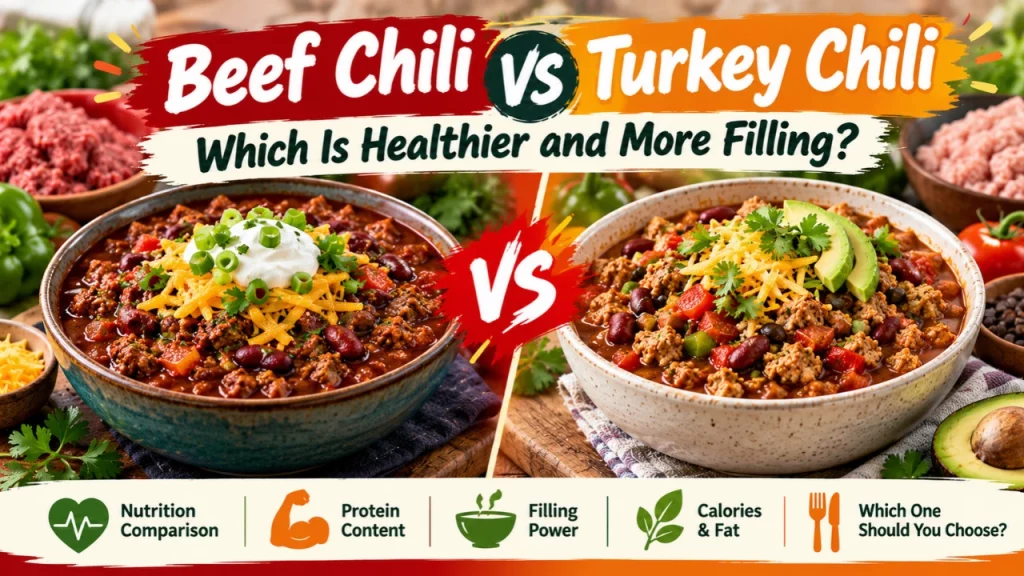
You’re standing at the meat case with two packages in your hands, and the math feels obvious: the turkey says “93% lean” right on the label, the beef doesn’t bother, so the turkey goes in the cart and you feel like you’ve already won the week’s nutrition. The swap seems like a free pass — same chili, same bowl size, fewer consequences.
Gram for gram, the turkey swap shaves real fat and calories off your bowl, but it also quietly cuts your iron and B12 roughly in half — and the sodium in your beans may matter more than either meat anyway.
What the Package Actually Says, Not What It Implies
USDA’s own numbers for 93% lean ground turkey, raw are specific enough to settle the vague “lighter” claim. Per 100 g: 150 kcal, 2.17 g saturated fat, 8.34 g total fat, 1.17 mg iron, 2.53 mg zinc, and 1.2 µg vitamin B-12. Scaled to a 1 oz (28 g) portion, that’s 42.5 kcal, 0.62 g saturated fat, 0.33 mg iron, 0.72 mg zinc, and 0.34 µg B-12. Those are the official figures for the leanest common turkey grind, not an estimate, and they’re raw weights — cooking concentrates calories somewhat as water cooks off, but the relative gap between meats barely moves.
The fat and calorie advantage of turkey over fattier beef grinds is real and already well documented, so it won’t get re-litigated here. What’s worth sitting with instead is what you give up: iron, zinc, and B-12 all track with fat content in red meat, so the leanest turkey grind isn’t just lower in saturated fat, it’s also lower in the micronutrients that make beef chili nutritionally interesting in the first place.
The Sodium Nobody’s Comparing
Here’s the number that rarely makes it into the beef-versus-turkey debate. Canned kidney beans carry 296 mg of sodium per 100 g — more than four times the 69 mg per 100 g found in raw 93% lean turkey, and almost certainly more than raw beef contributes too, since meat itself isn’t salted. Per 28 g, that’s 83.9 mg of sodium from beans versus 19.6 mg from turkey. A chili recipe typically includes two or three times as much canned bean weight as meat weight, plus canned tomatoes and broth that aren’t even part of this comparison. Do the arithmetic on a full pot and the sodium contributed by the bean can dwarfs anything you’d save or lose by picking turkey over beef. If sodium and heart health are the actual goal, rinsing canned beans and choosing low-sodium broth does more work than the meat decision ever will — the meat swap is solving the wrong variable.
Who Should Not Default to Turkey
There’s a detail in the USDA data that undercuts the “just use turkey” advice for certain people: iron in 93% lean turkey sits at 1.17 mg per 100 g — nearly identical to the 1.17 mg per 100 g already present in canned kidney beans. In other words, the turkey isn’t adding much iron over what the beans already supply. Beef’s iron advantage over turkey, already noted elsewhere, becomes far more important for anyone running a deficit: people with iron-deficiency anemia, pregnant women with higher iron requirements, heavy menstruators, and endurance athletes who lose iron through sweat and foot-strike hemolysis. For B-12 the gap is simpler to see because beans contribute zero: turkey supplies 1.2 µg per 100 g while kidney beans supply none, and anyone eating plant-forward most of the week — vegetarian-adjacent eaters who rely on meat sparingly — loses a meaningful B-12 source by choosing the leanest, most processed-feeling turkey instead of a beef chili with more fat but a thicker nutrient margin. For these specific groups, the “healthier” swap can mean quietly under-fueling the exact nutrients they need most.
Does Leaner Actually Keep You Fuller?
The fullness claim is the one that collapses fastest under scrutiny. A review on fat’s role in gastric emptying and satiety found that a single high-fat meal does slow stomach emptying and can even delay digestion of the next meal — which would favor beef chili’s staying power. But the same review noted the opposite happens over time: two weeks of a habitually high-fat diet sped up gastric emptying rather than slowing it, and was linked to increased food intake, not less. That’s a meaningful complication — fat’s satiety effect isn’t fixed, it depends on whether your gut has adapted to eating that way regularly.
A small crossover trial in people with type 2 diabetes adds another layer: 28 patients were switched between a carb-reduced, higher-protein diet and a conventional one, and researchers tracked gastric emptying and satiety ratings alongside blood sugar. The higher-protein, higher-fat approach cut post-meal glucose spikes by 60 percent — but this was a small, short trial in people with diabetes, not a general population finding, and it says nothing specific about beef versus turkey. What it does confirm is that meal composition genuinely changes measured fullness and digestion speed, it’s just not a simple “more fat equals more full” rule.
One more wrinkle worth naming honestly: gastric emptying speed varies a lot between individuals, enough that clinicians diagnose delayed gastric emptying as its own medical condition using multi-hour imaging tests. For most people that’s irrelevant to a bowl of chili. But for anyone with diabetes-related or post-surgical gastroparesis, a fattier beef chili may cause uncomfortable prolonged fullness rather than the pleasant kind — another reason “which chili is more filling” doesn’t have one universal answer.
Protein Per Calorie, If Not Per Dollar
Grocery prices shift too much by region and season to responsibly assign a dollar figure here, so the honest version of the “value” question is protein efficiency. Turkey at 93% lean delivers 18.7 g protein for 150 kcal per 100 g — about 0.12 g of protein per calorie. Canned kidney beans deliver 5.22 g protein for 84 kcal per 100 g, closer to 0.06 g per calorie, roughly half as protein-dense per calorie as the turkey. That doesn’t make beans the loser — their 4.3 g of fiber per 100 g is doing separate work turkey can’t — but if the goal is maximizing protein within a calorie budget, the meat is still carrying more of that load than the bean filler people assume is “the healthy part.”
Back at the Meat Case
So the package that says “93% lean” isn’t lying, and it isn’t the whole story either. It’s genuinely lower in calories and saturated fat than a fattier beef grind, exactly as advertised. But it’s also lower in iron, zinc, and B-12, roughly matches a can of beans on iron, contributes less sodium than that same can of beans does to the pot, and its fullness advantage depends on variables — your gut’s fat adaptation, your blood sugar status, your baseline iron stores — that no label can print. Which chili belongs in your cart next time: the one you pick for the calories on the package, or the one you pick for what your body happens to be running low on?
Sources
- USDA FoodData Central: Ground turkey, 93% lean, raw
- USDA FoodData Central: Kidney beans, canned
- The role of fat in gastric emptying and satiety (2009)
- Delayed gastric emptying: whom to test, how to test, and what to do (2006)
- Effects of carbohydrate restriction on postprandial glucose metabolism and sat
