Bananas vs. Apples vs. Oranges: Which Fruit Offers the Most Nutrients?
Real GI, glycemic load, and potassium numbers for bananas, apples, and oranges — so diabetics, dieters, and kidney patients can choose with data, not guesswork.
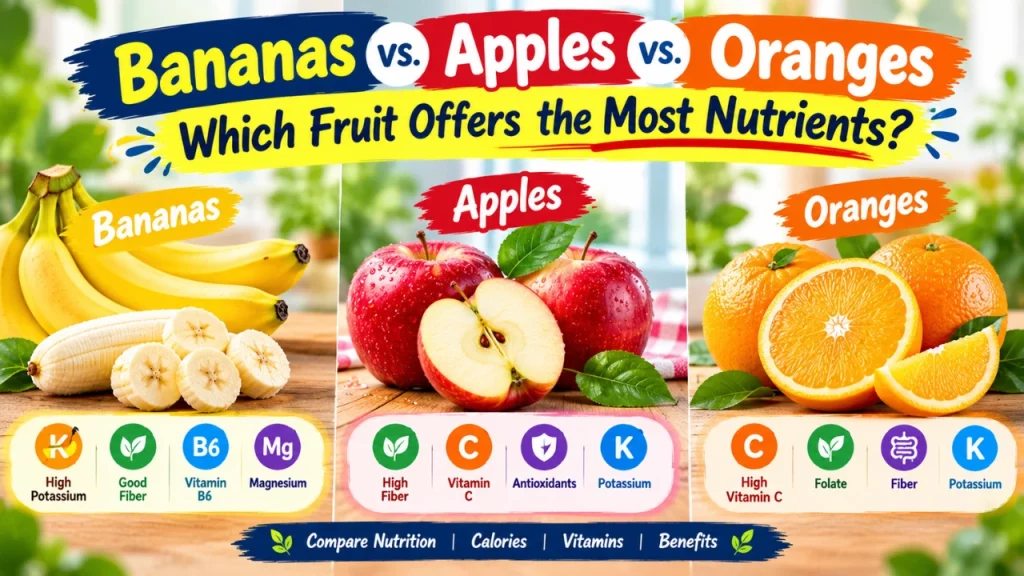
At 7:14 a.m., Mark’s continuous glucose monitor buzzes before he’s even finished chewing. He looks down at the three pieces of fruit on his counter — a banana going freckled at the tip, a crisp apple, and a navel orange — and realizes he has no idea which one is about to push his blood sugar up the least, which one will keep him full until lunch, or which one his nephrologist would actually want him eating. “Rotate all three” is not an answer when your meter, your scale, or your lab results are the ones keeping score.
This guide skips the vitamin-C-versus-potassium scoreboard you’ve already seen and goes straight to the numbers that change a real decision: glycemic index and load, fiber-to-calorie ratios, and the potassium math that actually matters for kidney health.
Step 1: Match the fruit to your blood sugar goal
Glycemic index (GI) ranks how fast a food raises blood glucose on a 0–100 scale, with under 55 considered low, 56–69 medium, and 70-plus high. On standard GI testing, a ripe banana sits around the low-to-mid 50s, an apple tests in the mid-30s, and an orange lands in the low-to-mid 40s. Translated into glycemic load (GI multiplied by carbs per 100 g, divided by 100) — the number that reflects an actual portion rather than a lab test — a 100 g serving of banana runs roughly 12, apple about 5, and orange about 5. A whole medium apple or orange still lands in the “low glycemic load” range (under 10); a whole banana edges past that line, closer to 14–16, because a typical banana weighs more than 100 g and carries more total carbohydrate per piece once you account for its size.
Ripeness changes this math more than most people expect. A green-tipped banana has a larger share of resistant starch, which digests slowly and behaves more like fiber than sugar; by the time the peel is fully speckled, much of that starch has converted to simple sugars, which is why an overripe banana spikes glucose faster than a just-yellow one. The practical takeaway for someone timing fruit around insulin or watching post-meal spikes: if bananas are going to be part of the rotation, eat them on the firmer side and pair them with a source of protein or fat — a spoonful of nut butter, a handful of nuts — which slows gastric emptying and blunts the glucose curve for all three fruits, not just the banana. This pairing trick does not change the official GI number of the fruit itself, but it does change what shows up on a CGM graph twenty minutes later, which is the number that actually matters day to day.
One caveat worth stating plainly: GI and glycemic load describe a food eaten alone, in a lab-controlled portion, with nothing else in the stomach. Real meals rarely look like that. Someone eating an apple as dessert after a protein-heavy dinner will see a flatter curve than the GI table predicts, while someone eating an orange on an empty stomach first thing in the morning may see a sharper one. GI is a useful sorting tool for choosing between fruits, not a precise prediction of what your own glucose will do.
Step 2: Check the fiber-to-calorie ratio before you count carbs
Carb counts alone can be misleading because they lump sugar and fiber together, even though fiber doesn’t raise blood glucose the way sugar does. A medium apple with the skin on carries close to 4–5 grams of fiber against roughly 95 calories — one of the better fiber-per-calorie ratios of any common fruit, largely because most of that fiber sits in the skin. Peeling the apple strips out a meaningful share of that fiber while leaving the calorie count almost unchanged, which is the opposite of what someone trying to manage both weight and blood sugar actually wants. An orange, eaten whole rather than juiced, delivers a similar fiber benefit from the pith and membranes most people discard; juicing removes virtually all of it, which is one reason a glass of orange juice spikes glucose far faster than the whole fruit despite starting from the same produce.
Bananas fall slightly behind on this ratio — around 3 grams of fiber for roughly 105 calories — but they make up ground with resistant starch when slightly underripe, as noted above. For someone managing weight alongside blood sugar, the practical rule is simple: eat the skin or pith when it’s edible, avoid juiced or blended versions of any fruit, and don’t assume “natural sugar” and “low impact” mean the same thing. A smoothie made from all three fruits can easily pack more rapidly absorbed sugar than eating each piece whole over the course of a day, even though the ingredient list looks identical.
Step 3: Do the potassium math for kidney health
This is the step most general nutrition advice skips entirely, and it’s the one that matters most for anyone with reduced kidney function. Healthy kidneys filter excess potassium efficiently, so for most people the mineral is simply a benefit — it supports blood pressure regulation and muscle function. But as kidney function declines, that filtering capacity drops, and potassium can build up in the blood to levels that affect heart rhythm. This is why potassium limits show up so often in renal diets, and why the same banana that’s a convenient snack for one person can be a genuine risk for another (Journal of Renal Nutrition).
In raw numbers, a medium banana carries roughly 400–450 mg of potassium, an orange around 230–250 mg, and an apple considerably less, around 150–195 mg. For someone on a potassium-restricted diet, that gap is the whole decision: an apple can often fit into a single meal’s allowance where a banana would use up a much larger share of the daily limit in one serving. This is not a reason for everyone to avoid bananas — for people with normal kidney function, the potassium is a plus, not a problem — but it is a reason for anyone managing chronic kidney disease, or advising a family member who is, to treat “fruit” as a category that needs portion-specific math rather than blanket rules (Pediatric Nephrology).
Cooking and soaking can reduce the potassium content of some produce, a technique sometimes called leaching, but it works far better on starchy vegetables like potatoes than on fruit eaten raw, so it isn’t a realistic workaround for someone who wants a banana or orange as a quick snack. The more practical approach for renal diets is portion control paired with variety — a smaller piece of higher-potassium fruit alongside lower-potassium choices through the rest of the day — rather than trying to process the potassium out of the fruit itself. Anyone with diagnosed kidney disease should treat these ranges as a starting point for a conversation with a nephrologist or renal dietitian, not a substitute for lab-based guidance, since individual potassium targets vary with the stage of kidney disease and with medications that themselves affect potassium levels.
Where fruit choice intersects with inflammation and metabolic health
Beyond the glucose and potassium numbers, the polyphenols and antioxidant compounds concentrated in apple skin and orange pith have been studied for their role in lowering oxidative stress markers, which matters for anyone managing a chronic condition where inflammation is already elevated (International Journal of Molecular Sciences). This doesn’t override the glycemic or potassium math above — a high-polyphenol fruit can still spike blood sugar or exceed a potassium limit — but it is a reasonable tiebreaker when two fruits otherwise score similarly on the numbers that matter most for a given condition. Broader dietary pattern research also backs up the instinct to vary fruit choices across the week rather than defaulting to whichever piece is easiest to grab, since no single fruit covers every nutritional priority at once (Nutrients).
There’s also a metabolic argument for keeping portion size, not just fruit type, in view. Even a low-glycemic-load fruit can contribute meaningfully to total daily sugar intake if the portion creeps up — two apples instead of one, a large navel orange instead of a small one — and that cumulative effect shows up in longer-term metabolic markers more than any single piece of fruit does on its own (The Journal of Nutrition). For someone tracking blood sugar daily, this means the size of the fruit in hand deserves as much attention as which fruit it is.
Putting it together: a practical routine
For Mark, standing at the counter with three pieces of fruit and a buzzing monitor, the decision doesn’t need to be complicated once the numbers are in view. If the priority is a flat glucose curve, the apple — eaten whole, skin on, maybe with a few almonds — is the safer default, with the orange a close second. If the priority is managing potassium because of kidney function, the apple again comes out ahead by a wide margin, with the orange as a moderate middle option and the banana reserved for days when the rest of the day’s potassium intake has been low. If neither glucose nor kidney function is a concern, the banana’s fiber, potassium, and convenience make it a perfectly reasonable everyday choice — the caveats above apply specifically to people managing diabetes or chronic kidney disease, not to general healthy eating.
The broader habit worth building isn’t memorizing exact numbers for every fruit in the produce aisle — it’s asking the right question before reaching for one. “What does this do to my glucose,” “how much fiber am I actually getting,” and “how does this fit my potassium limit” are three different questions with three different answers, and the fruit that wins one doesn’t automatically win the others. Keeping all three in mind, rather than defaulting to whichever fruit is ripest or closest to hand, is what turns a guessing game at 7:14 a.m. into an informed decision.
Sources
