Avocado Salad vs. Tomato Salad vs. Beet Salad: Which Is Best for Nutrients?
The "best" salad flips depending on kidney stones, blood thinners, or blood pressure pills — here's the science the nutrient charts skip.
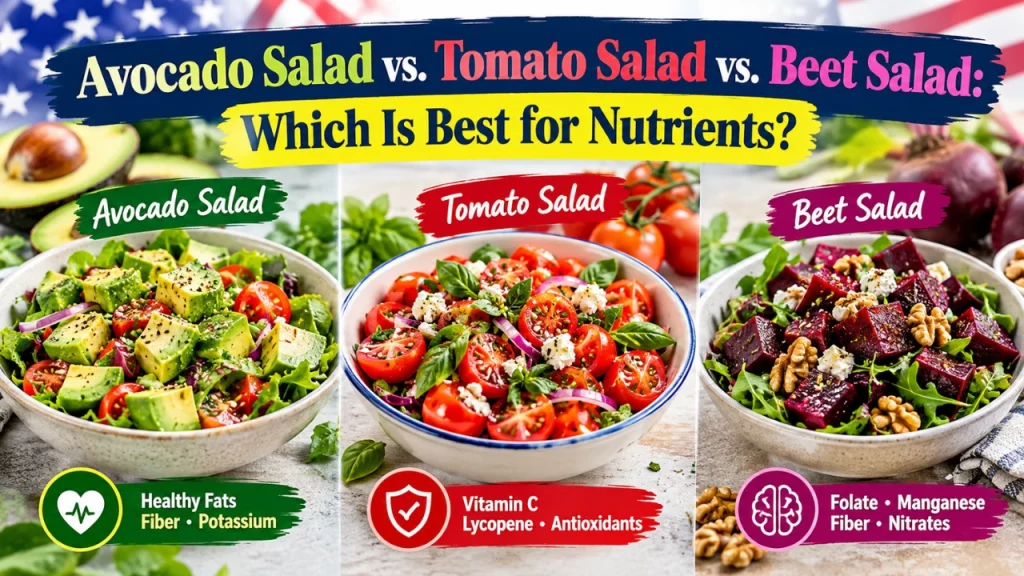
Most people assume the healthiest salad is whichever one wins the nutrient scoreboard — most fiber, most vitamins, fewest calories, done. That assumption works fine if you’re a healthy adult with no prescriptions in your medicine cabinet. It falls apart fast if you’ve ever passed a kidney stone, take warfarin, or manage blood pressure with medication. For those readers, the “best” salad isn’t the one with the highest numbers — it’s the one that doesn’t quietly work against what’s already in your bloodstream.
Myth: The Salad With the Most Nutrients Per 100g Is Automatically the Healthiest Pick
Avocado salad leads on fiber, potassium, and monounsaturated fat; tomato salad is lowest in calories and highest in lycopene and vitamin A; beet salad tops the folate and iron columns but also carries the most sugar. None of that changes — but none of it tells you what happens once that food meets a specific medical condition. A food can be nutrient-dense and still be the wrong choice for a particular body. That’s the piece the side-by-side charts leave out, and it’s where this comparison actually starts.
Myth: Beet Salad’s Iron Content Makes It the Best Choice for Anyone Who’s Low in Iron
Beets do have more iron by weight than avocado or tomato, but it’s non-heme iron, the plant form the body absorbs far less efficiently than the heme iron in meat. Non-heme iron absorption depends heavily on what’s eaten alongside it — vitamin C sharply improves uptake, while certain plant compounds can blunt it. So the raw iron number on a nutrition label overstates what a beet salad actually delivers to your blood unless it’s paired with something like citrus, bell pepper, or tomato itself. Judging “best for iron” by the gram count alone, without asking what’s on the plate with it, is the kind of shortcut that makes nutrient tables misleading.
Myth: If It’s Full of Vitamins, Beet Salad Can’t Be a Problem for Your Kidneys
This is the gap most comparisons skip entirely: beets are one of the higher-oxalate vegetables, and oxalate is a primary building block of the most common type of kidney stone. People who have formed calcium oxalate stones before are typically advised to watch high-oxalate foods, and beets sit well up that list alongside spinach and rhubarb. A review of oxalate homeostasis in chronic kidney disease notes that oxalate balance is tightly tied to kidney health and that the gut-kidney relationship affects how much oxalate the body actually retains versus excretes. That review focuses on non-stone-forming CKD specifically, but it underscores a broader point stone-formers already live with: oxalate load isn’t a side note, it’s a direct dietary variable. For someone with a stone history, a beet salad that looks like a folate-and-iron win on paper may not be the “best” option at all — tomato or avocado salad would carry far less oxalate risk.
Myth: Avocado Salad Is the Safe Default Because It’s “Just Healthy Fat”
Avocado’s fiber, potassium, and unsaturated fat profile is genuinely strong, but it comes with vitamin K, a nutrient that directly affects blood clotting. Anyone on warfarin or a similar blood thinner knows (or should know) that sudden swings in vitamin K intake can interfere with how well the medication controls clotting — not because vitamin K is dangerous, but because these drugs work by blocking vitamin K’s clotting action, and large or inconsistent amounts of it can throw off a carefully managed dose. The point isn’t that avocado is off-limits; it’s that consistency matters more than quantity for people on anticoagulants, and that’s a safety detail none of the standard nutrient comparisons mention at all.
Myth: Beet Nitrates Only Help Blood Pressure, So More Is Always Better
Beets are rich in dietary nitrate, and there’s real research behind the idea that nitrate can support blood flow. But “helps blood pressure” and “safe to combine with blood pressure medication without a second thought” are not the same claim. A small study of adults with hypertension found that three days of nitrate-rich beetroot juice raised plasma nitrite in both medicated and unmedicated groups, but blood pressure and vascular function only improved meaningfully in the unmedicated group, not those already on antihypertensive drugs, in that particular trial of 13 and 14 patients. A separate study of hypertensive patients found dietary nitrate still lowered mean arterial pressure during leg exercise regardless of medication status, in a trial of 14 unmedicated and 12 medicated patients. Those two small studies don’t agree on exactly when the effect shows up, which is itself the honest takeaway: nitrate’s interaction with blood pressure drugs is inconsistent and understudied, and stacking a nitrate-heavy beet habit on top of medication could plausibly push blood pressure lower than intended on some days. A broader review of dietary nitrate research makes the same point — promising lab findings haven’t yet translated into clear, large-scale clinical guidance. Anyone on blood pressure medication who eats beet salad regularly has reasonable grounds to mention it to their prescriber, especially if they notice dizziness or lightheadedness.
Myth: Beet Salad’s Higher Sugar Number Means It’s Worse for Blood Sugar Than Tomato Salad
Beets do contain more sugar by weight than tomatoes, but total sugar content isn’t the same as blood sugar impact — that depends on glycemic load, fiber, and portion size, none of which show up in a simple sugar-gram comparison. A pilot study in people with type 2 diabetes tested beetroot juice specifically, temporarily pausing participants’ blood pressure and glucose medications to isolate the effect, and measured both glycemic and blood pressure responses after beetroot intake in just seven participants. It’s a small, early study, not a basis for sweeping claims, but it illustrates why the sugar-content comparison oversimplifies things: how a beet actually behaves in someone’s bloodstream depends on fiber intact in the whole vegetable, portion eaten, and what medications are already modulating glucose — not the raw sugar figure printed on a nutrient chart.
So which salad is “best”? For a healthy adult with no relevant conditions, the nutrient chart answer still holds roughly true — pick based on what you’re short on, fiber, lycopene, or folate. But for a kidney stone former, tomato or avocado salad is the safer default over beet. For someone on warfarin, avocado needs consistency, not avoidance. For someone on blood pressure medication, beet salad deserves a conversation with a doctor rather than unlimited servings. Which of these trade-offs had you rethinking your usual salad bowl?
Sources
- Influence of dietary inorganic nitrate on blood pressure and vascular function in hypertension (2019)
- The Effects of Acute Beetroot Juice Intake on Glycemic and Blood Pressure Responses in Type 2 Diabetes (2024)
- Oxalate Homeostasis in Non-Stone-Forming Chronic Kidney Disease (2023)
- Dietary nitrate and population health: a narrative review (2021)
- Dietary nitrate supplementation and small muscle mass exercise hemodynamics in hypertension (2022)

James Carter
The EverBBQ editorial desk — covering BBQ news, features and everything off the grill.