American Sweet Tea vs. British Milk Tea: Which Drink Has More Sugar?
The real answer isn't a single number — it's who made the tea, how big the glass is, and what counts as "sugar" in the first place.
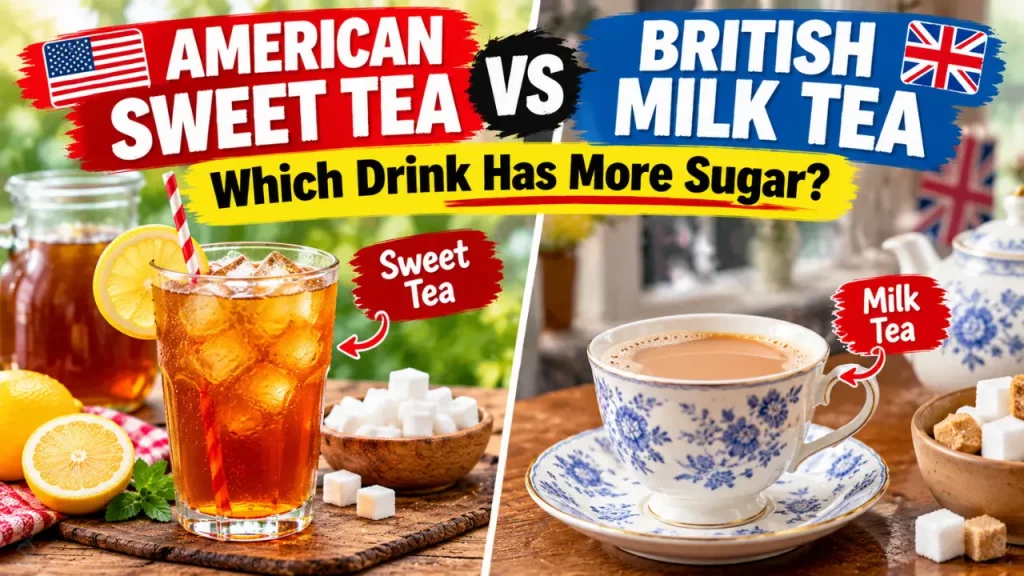
Have you ever stood at a diner counter somewhere in Georgia or South Carolina, watched a server fill your glass with tea before you’d even ordered, and wondered how that drink stacks up against the cup your British friend insists on having with milk, “just a splash,” every afternoon at four? Most people assume this is a simple nutrition-label question. It isn’t. And the parts that get skipped are exactly the parts that decide the answer.
The Question Nobody Can Actually Answer With One Number
Ask “which has more sugar, sweet tea or milk tea?” and you’ll usually get a confident, tidy reply. The trouble is that neither drink is one drink. Sweet tea can mean a gallon pitcher stirred together by a grandmother using a recipe passed down for decades, or a fast-food fountain drink dispensed from a machine, or a bottled version sold in a grocery store cooler. British milk tea can mean builder’s tea with a spoon of sugar stirred in, or tea with just milk and no sugar at all, or a sweet, spiced chai-style milk tea that behaves more like a dessert. Treating “sweet tea” and “milk tea” as if each is a single fixed recipe is the first thing most coverage gets wrong, and it’s the reason a straight numeric comparison is misleading before it even starts.
Sweet Tea’s Hidden Variable: Who’s Pouring It
In much of the American South, sweet tea is sweetened while the tea is still hot, which lets far more sugar dissolve and stay suspended in the liquid than if it were stirred into a cold glass. Homemade recipes vary enormously from household to household — some cooks sweeten lightly, others sweeten aggressively enough that the tea tastes closer to a soft drink than to tea. Restaurant and fast-food versions add another layer of unpredictability: the syrup-to-water ratio in a fountain dispenser is set by the restaurant, not by you, and it can shift from one chain to another, or even from one location to another if the machine isn’t calibrated the same way. The person drinking sweet tea at a diner has essentially no way of knowing, glass to glass, how much sugar they’re getting unless they make it themselves and measure it.
Milk Tea’s Quiet Sugar Bowl
British milk tea has its own hidden variable, just a quieter one. The tea itself — black tea with milk — contains no added sugar unless a spoonful goes in separately, and plenty of British tea drinkers take it with none at all. But “milk tea” gets used loosely to describe very different drinks. A builder’s mug with one modest spoon of sugar is a completely different proposition from a café-style sweet milk tea, a chai latte, or a bubble tea–style milk tea sweetened with syrup, all of which have crossed into British cafés in recent years and carry far more added sugar than a traditional cuppa. Lumping all of these under “British milk tea” and comparing the result to American sweet tea is comparing a moving target to another moving target.
The Serving Size Nobody Mentions
Even if you could pin down a “standard” recipe for each drink, the comparison still falls apart over serving size, and this is the detail most coverage leaves out entirely. American sweet tea is typically served in a large glass and refilled freely, especially in restaurants where free refills are the norm. A cup of British tea is, by comparison, a modest serving, and it’s rarely refilled the way a sweet tea glass is — you make or order a fresh cup instead. So the honest question isn’t just “which recipe has a higher sugar concentration,” it’s “how much of each drink does a person typically consume in one sitting, and how many times is that glass refilled before the meal is over.” A mild sweet tea recipe, drunk across three refills, can easily deliver more total sugar than a more concentrated but single, small cup of British tea.
Sugar You Can See vs. Sugar You Can’t
There’s a further distinction that almost never makes it into these comparisons: the sugar naturally present in milk, called lactose, is not the same thing as added sugar, the kind stirred or poured in deliberately. Milk tea picks up some natural sugar just from the milk itself, but that’s a small, incidental amount compared to a spoonful of added sugar, and nutrition guidance that focuses on limiting added sugars is concerned with the sugar people pour in, not the sugar naturally present in dairy. Sweet tea, by contrast, carries essentially all of its sugar as added sugar — there’s no hidden “natural” source doing any of the work. This matters if you’re trying to track added sugar specifically rather than total sugar content, because the two drinks aren’t built from the same kind of sweetness in the first place.
So, Which Actually Has More?
Given all of that, the fair, caveat-filled answer is this: a classic, generously sweetened American sweet tea — the kind made hot, sweetened heavily, and served in a large glass with refills — will typically carry noticeably more total and added sugar than a traditional British cup of tea with milk and a modest spoon of sugar, or no sugar at all. But the moment either drink shifts away from its traditional form — a lightly sweetened homemade tea on one side, or a syrup-heavy café milk tea on the other — that gap can shrink, disappear, or even reverse. There is no single correct number because there is no single version of either drink.
What To Do With This At The Table
If you actually want to know what’s in your glass, the most useful habit isn’t memorizing a statistic, it’s asking two questions before you drink: how was this sweetened, and how big is the serving I’m about to have more than once? At a restaurant, that might mean asking whether the tea is pre-sweetened or sweetened to order. At home, it might mean noticing how heavy your own hand is with the sugar before you pour the next glass. And at a British café serving a “milk tea” that looks suspiciously like dessert, it means recognizing that the name hasn’t changed even though the drink inside the cup has.
So next time you’re back at that diner counter, tea already poured, or lifting a cup someone just made “the proper way” with milk, the real comparison isn’t in a nutrition chart — it’s in the pitcher, the spoon, and however many times your glass gets filled before you push it away.
