American Beef vs. British Beef: Which Is Healthier? A Nutrition Comparison
The country stamped on a beef label tells you almost nothing about its fat, protein, or feed — here's what actually does.
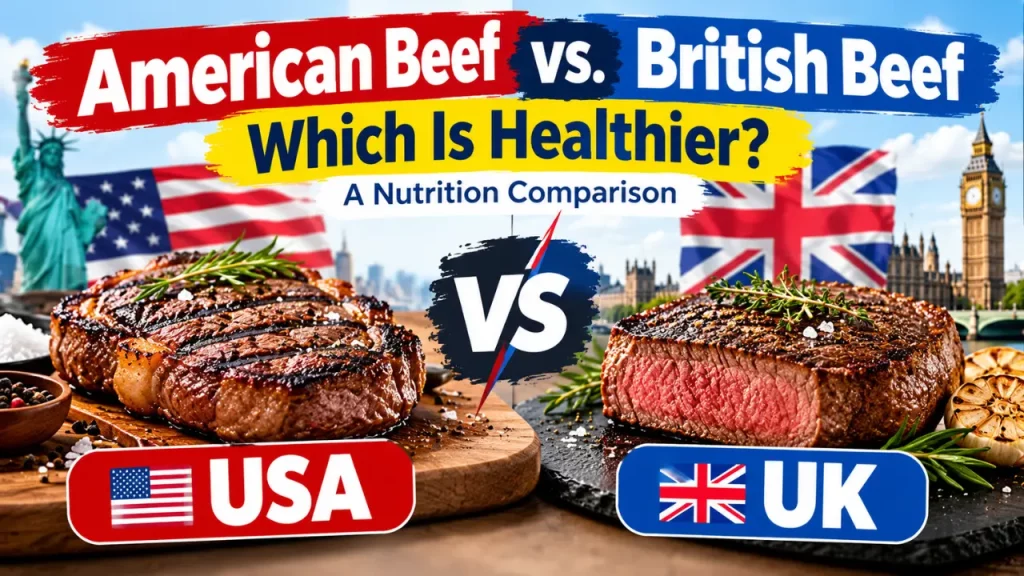
There is no such thing as “American beef” or “British beef” nutritionally — there is only the specific animal, its diet, its cut, and how it was trimmed.
- Flag-based comparisons treat each country as if it produces one uniform product, when in reality the spread in fat and nutrient content within American beef, or within British beef, is often larger than the average difference between the two countries.
- What actually moves the nutrition needle — grass-finishing versus grain-finishing, cut and trim, aging method, and animal age — can happen in either country and often does.
- Labeling rules differ enough between the US and UK that a “grass-fed” or “natural” claim does not mean the same verified thing on both sides of the Atlantic.
- The honest answer to “which is healthier” is that country of origin is the wrong variable to optimize; production method and cut are the right ones.
What the comparison is actually measuring
When people ask whether American beef or British beef is healthier, they are usually imagining two distinct national products: a leaner, grass-raised British animal versus a fattier, grain-finished American one, or some version of that story. That image is a simplification built on how each country’s beef industry is typically described, not on what ends up on a specific plate. Both countries raise cattle on pasture for most of their lives. The real divergence, where it exists, tends to happen in the final months before slaughter, during what’s called the finishing period, and even then it is not universal within either country.
A nutrition comparison that only says “country A” versus “country B” is comparing labels, not meat. Two ribeyes sitting side by side in a butcher’s case, one from Nebraska and one from Yorkshire, could be nutritionally closer to each other than either is to a different cut from its own country. Fat content, which drives most of the calorie and saturated-fat differences people care about, varies enormously by cut — a trimmed sirloin and a well-marbled ribeye are not interchangeable, regardless of flag.
Why the national averages get treated as facts
This confusion happens for a structural reason: industry and government bodies in each country do publish broad descriptions of typical practice, and journalists reasonably use them as shorthand. In the US, a large share of beef cattle spend their final months in feedlots eating a grain-heavy diet, which tends to increase marbling and overall fat content compared with an animal finished purely on grass. In the UK, a larger proportion of beef cattle finish on pasture or on mixed forage-based diets, partly because of climate and farm structure, and that is often summarized as “British beef is grass-fed.” Both of those generalizations have real statistical backing at the industry level, which is exactly why they get repeated.
The problem is that “a larger proportion” and “tends to” are not the same as “always.” Premium and export-grade American beef includes grass-fed and grass-finished programs that are explicitly marketed and sold at a premium specifically because they are the exception to the feedlot norm. Meanwhile, British beef also includes grain-finished and barley-beef systems, particularly for intensively reared animals destined for standard supermarket mince and burgers rather than premium joints. So the moment you step out of “typical commodity beef” and into any specific product — a grass-fed ribeye from Texas, a supermarket own-brand mince from the English Midlands — the national stereotype can flip entirely.
Aging method adds another layer that has nothing to do with national borders. Dry-aged beef, more common at specialty butchers in both countries, develops a different texture and flavor concentration than wet-aged beef, which is the commercial default almost everywhere. Neither aging method changes the fat or protein content much, but both affect how the meat is perceived and priced, which can create an illusion of a “healthier” product that is really just a different processing choice.
What this means for your actual grocery decision
If you are standing in a supermarket trying to decide whether to buy the American import or the British joint because you think one is inherently better for your arteries or your waistline, you are solving the wrong problem. The cut in front of you matters far more than the country stamped on the label. A well-trimmed flank, skirt, or sirloin from either country will be leaner than a heavily marbled ribeye or a fatty mince from either country. The visible fat cap and the marbling flecks running through the muscle are the signal worth reading, not the flag on the packaging.
Feed system matters too, but it is a separate axis from nationality, not a synonym for it. If your actual goal is to eat beef from animals finished mostly on pasture, the question to ask is “was this grass-finished,” and that question has to be asked of American beef and British beef equally, because both countries sell product on either side of that line. A “Product of USA” sticker does not tell you the finishing diet, and a “British beef” sticker does not guarantee it either, unless it carries a specific pasture-fed or grass-fed certification that spells out the standard behind it.
Labeling rules themselves differ enough to trip people up. US grass-fed claims have gone through several rounds of regulatory change and, depending on when and where the product was packed, may or may not have been independently verified. UK and EU-derived standards around pasture-fed claims have their own certification bodies and criteria, which are not identical to the American ones. A shopper who assumes the word “grass-fed” means the same audited thing on both sides of the Atlantic is making an assumption the label itself does not support.
What to actually do with this information
Stop choosing by country and start choosing by three things you can check on the pack or ask the butcher: the cut, the visible fat trim, and whether there’s a specific, named certification behind any grass-fed or pasture-raised claim rather than just the word printed on the front. A trimmed, leaner cut from a feedlot-finished American animal can easily contain less total fat than a fattier, well-marbled cut from a grass-finished British animal, simply because cut and trim overwhelm the finishing-diet effect in many real-world comparisons.
If fat content specifically is your concern, compare cuts of the same type — sirloin to sirloin, mince to mince — rather than comparing a premium cut from one country to a basic cut from another. If you care about how the animal was raised for reasons beyond nutrition, such as environmental footprint or animal welfare, treat that as its own separate research question, because the evidence there doesn’t run cleanly along national lines either, and conflating it with a health claim muddies both arguments. The honest takeaway is unglamorous but useful: judge the beef in front of you, not the country it came from.

James Carter
The EverBBQ editorial desk — covering BBQ news, features and everything off the grill.