Almonds vs Walnuts vs Pistachios vs Dry Fig: Which One Should You Eat Daily?
Who should actually skip each "healthy" handful daily, and the real calorie math of eating all four without cutting anything else.
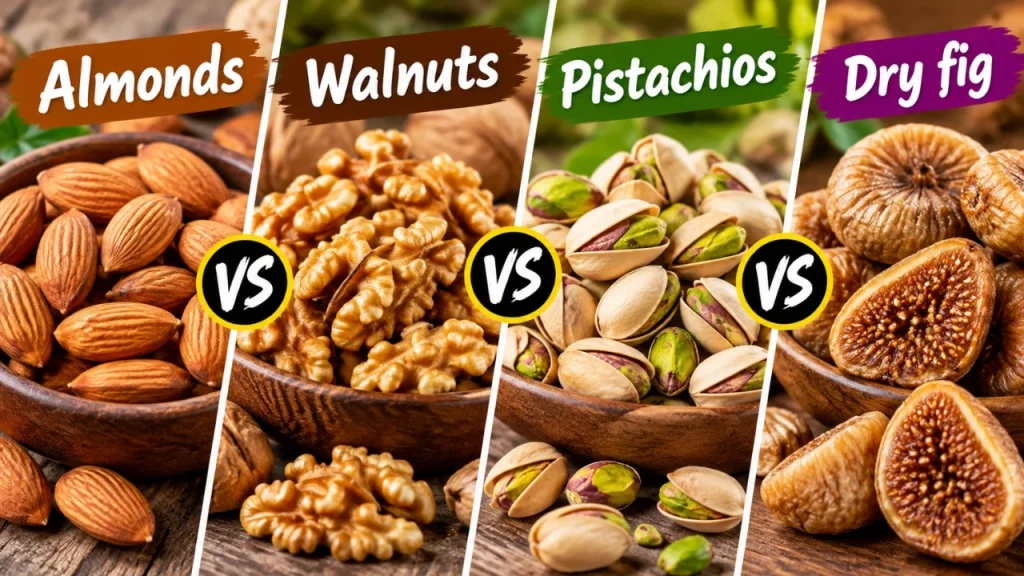
A coworker keeps a drawer at her desk with four small bags: almonds, walnuts, pistachios, dried figs. She grazes on all four most afternoons, convinced she’s doing her arteries a favor. Nobody has told her that one of those bags could be quietly feeding a kidney stone, another could be wrecking her gut on a low-FODMAP day, and that the four bags together are adding more to her daily calorie count than she thinks.
So which one should you actually eat every day?
There isn’t one correct answer, because each nut and the dried fig solve different problems — almonds bring fiber, protein and vitamin E, walnuts are the richest tree-nut source of plant omega-3 (ALA), pistachios pack potassium, lutein and built-in portion control from shelling, and dried figs offer fiber and natural sugar with almost no fat. The real question isn’t which one wins — it’s who, specifically, should be cautious with each, and what happens if you eat all four, every day, forever.
Who should actually limit or avoid almonds?
People prone to calcium-oxalate kidney stones should treat almonds as a trigger food, not a snack. A 2025 oxalate-loading study gave seven healthy volunteers 150 grams of almonds and measured urinary oxalate before and after: excretion rose significantly, from a baseline of 696 micromoles per 24 hours to 931 micromoles per 24 hours after the almond load — a jump the same researchers could not reproduce with 100 grams of dark chocolate, which barely moved the number (small 2025 almond oxalate-loading study). Separately, an analysis of plant-based milks found almond milk had the highest oxalate concentration of all the alternatives tested, ahead of cashew, hazelnut and soy (2022 study on plant-based milks and kidney stone risk). Neither study is large, but both point the same direction: if you’ve ever passed a stone, a daily almond habit deserves a conversation with your doctor, not a shrug.
Who should skip dried figs most days?
Two groups: people managing IBS on a low-FODMAP plan, and people with chronic kidney disease who’ve been told to restrict potassium. Dried figs concentrate natural sugars and fermentable short-chain carbohydrates during the drying process, which is exactly the category that triggers bloating, gas and cramping in FODMAP-sensitive guts — it’s why figs sit on most low-FODMAP elimination lists even though fresh figs in small amounts are often tolerated. Drying also concentrates potassium per gram, which matters if a nephrologist has already asked you to watch potassium intake. On top of that, commercially dried figs are sometimes treated with sulfur dioxide or other sulfites to preserve color and prevent spoilage, and because figs are soft and sticky, poorly stored batches are also a recognized mold risk — another reason to check labels and skip figs that look sugared-over, discolored or unusually soft on the inside.
Who should go easy on pistachios?
The same potassium-restricted kidney patients mentioned above. Pistachios are one of the more potassium-dense nuts, which is a selling point for most people but a liability for anyone with reduced kidney function who’s been told to cap daily potassium — in that situation, a “healthy handful” can undo portion planning elsewhere in the day. If you’re on dialysis or have been given a specific potassium target by your care team, pistachios (and dried figs) are worth counting, not eyeballing.
Does soaking almonds before eating actually change anything?
There isn’t solid evidence that it meaningfully improves nutrient absorption in people. The soaking claim usually rests on the idea that water pulls out phytic acid, which can bind minerals like zinc and iron. That chemistry is real in a test tube, but none of the current research on almonds and oxalate or mineral status shows that a home soak changes how much protein, fiber, vitamin E or oxalate actually reaches your bloodstream. If you like soaked almonds for texture, that’s a fine reason to keep doing it — just don’t expect it to cancel out the oxalate concern above, since soaking doesn’t remove oxalate.
What actually happens if you eat a handful of all four, daily, without cutting anything else?
Using standard USDA calorie figures for a 28-gram (1-ounce) portion — almonds around 164 calories, walnuts around 185, pistachios around 159, and dried figs around 70 — four daily handfuls add up to roughly 578 calories on top of whatever you’d normally eat. That’s not a rounding error.
- Over one week: 578 calories x 7 days ≈ 4,046 extra calories
- Over one month: ≈ 17,340 extra calories, which at roughly 3,500 calories per pound of stored fat works out to close to 5 pounds gained in 30 days if nothing else changes
- Over a year, unmodified: the arithmetic runs past 200,000 extra calories — a number nobody actually gains in practice because appetite, activity and metabolism adjust, but it shows how fast “healthy” snacking stacks up if it’s added rather than swapped in for something else
The fix isn’t avoiding these foods — it’s treating the four bags as a replacement for an existing snack, not a bonus on top of your usual meals.
Is there any real benefit to eating almonds and walnuts together daily?
No study has tested that specific combination for an added or synergistic effect — you simply get the sum of what each one offers individually: almonds’ fiber and vitamin E alongside walnuts’ ALA omega-3. That’s a reasonable pairing nutritionally, but there’s no documented interaction that makes the combination better than either nut eaten on its own in a similar total amount.
Could these snacks interfere with blood thinners?
Large daily doses of vitamin E (concentrated in almonds) and omega-3 fats (concentrated in walnuts) are generally recognized to have mild effects on clotting, which is why anyone on warfarin or other anticoagulants should mention regular nut snacking to their prescribing doctor rather than assume a small daily handful is automatically risk-free.
What’s the practical takeaway?
- No single winner — match the food to your actual health situation, not a general ranking
- Kidney stone formers: treat almonds with caution given the documented rise in urinary oxalate after an almond load
- IBS/FODMAP and potassium-restricted kidney patients: limit dried figs and pistachios
- Soaking almonds changes texture, not proven nutrient absorption or oxalate content
- Four daily handfuls add roughly 578 calories — swap, don’t stack
Which of these four is already sitting in your kitchen right now, and did you know it came with a catch?
Sources
